Spinosaurus: How Do You Test Whether a Fossil Could Swim?
PALEODEX · 11 September 2026 · 7 min read
You cannot watch an extinct animal swim. That sounds like the end of the question — and for Spinosaurus it very nearly was, until one nearly complete tail came out of the Moroccan desert and somebody built a copy of it in plastic.
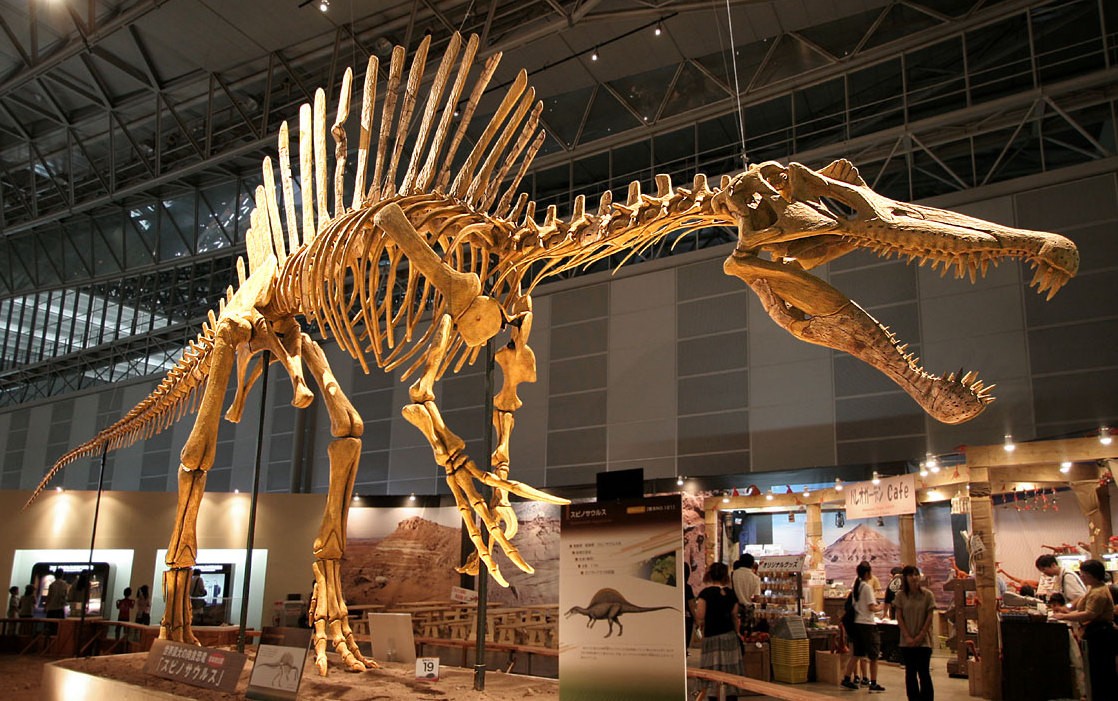
Most arguments about extinct animals are arguments about behaviour, and behaviour is the one thing fossils never record directly. You can measure a bone. You cannot measure what its owner did on a Tuesday ninety-five million years ago.
So when the question is "could this animal swim?", the honest first answer is that nobody is ever going to see it happen. What you can do instead is test the equipment — and that is what makes this a how do we know story rather than a verdict.
One nearly complete tail
In 2018 a team working in the Kem Kem beds of southeastern Morocco — a sandstone formation between 95 and 100 million years old — excavated a nearly complete Spinosaurus tail. They described it in Nature in 2020.
That two-year gap is worth keeping straight, because the tail is routinely described as having "come out of the ground in 2020". It didn't; that is the publication date, and fieldwork at the site continued into 2019. No duplicate bones turned up there, which is a good indication the material belongs to a single individual.
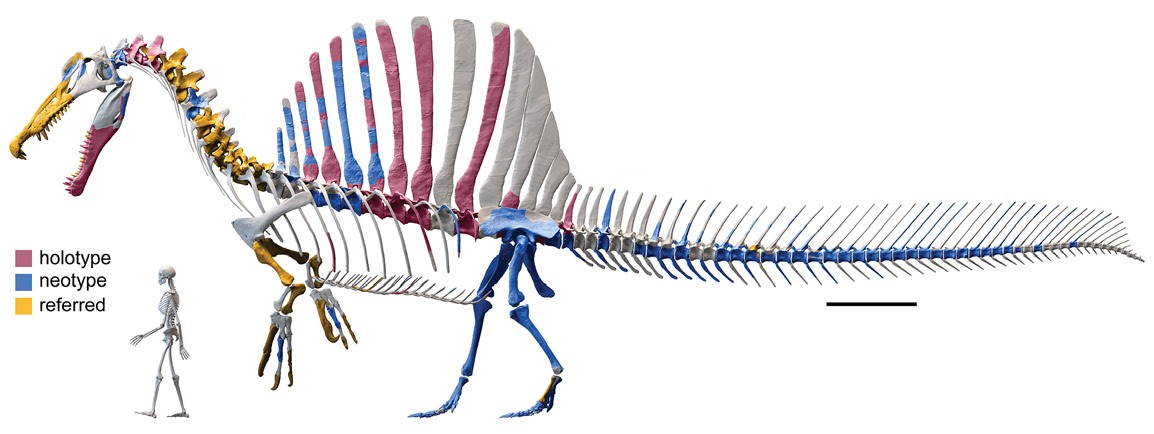
Why it mattered so much is a matter of how little of this animal anyone had. For most of the last century Spinosaurus was known from fragments, and almost every reconstruction of it was a reasonable guess built around a small amount of real bone. The diagram below is the honest version of that: the coloured bones are actual material, and the grey silhouette is inference.
Not a rod. A blade.
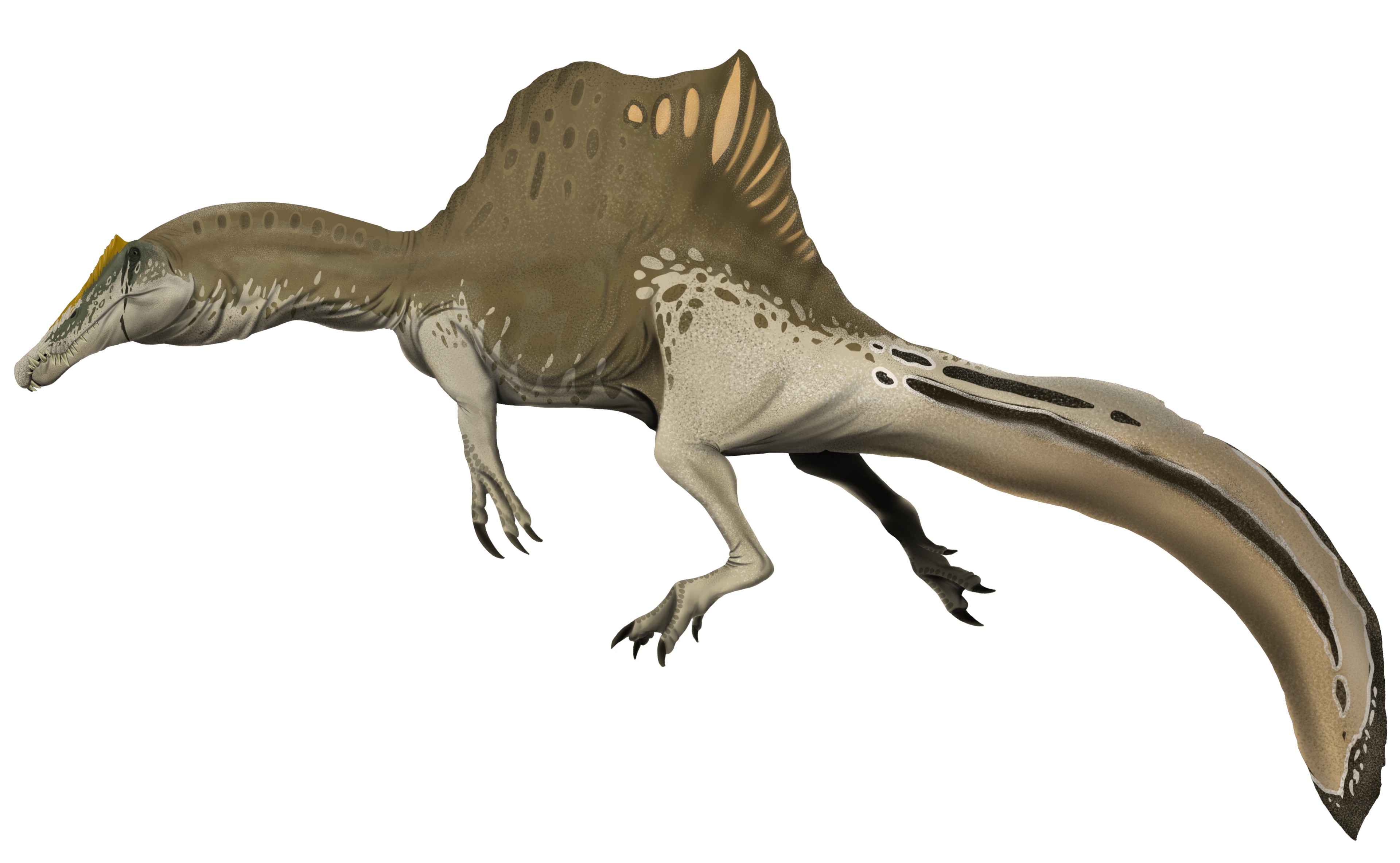
A land-living predatory dinosaur carries a tail like a stiff tapering rod — a counterweight, held clear of the ground, doing structural work. The tail that came out of Morocco is not built like that at all.
Every vertebra along it carries a neural spine so tall, and so flat, that the profile of the whole tail becomes a broad blade rather than a cone. The chevrons underneath are elongated to match. Ibrahim and colleagues described the result as a large, flexible, fin-like organ of unexpected and unique shape.
So they built it and put it in water
This is the part that earns the "how do we know". The team made a physical model of the tail in plastic, mounted it on a robotic rig that flaps it through water, and put the whole thing in a tank with sensors reading thrust and efficiency.
Then they did the same with five more tails at the same scale, so there was something to compare against: the land-living theropods Coelophysis and Allosaurus, a crocodile, a crested newt, and a plain rectangle as a control.
The Spinosaurus tail produced more than eight times the forward thrust of the two land theropods' tails.
What that number is, and what it is not
It is a real, repeatable measurement of a shape in moving water. That is a genuinely rare thing to have for an extinct animal, and it does not depend on anyone's interpretation.
It is also not a recording of behaviour. A tail that can generate thrust is not the same claim as an animal that habitually swam, still less one that chased fish underwater — and this is exactly where the field stops agreeing.
Three groups, three readings, no winner
There are currently three positions in the literature, and they are worth getting the right way round, because they are frequently mixed up:
- Ibrahim and colleagues (2020) read the tail as an aquatic propulsive structure — the animal used it to swim.
- Fabbri and colleagues (2022) argued from bone compactness, measured across many species, for foraging beneath the surface. This is the bone-density argument, and it sits on the pro-aquatic side — which is worth saying plainly, because it often gets attributed to the other camp.
- Sereno and colleagues (2022) argued from digital flesh models — flotation stability, buoyancy, limb proportions and centre of mass — for a bipedal, semiaquatic animal using ambush predation of large fish while wading into shallow coastal and riverine waters, rather than an underwater pursuit predator. In 2024, Myhrvold, Sereno and colleagues published a critique of the bone-compactness method itself; Fabbri's team disputes that critique.
And this is not a closed file from 2024. In February 2026, Sereno's group described a new spinosaur from Niger in Science and restated the wading reading, characterising the animal as a kind of "hell heron". The exchange is live.
One figure we are leaving out on purpose
The 2020 experiment reported an efficiency result as well as a thrust result, and you will find it quoted two different ways. Some reports give 2.6 times the efficiency of the land-theropod tails. National Geographic, which interviewed the authors, says the tail does it "twice as efficiently".
Those are two different numbers for one quantity, and we could not open the paywalled primary to settle which is the paper's own. So we are not using either. The thrust multiple is quoted by three independent reports in the same words, so that is the figure on the page — and the efficiency result simply isn't here. If a fact isn't sourced, we leave it blank.
Why this belongs in PaleoDex
Because the method is the interesting part. An animal whose behaviour is genuinely unknowable got a real, physical experiment run on a copy of its own anatomy, and the result is a number that survives whichever way the behavioural argument eventually lands. That is a much better outcome than a tidy answer would have been.
It also sits alongside some of our favourite cases of reading behaviour off bone: Basilosaurus, the whale that still had legs, the problem of estimating size from partial remains, and the more basic question of whether a fossil is still bone at all. For the fuller catalogue this kind of fact comes from, see the Fossil Dex, and for how we handle sourcing, about the data.
What nobody disputes is the paddle. That tail was shaped to move water. What the animal was doing with it is still argued — and an honest open question on the end of a real measurement is worth more than a clean story.
Sources
Every claim above traces to the primary literature. Where we could not read the primary directly, we say so.
- Ibrahim, N., Maganuco, S., Dal Sasso, C., et al. (2020). "Tail-propelled aquatic locomotion in a theropod dinosaur." Nature 581: 67–70. Source for the tail material, its description as a fin-like organ, and the flapping-rig thrust experiment. Paywalled to us; the thrust figure, the apparatus and the comparison taxa were read through three independent secondary reports, including National Geographic's coverage.
- Fabbri, M., et al. (2022). "Subaqueous foraging among carnivorous dinosaurs." Nature 603: 852–857. Source for the bone-compactness argument for submerged foraging.
- Sereno, P.C., Myhrvold, N., Henderson, D.M., Fish, F.E., Vidal, D., Baumgart, S.L., Keillor, T.M., Formoso, K.K. & Conroy, L.L. (2022). "Spinosaurus is not an aquatic dinosaur." eLife 11: e80092. Open access. Source for the flotation, buoyancy, limb-proportion and centre-of-mass argument, and for the wading conclusion quoted above.
- Myhrvold, N., Sereno, P.C., et al. (2024). "Diving dinosaurs? Caveats on the use of bone compactness and pFDA for inferring lifestyle." PLOS ONE. Source for the critique of the bone-compactness method.
- Sereno, P.C., et al. (2026). "Spinosaurus mirabilis," Science, published online 19 February 2026. Source for the 2026 restatement of the wading reading. Note: this paper is widely mis-cited to Nature; it is Science.
The real record, in your pocket.
PaleoDex catalogues the real fossil record, and every fact in it is sourced. Get the app.
GET IT ON GOOGLE PLAY →