A Whale With Legs: The 1990 Fossil That Settled It
PALEODEX · 7 August 2026 · 7 min read
It had a thigh bone, a knee that hinged, an ankle and toes. On a whale.
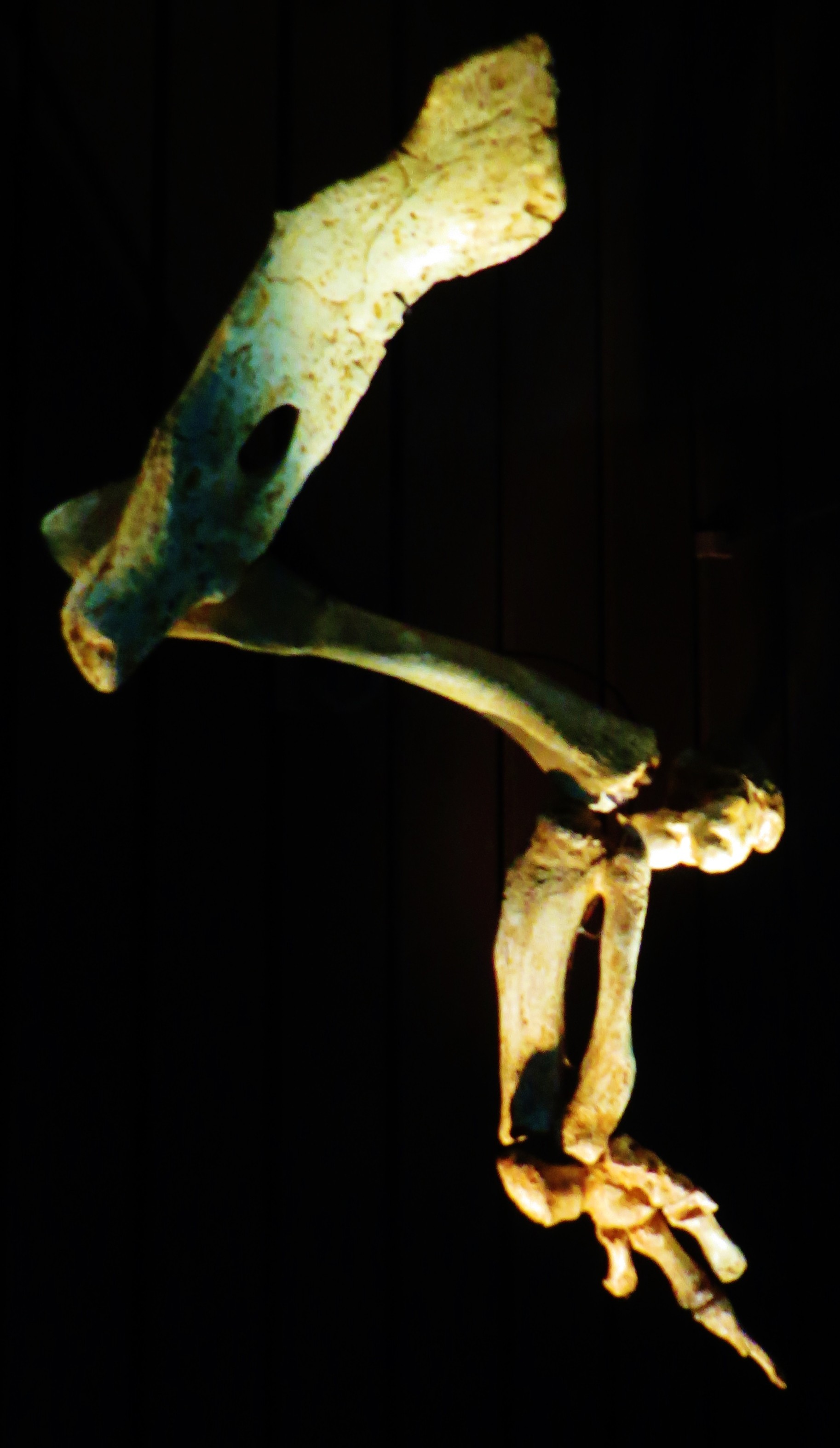
A whale with legs sounds like a joke until you see the bones. Basilosaurus swam the late Eocene as a fully aquatic whale, up to fifteen metres long, hunting the warm shallow seas that covered the American South and North Africa about 37 million years ago. And it still had hind limbs.
Not stumps. A thigh bone, a knee that hinged, an ankle, and toes.
Named by mistake
The animal was first found in Tertiary rock in Louisiana and described in 1834 by the Philadelphia naturalist Richard Harlan. He read the enormous vertebrae as a sea serpent and gave the animal a name to match: Basilosaurus — king lizard.
Richard Owen examined the material in London and found something Harlan had not made anything of: the molars were double-rooted. That is a dental morphology no fish and no reptile has. The closest match Owen could find was a whale, and he proposed a new name for it, Zeuglodon — the yoke-toothed one.
The rule that outranks being right
Owen was right about the animal and his name still lost. Zoological nomenclature gives priority to whichever name was published first, and Harlan had published his in 1834. Zeuglodon arrived five years later and is filed today as a junior synonym — you can look it up and find it pointing straight back at Basilosaurus Harlan, 1834.
So a fully aquatic whale carries a lizard’s name, permanently, because of a filing rule.
The feet
For more than 150 years nobody had found its back end. Then in 1990 Philip Gingerich, B. Holly Smith and Elwyn Simons published what they had dug out of the Egyptian desert: hind limbs on a fully aquatic whale, with a functional knee and toes.
The scale is the part that does not settle. A complete foot fifteen centimetres long, on an animal fifteen metres long — a hundred times shorter than the whale it belonged to.
What were they for?
They could not carry weight. Nothing that size could, on a body that large. What they were actually for is still open: Gingerich’s team suggested they helped guide mating, other uses have been proposed since, and nobody has settled it. The honest answer is that the limbs are certain and the function is not.
Where they came from
One thing worth saying plainly, because the popular framing usually overstates it: Basilosaurus is not a direct ancestor of the whales alive now. Gingerich files it as a specialised side branch, off the main line of cetacean evolution. It is a cousin, not a grandparent.
But the ground those legs came out of is still there. Wadi Al-Hitan — the Valley of the Whales, in Egypt’s Western Desert — has hundreds of archaeocete skeletons lying exposed at the surface. UNESCO inscribed it in 2005 and describes them as the youngest archaeocetes, in the last stages of losing their hind limbs.
You can browse the extinct record, Basilosaurus included, in the Fossil Library, watch the continents move under it on the Continental Drift map, and see where every fact comes from.
Sources
Every claim above traces to a primary source or to a database of record.
- Gingerich, Smith & Simons 1990 — “Hind Limbs of Eocene Basilosaurus: Evidence of Feet in Whales”, Science 249:154–157
- Gingerich 2012 — “Evolution of Whales from Land to Sea”, Proceedings of the American Philosophical Society 156:309–323
- Owen — “Observations on the Basilosaurus of Dr. Harlan (Zeuglodon cetoides, Owen)”, Transactions of the Geological Society of London ser. 2, 6:69–79
- Harlan 1834 — “Notice of fossil bones found in the Tertiary formation of the State of Louisiana”, Transactions of the American Philosophical Society 4:397–403
- UNESCO World Heritage Centre — Wadi Al-Hitan (Whale Valley), ref 1186, inscribed 2005
- GBIF — Basilosaurus Harlan, 1834, with Zeuglodon Owen, 1839 as a synonym
The real record, in your pocket.
PaleoDex catalogues the real fossil record, and every fact in it is sourced. Get the app.
GET IT ON GOOGLE PLAY →