How Big Was Dunkleosteus? The Fish Nobody Ever Measured
Dunkleosteus terrelli
PALEODEX · 29 July 2026 · 7 min read
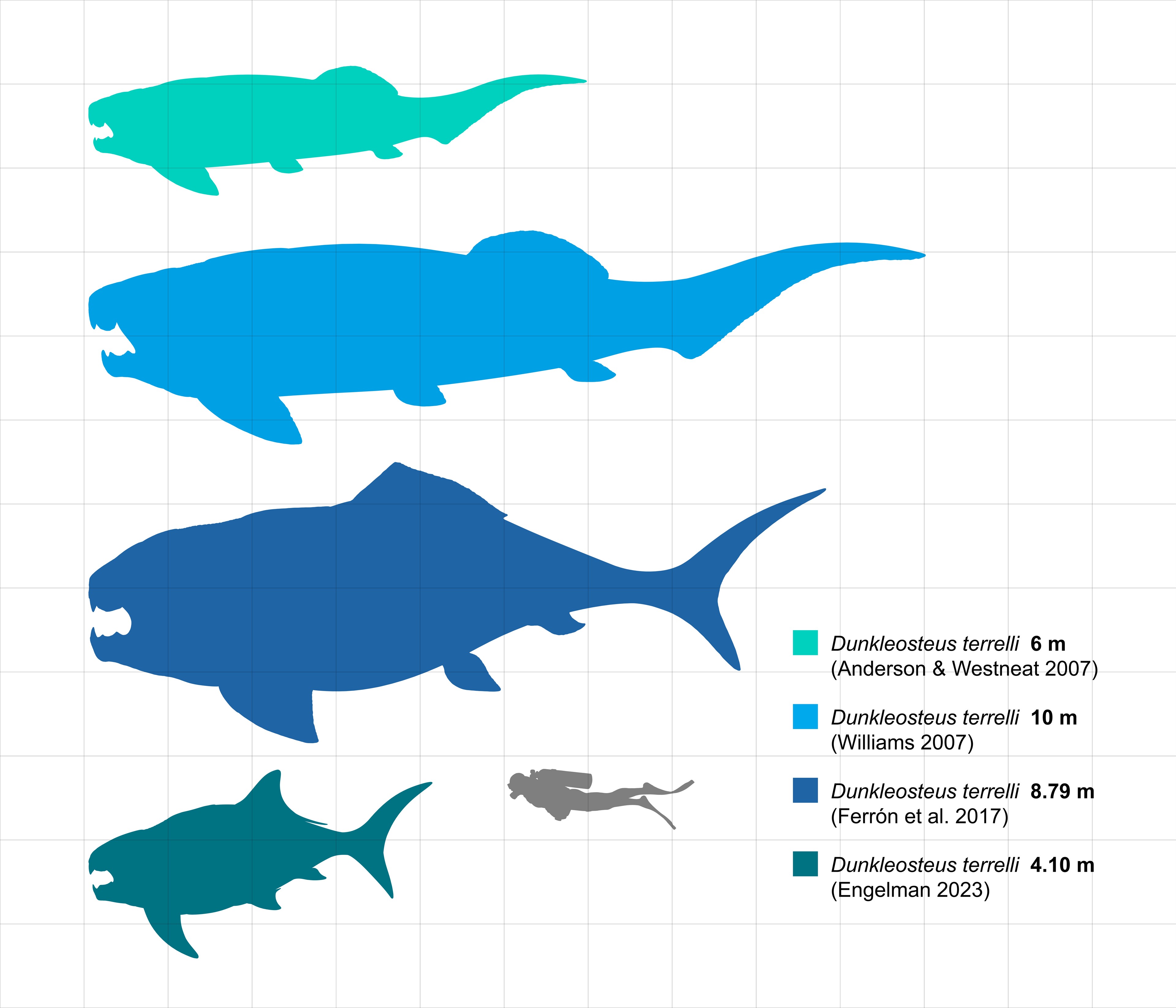
Every museum poster gives Dunkleosteus a number. Five metres, eight, sometimes ten. The honest answer is that nobody ever measured it — and when someone finally built a method that uses only the bones we actually have, the animal came out at roughly half the poster.
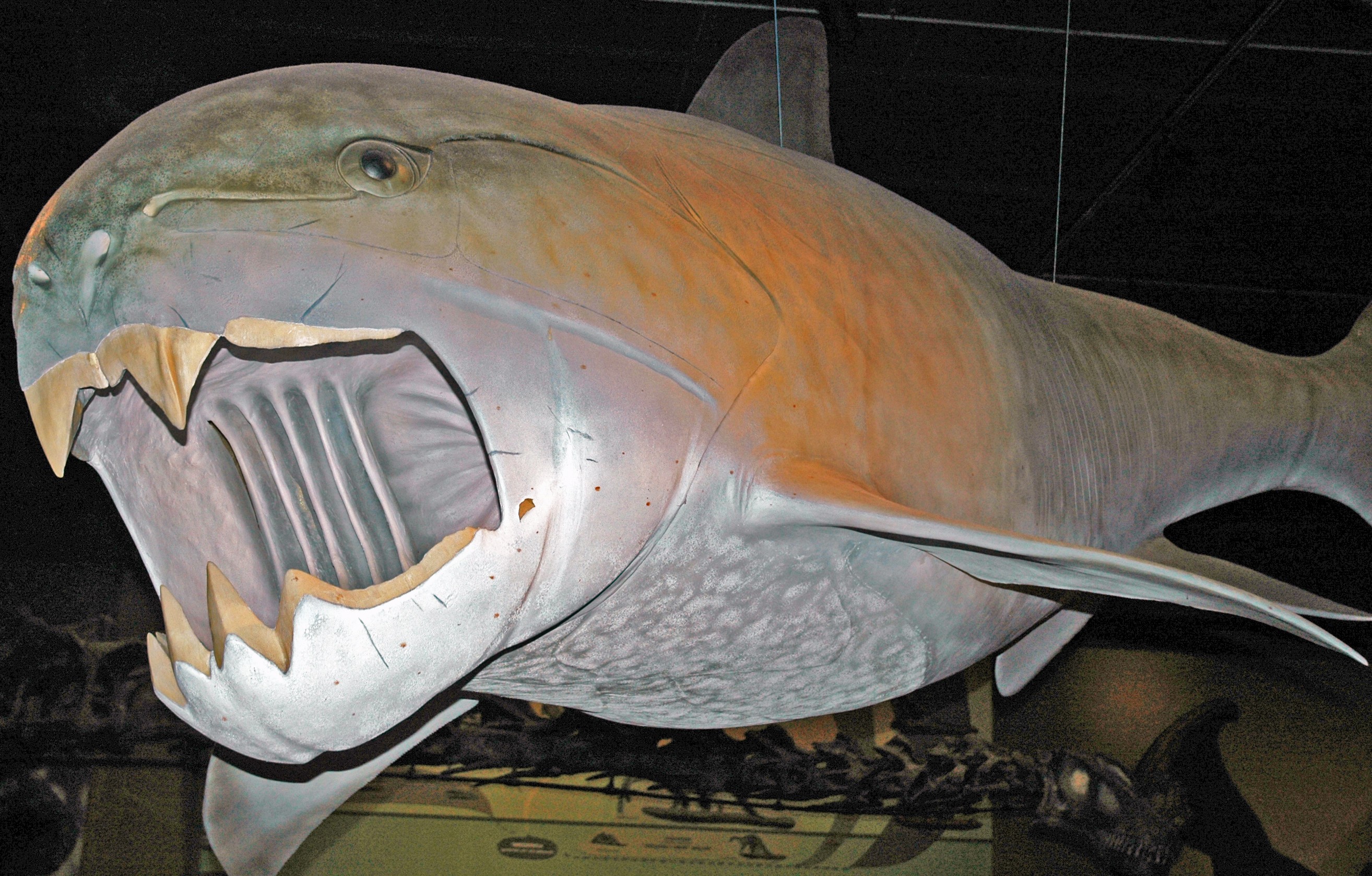
Ask how big the first great armoured predator was and you will get a confident number. Museums say it. Documentaries say it. Textbooks say it. What almost nobody says is where the number came from — because for most of the last century, it did not come from measuring anything.
Only the front end survives
There is a concrete reason the figure was always soft. Of the entire animal, only two things fossilise reliably: the head, and the armoured shield across the shoulders. Those are, in the words of the 2023 study that re-examined the problem, "the only elements of its body regularly preserved in the fossil record." The whole back half — the trunk, the tail, the part that would actually tell you how long the animal was — is simply gone.
So every large estimate you have ever read was an extrapolation backwards from a head. The question was never "how long is this fossil." It was "what body do we think belongs behind this face."
The yardstick was a shark
The most-cited answers came from sharks. Researchers took the perimeter of Dunkleosteus's upper jaw and scaled it up using the relationship between mouth size and body length in large living sharks. That is where the frequently-quoted range of 5.3–8.8 metres comes from.
In 2023 Russell Engelman tested whether that relationship actually holds for this group, and it does not. Arthrodires — the armoured fish group Dunkleosteus belongs to — have proportionally much larger mouths than sharks at the same body size, closer to a catfish. Feed a catfish-mouthed animal through shark proportions and you get something enormous that never existed. Tested against arthrodires we do have complete skeletons for, the method overshoots the real length by at least double.
A measurement that only uses what survives
Engelman's replacement is deliberately modest: orbit-opercular length, a measurement taken across the head — the one part of the animal that always fossilises. He then calibrated it against fish whose real total length was already known, across a dataset of 3,169 observations spanning 972 species. Across all of them, that single distance tracks total body length strongly (r² = 0.947).
Roughly half the poster
Run Dunkleosteus terrelli through the new method and the animal collapses. The best-preserved typical adult — catalogued as CMNH 5768 — comes out at 3.4 metres. The largest individual anyone has ever found, CMNH 5936, reaches about 4.1 metres. Not five. Not ten.
The consequence reaches past one fish. On these numbers, vertebrates likely did not reach five metres or more until the Carboniferous — the period that begins after Dunkleosteus is already gone.
It did not shrink. It got denser.
Here is the part that saves the animal, and it is the part the headlines usually skip. The length did not vanish; it moved. Arthrodires had a short, deep, cylindrical body plan, "distinctly different from either actinopterygians or elasmobranchs" — built like neither a bony fish nor a shark.
Engelman's own description is worth quoting directly: it had "the same body shape as a tuna…and a mouth twice as large as a great white shark." A 3.5-metre Dunkleosteus weighs about what a 4.5-metre great white does. Or, as he put it more bluntly: "These things were built like wrecking balls."
The honest caveat
This is still an estimate of an animal missing its back half, and the researcher who produced it says so himself. Engelman is a co-author on a 2024 paper using Dunkleosteus as one of four case studies in how proxy-based body-size reconstruction goes wrong — limitations that are "often overlooked, leading to controversy and downstream inaccuracies."
That is not a retraction. It is the difference that matters: the old figures had no statistics behind them at all, and the new one does. Both are inferences about a body nobody has ever seen. One of them shows its work.
Sources
Every number above traces to a named paper — read them yourself.
- Engelman, R.K. (2023), "A Devonian Fish Tale: A New Method of Body Length Estimation Suggests Much Smaller Sizes for Dunkleosteus terrelli (Placodermi: Arthrodira)," Diversity 15(3):318
- Engelman, R. (2023), "Giant, swimming mouths: oral dimensions of extant sharks do not accurately predict body size in Dunkleosteus terrelli (Placodermi: Arthrodira)," PeerJ 11:e15131
- Gayford, J.H., Engelman, R.K., Sternes, P.C., Itano, W.M., Bazzi, M., Collareta, A., Salas-Gismondi, R. & Shimada, K. (2024), "Cautionary tales on the use of proxies to estimate body size and form of extinct animals," Ecology and Evolution 14(9)
- Engelman, R.K. (2024), "Reconstructing Dunkleosteus terrelli (Placodermi: Arthrodira): A new look for an iconic Devonian predator," Palaeontologia Electronica 27(3):a45
Quotations from Russell Engelman are as given in the Case Western Reserve University news release of 1 March 2023.
The real record, in your pocket.
PaleoDex catalogues the real fossil record, and every fact in it is sourced. Get the app.
GET IT ON GOOGLE PLAY →