Is a Fossil Still Bone, or Just Rock?
PALEODEX · 18 August 2026 · 6 min read
A fossil bone, most people will tell you, is a rock in the shape of a bone. For most fossil bone that is the wrong process — and the right one is stranger.
Pick up a fossil bone in a museum shop and someone will tell you what it is. The bone dissolved away millions of years ago; what you are holding is a rock that happens to be bone-shaped. It gets said with real confidence, and it is not made up. It describes a real geological process.
It is just not the one that usually happens to bone.
Bone is mostly holes
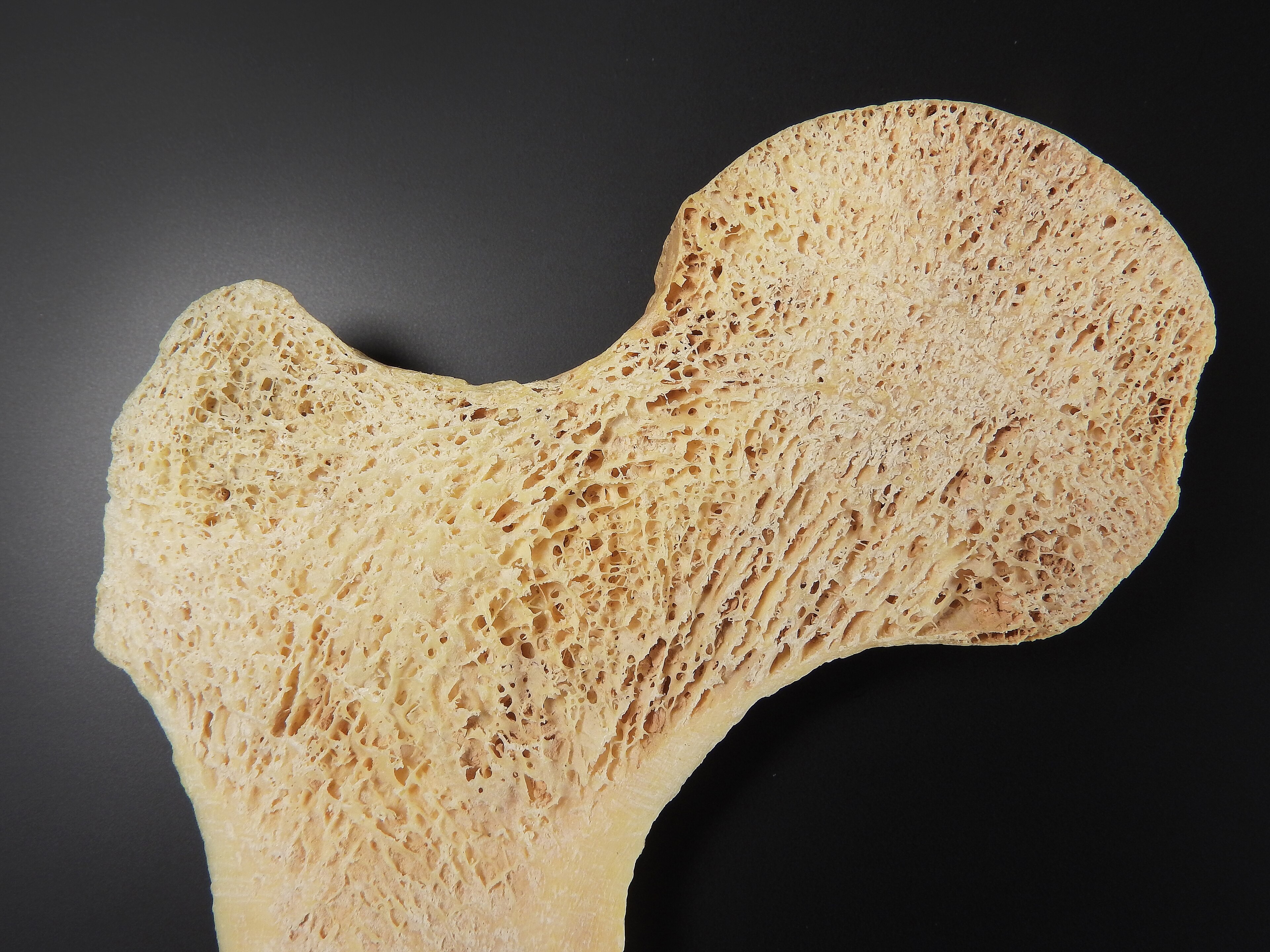
Start with the thing before it fossilises. A bone is not a solid object. It is a highly porous material, because space has to be available inside it to hold marrow and other tissues. Saw one across and the interior is a lattice — a dense honeycomb of struts with open space between them, wrapped in a thin solid wall.
That porosity is not a weakness in the design. It is the design. And it is the reason the rest of this happens.
What fills them
Once a bone is buried, groundwater moves through it. Minerals dissolved in that water — commonly calcite or silica — precipitate out into the pore spaces and set, forming a cement. The U.S. National Park Service gives the process its one-line definition: permineralization is “the infilling of natural pores in original organic material by minerals.”
Read that again, because the load-bearing word is infilling. The Digital Atlas of Ancient Life states the consequence outright: “The original organic material, however, is not removed; thus, that material could be classified as unaltered.” The minerals go into the gaps around the bone. They do not go in place of it.
Where the other answer comes from
The confident version is not nonsense. It is an accurate description of a different process.
That process is replacement, which the NPS defines as “the substitution of inorganic minerals for the original hard parts of organisms that have been dissolved away.” Here the original really does go. Fossils formed this way, in the Digital Atlas's words, “do not preserve the original body parts produced by the organism when it was alive.” A pyritised ammonite is a shell shape rendered in metal; the shell itself is gone.
The petrified wood problem
And here is where the confusion almost certainly comes from, because it is the fossil everybody can picture.
Petrified wood is not a good analogy for permineralised bone. It is the opposite case. The Digital Atlas is explicit that petrification takes permineralization one step further: minerals fill the pore spaces in the wood, and the original organic material — the wood itself — is replaced with minerals. The conclusion is flat: “no original wood remains in petrified wood samples.”
Most fossil bone is still bone
Bone usually goes the other way. The Digital Atlas states it in five words: “Most fossil bones … exhibit permineralization.”
That is the whole correction. The confident answer is not wrong about the world — replacement happens, and petrified wood is exactly what it looks like. It is wrong about the proportions. It takes the minority case for bone and states it as the rule.
Thin enough to look through
One consequence is worth ending on, and it follows directly from the original material still being in there.
Because permineralization fills the internal spaces rather than dissolving the structure, it can form a three-dimensional internal mould of the original tissue — sometimes, the NPS notes, preserving detail at the microscopic or cellular level. Cut a section thin enough that light passes through it, put it under a microscope, and the internal architecture is still there to look at: the small cavities that held bone cells, the channels that carried blood vessels, in their original arrangement.
Not an impression of a bone. Not a cast of one. The thing itself, with the gaps filled in.
You can browse the extinct record in the Fossil Library, watch the continents move underneath it on the Continental Drift map, and see where every fact comes from.
Sources
Every quoted definition below is verbatim from the cited page, checked against the source rather than a summary of it.
- U.S. National Park Service — “Permineralization and Replacement” (last updated 16 August 2024) — the definitions of both processes, and the note that permineralization can preserve detail at the microscopic or cellular level
- Digital Atlas of Ancient Life (Paleontological Research Institution) — “Types of fossil preservation” — why bone is porous, what fills it, the unaltered-original-material statement, the weight test, and the sentence this whole post turns on: “Most fossil bones … exhibit permineralization”
The real record, in your pocket.
PaleoDex catalogues the real fossil record, and every fact in it is sourced. Get the app.
GET IT ON GOOGLE PLAY →