Were Pterosaurs Really Bald and Leathery?
PALEODEX · 13 September 2026 · 6 min read
Plenty of old pictures drew pterosaurs as bare, leathery animals. The fossils tell a more interesting story, and one part of it is still being argued.
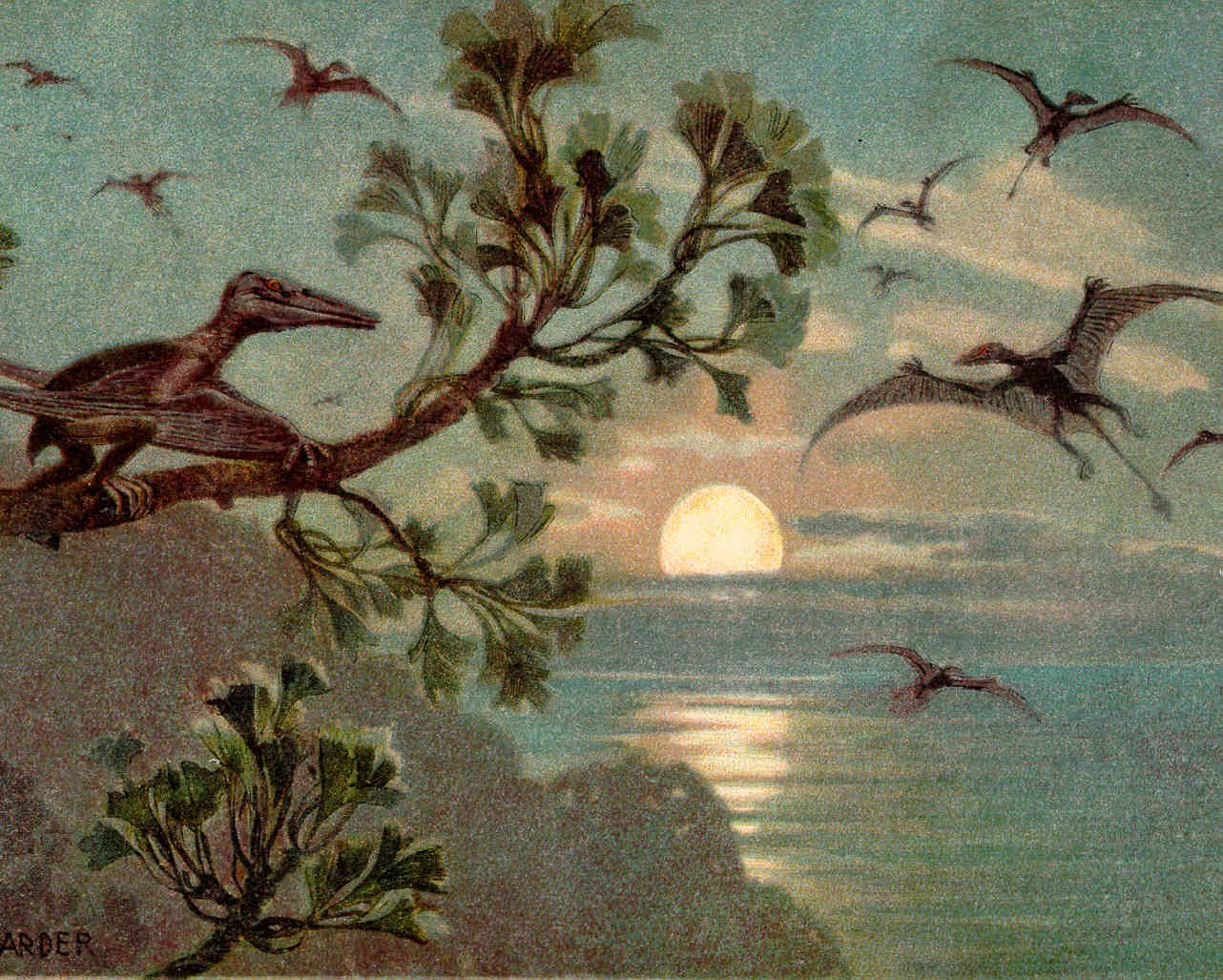
The bald picture
Plenty of pictures from over a century ago show pterosaurs one particular way: skin stretched over bone, and nothing at all on the body.
The examples are easy to find. The pterosaur sculptures made for Crystal Palace Park in London in 1854 are smooth. So is the flying pterosaur on a plate in The Book of the Animal Kingdom from 1910, and so are the animals in Heinrich Harder's 1916 painting above.
But "plenty of pictures" is as far as that goes. It was never all of them, and the exceptions go back a long way.
Somebody saw fur in 1831
In 1831 Georg August Goldfuss described the pterosaur fossil we call Scaphognathus crassirostris, and he described, and drew, a fur-like covering on it. Hermann von Meyer rejected the idea.
Nearly two centuries later the same specimen was examined again with modern imaging. Studies published in 2018 and 2023 found fibres preserved on it, and the first of them put its verdict in the title: "Goldfuß was right".
The hairy devil
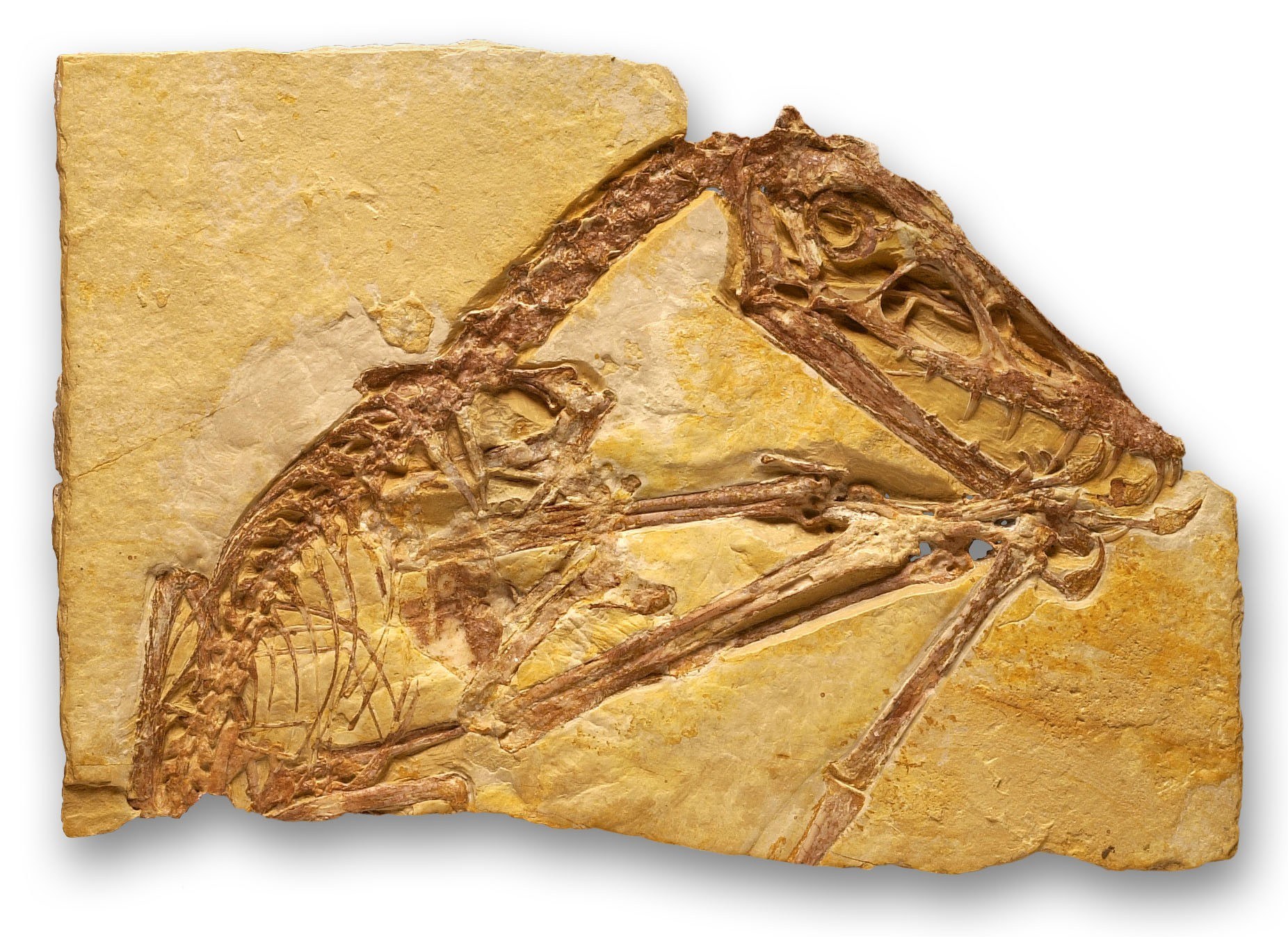
Then came Sordes. In 1971 the Soviet palaeontologist A. G. Sharov described a small pterosaur from Late Jurassic rocks at Karatau, in Kazakhstan, and named it Sordes pilosus.
Pilosus means hairy, and Sharov rendered Sordes as an evil spirit, which is how the animal got its nickname: the hairy devil. The name was a description. Sharov interpreted fine fibres on the fossils as a hair-like covering.
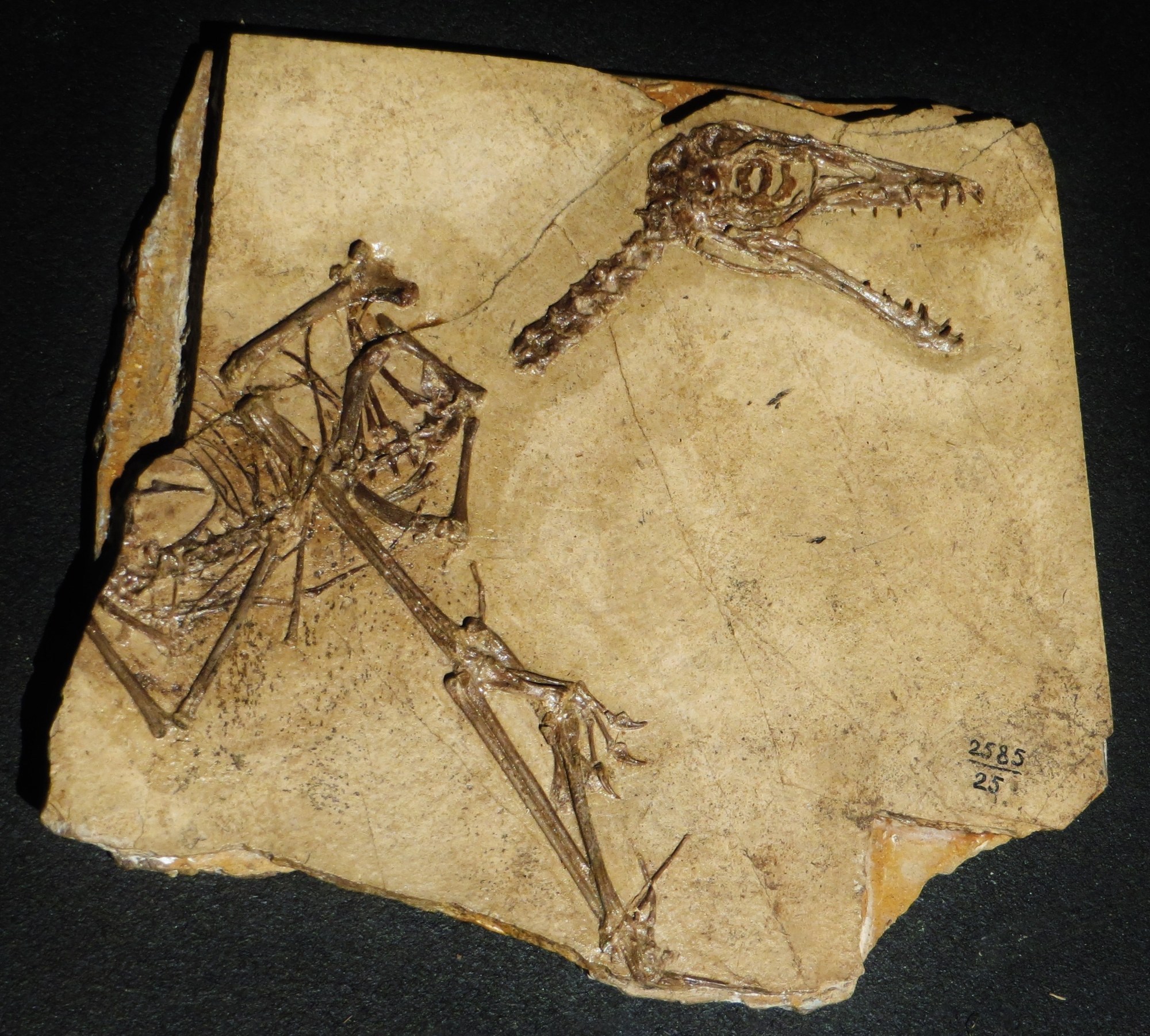
The type specimen, the one the name is pinned to, is catalogued as PIN 2585/3. The slab pictured below is a different Sordes: the number painted on it reads 2585/25.
A name for the fibres
The structures now have a name of their own. In 2010 Alexander Kellner and colleagues, describing the soft tissue of another pterosaur, called them pycnofibres, from the Greek pyknos, meaning dense.
The same paper went back over Sordes. It notes an earlier report of fibres at the back of the skull on a second specimen, describes fibres around the body, and records pycnofibres around the femur and tibia, the thigh and shin bones, on the holotype itself.
And Sordes is not alone. Pycnofibres have been reported on other pterosaur fossils too, including the Scaphognathus Goldfuss described, and on specimens of Rhamphorhynchus and Pterodactylus in earlier work that the 2023 study reviews.
Sordes has had its own back-and-forth
Even the hairy devil's fibres have been doubted. In 1994 Unwin and Bakhurina argued that what Sharov had taken for hair was not hair. A year later the same pair wrote that the holotype's fibres were too poorly preserved to identify, but reported hair on a second specimen. In 2010 Kellner's team concluded that Sharov had been at least partially correct.
The team that says they were naked
Not everyone accepts the fuzzy reading today, either. David Unwin and David Martill have argued that pterosaurs were naked.
In conference abstracts in 2019 and 2020, and in a University of Portsmouth press release in 2020, they argued that the fibres are collagen fibres from deep in the skin, exposed when a remarkably thin outer layer decayed, and that on the outside the animals were smooth.
We read those abstracts through two independent write-ups; the abstract volumes themselves were not available to us. As far as we could trace, the naked-pterosaur case has been made in abstracts and a press release rather than in a full paper, and the latest statement of it we found dates from 2020.
So what did a pterosaur look like?
Most experts picture a fine, fuzzy coat on the head, body and limbs, and fossils like the ones above are the evidence for it. It is a reading of the evidence rather than a photograph, and one experienced team reads the same evidence the other way.
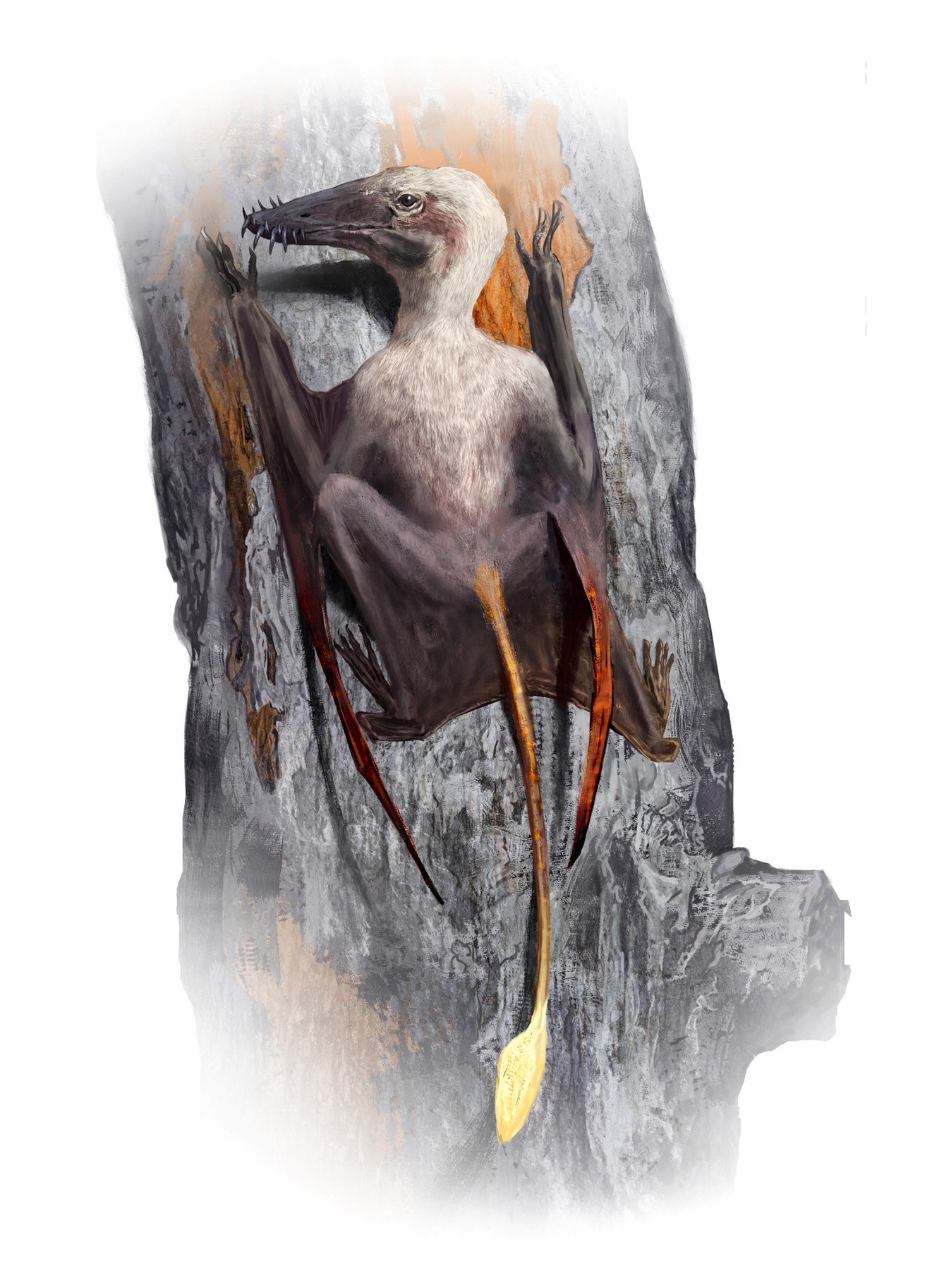
The coat is reported on the body, not on the wing membranes, which are a different structure.
Why this belongs in PaleoDex
Because it is the kind of correction we like best: not one fossil overturning everything, but an argument that has swung back and forth for almost two hundred years, with the evidence and the doubts both on the record. It sits alongside the skull on the wrong end, Hallucigenia, reconstructed upside down, and why we picture Neanderthals stooped. For the wider catalogue, see the Fossil Dex, and for how we handle sourcing, about the data.
Sources
Every claim above traces to the literature below. Where we could not read the primary directly, we say so.
- Sharov, A.G. (1971). "Novye letayushchie reptilii iz mezozoya Kazakhstana i Kirgizii" [New flying reptiles from the Mesozoic of Kazakhstan and Kirghizia]. Trudy Paleontologicheskogo Instituta AN SSSR 130: 104–113. Source for the naming of Sordes pilosus and the holotype, PIN 2585/3. Not read in the original; what Sharov saw is cited through Kellner et al. 2010.
- Unwin & Bakhurina (1994). Nature 371: 62–64. Source for the 1994 doubt about Sharov's hair. Read through Kellner et al. 2010.
- Kellner, A.W.A., Wang, X., Tischlinger, H., Campos, D.A., Hone, D.W.E. & Meng, X. (2010). "The soft tissue of Jeholopterus (Pterosauria, Anurognathidae, Batrachognathinae) and the structure of the pterosaur wing membrane." Proceedings of the Royal Society B 277: 321–329. DOI. Source for the term pycnofibre, the Sordes fibre records, and the 1994–2010 history.
- Jäger, Tischlinger, Oleschinski & Sander (2018). "Goldfuß was right…" Palaeontologia Electronica. Source for fibres on the Scaphognathus Goldfuss described.
- Henkemeier, Jäger & Sander (2023). Palaeontologia Electronica 26.2.a16. DOI. Source for Goldfuss's 1831 report, von Meyer's rejection, pycnofibres on that specimen, and the review of earlier Rhamphorhynchus and Pterodactylus records.
- Unwin, D.M. & Martill, D.M. (2020). Comment in Nature Ecology & Evolution 4: 1590–1591. DOI. Source for the "widely held" wording.
- Unwin & Martill, conference abstracts (SVPCA 2019, SVP 2020), and a University of Portsmouth press release of 28 September 2020. Source for the naked-pterosaur argument. Abstract volumes not reached; read through two independent write-ups.
- Wikipedia, "Sordes" (read 13 September 2026). Source for the meaning of the name and Sharov's rendering of it; the nickname "hairy devil" also appears in National Geographic's 2015 "Sciencespeak: Pycnofiber".
The real record, in your pocket.
PaleoDex catalogues the real fossil record, and every fact in it is sourced. Get the app.
GET IT ON GOOGLE PLAY →