Reconstructed Upside Down and Backwards
PALEODEX · 25 July 2026 · 8 min read
A half-billion-year-old animal so strange that the scientist describing it named it after a hallucination — then published it standing on its own spines, with a blob of its decay fluid labelled as the head. Getting it right took thirty-eight years and three separate corrections.
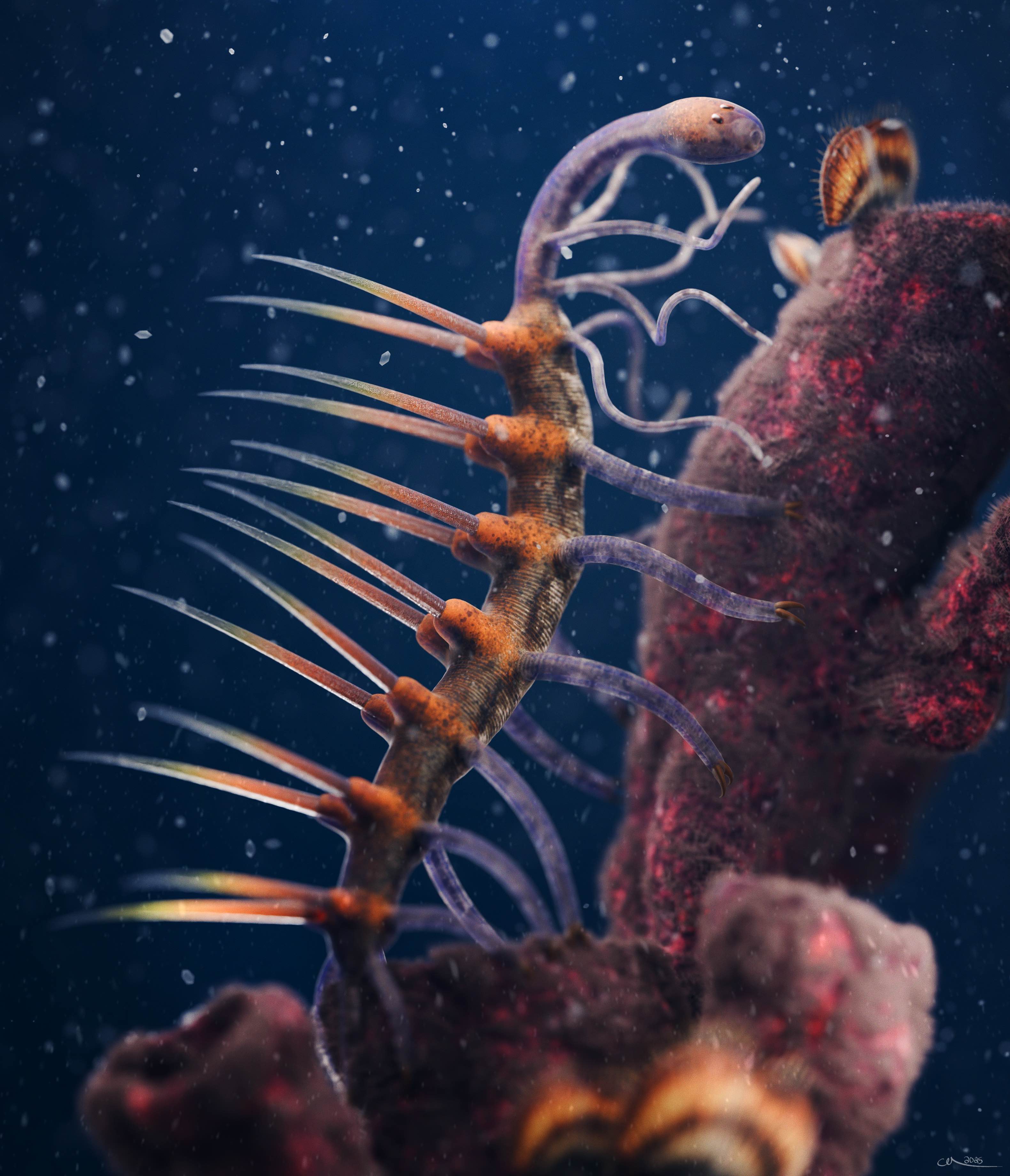
Most famous scientific mistakes are a single wrong answer. This one is rarer: an animal that was read wrong in two independent ways at once, the wrong way up and facing the wrong direction. Each error had to be fixed separately, decades apart, by different people using different evidence.
An animal named for a hallucination
The fossil comes from the Burgess Shale of Yoho National Park in British Columbia, a deposit roughly 505 million years old that preserves soft-bodied Cambrian animals in extraordinary detail. Charles Walcott, the Burgess Shale's discoverer, described it in 1911, but filed it away as a species of a polychaete worm, Canadia sparsa.
It was Simon Conway Morris who, restudying the material in 1977, recognised it was nothing of the kind and gave it a genus of its own. He chose the name for the animal's bizarre, dream-like quality: Hallucigenia. The name has aged extremely well, though not for the reasons he intended.
What Hallucigenia actually was
Strip away the history and the animal itself is a modest thing. It was barely a few centimetres long (the Royal Ontario Museum gives a maximum around 30 mm, and other sources stretch the range to about 50 mm), and it walked the Cambrian seafloor on rows of slender legs, each tipped with tiny claws.
Down its back ran seven pairs of rigid, conical spines. Underneath sat the legs: soft, flexible, clawed lobopods, the same basic limb design seen in a group of Cambrian animals collectively called lobopodians. The ROM reconstructs its ecology as epibenthic and probably a suspension feeder, using sponges as a substrate to stand up into the water column and filter food passing by.
Published upside down
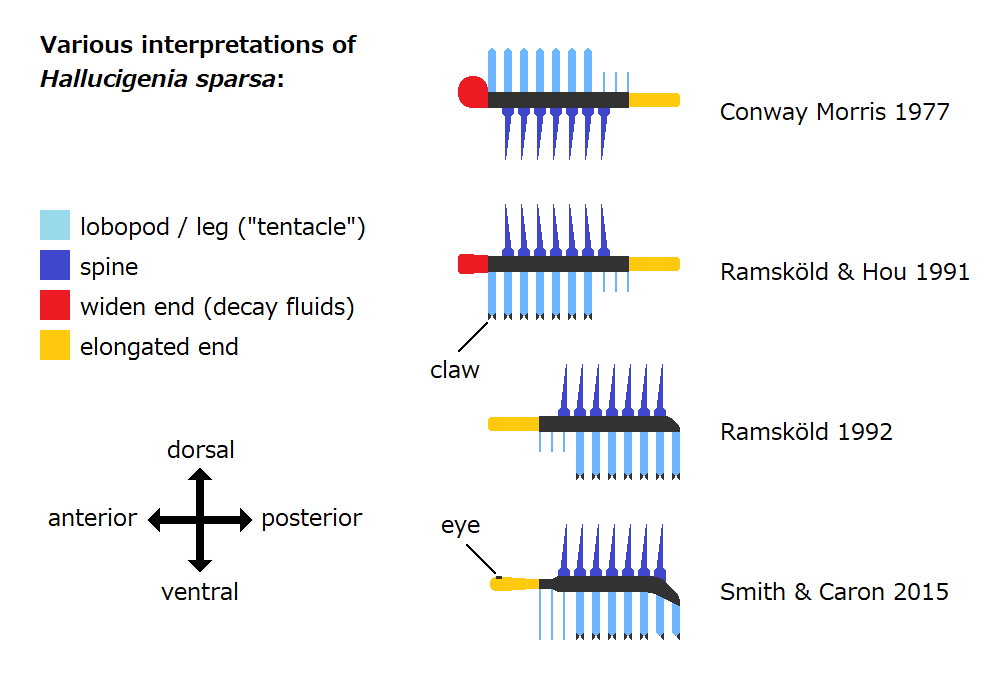
Conway Morris's 1977 reconstruction has Hallucigenia walking on its spines, balanced on seven pairs of rigid stilts, with the soft clawed limbs interpreted as a single row of feeding tentacles waving from its back. It is, anatomically, the animal turned exactly upside down.
It is easy to be unkind about this in hindsight. It is worth remembering that nothing else known at the time looked remotely like it, and that the spines really are the most prominent structures on the fossil. The reconstruction was a serious attempt at an animal with no obvious relatives.
The head that was never a head
The second error was stranger. At one end of many specimens sits a dark, balloon-like stain. Conway Morris interpreted it as a featureless head. With no mouth visible anywhere, he suggested each of the dorsal "tentacles" might carry its own mouth, feeding the animal along the row.
That blob is not anatomy at all. Lars Ramsköld showed in 1992 that it appears in specimen after specimen as a stain rather than a structure, and it is now read as decay fluid or gut contents that oozed out as the animal was flattened during burial. The "head" was the animal leaking.
1991: claws belong on the ground
The first correction came from China. In 1991, Lars Ramsköld and Hou Xianguang published on lobopodian material from the Chengjiang deposit in Yunnan, a Cambrian site comparable in quality to the Burgess Shale, and one Hou himself had brought to scientific attention in the 1980s.
The Chengjiang fossils showed the paired soft appendages ending in claws. Claws are for gripping ground. That single detail inverted the animal: the soft limbs were legs, the row was paired rather than single, and the spines were never stilts at all: they were armour carried on the back. Hallucigenia was turned the right way up.
2015: the real head, at the other end
Turning the animal over did not answer which end was the front. Killing the false head told the field what the blob wasn't, not where the real one was. That took another twenty-three years.
In 2015, Martin Smith and Jean-Bernard Caron published a restudy in Nature using electron microscopy on the Burgess Shale material. They found the head at the opposite end from the blob: an elongated head carrying a pair of simple eyes, sitting above a mouth ringed with teeth, with the throat behind it lined with needle-shaped teeth. The ring of teeth around the mouth probably worked as a suction mechanism, flexing like a valve.
Smith was explicit about how open the question had been right up to that point: "Prior to our study there was still some uncertainty as to which end of the animal represented the head, and which the tail."
Why this one is worth telling properly
It would be easy to file Hallucigenia under "scientists were silly once." That reading misses what actually happened. Each correction was driven by a specific new piece of evidence: better fossils from a different continent, a pattern spotted across many specimens, a microscope fine enough to resolve a two-millimetre head. Each one was published, argued, and absorbed.
The animal was described from difficult material with no comparison points, reconstructed as well as anyone could manage in 1977, and then steadily corrected over four decades as the evidence improved. That is not the system failing. That is the only version of the system that works.
If you like a mistake that took even longer to unpick, the skull that Edward Cope mounted on the wrong end of Elasmosaurus is the same kind of story with a credit theft attached, and Piltdown Man is the one where the error was deliberate. At PaleoDex we care about getting these details right, because the record is more interesting when it's accurate than when it's convenient.
Sources
Every fact above is drawn from primary and institutional sources:
- Conway Morris, S. (1977). "A new metazoan from the Cambrian Burgess Shale of British Columbia." Palaeontology 20(3):623–640. (The genus Hallucigenia, and the upside-down reconstruction.)
- Ramsköld, L. & Hou Xianguang (1991). "New Early Cambrian animal and onychophoran affinities of enigmatic metazoans." Nature 351:225–228. (Clawed Chengjiang lobopodians; the animal inverted.)
- Ramsköld, L. (1992). On the "head" blob being a decay stain rather than preserved anatomy.
- Smith, M. R. & Caron, J.-B. (2015). "Hallucigenia's head and the pharyngeal armature of early ecdysozoans." Nature 523. (nature.com)
- University of Cambridge (24 June 2015). "Newly-discovered 'ring of teeth' helps determine what common ancestor of moulting animals looked like." (Eyes, the mouth ring, pharyngeal teeth, body length, and the Smith quote.) (cam.ac.uk)
- Royal Ontario Museum, Burgess Shale database, Hallucigenia sparsa (age and formation, spine and limb counts, claws, suspension-feeding ecology). (burgess-shale.rom.on.ca)
- Wikipedia, "Hallucigenia" (Walcott's 1911 Canadia sparsa, the sequence of reinterpretations, and the unresolved phylogenetic placement). (en.wikipedia.org)
The real record, in your pocket.
PaleoDex catalogues the real fossil record: sourced, and honest about what is still disputed. Get the app.
GET IT ON GOOGLE PLAY →