The Skull on the Wrong End
PALEODEX · 24 July 2026 · 7 min read
In 1868 America's most famous fossil hunter unveiled a sea reptile with a neck longer than its whole body — and mounted the skull on the tip of its tail. The famous version of this story credits his rival with catching the blunder. That part is wrong, and untangling it is more interesting than the mistake itself.
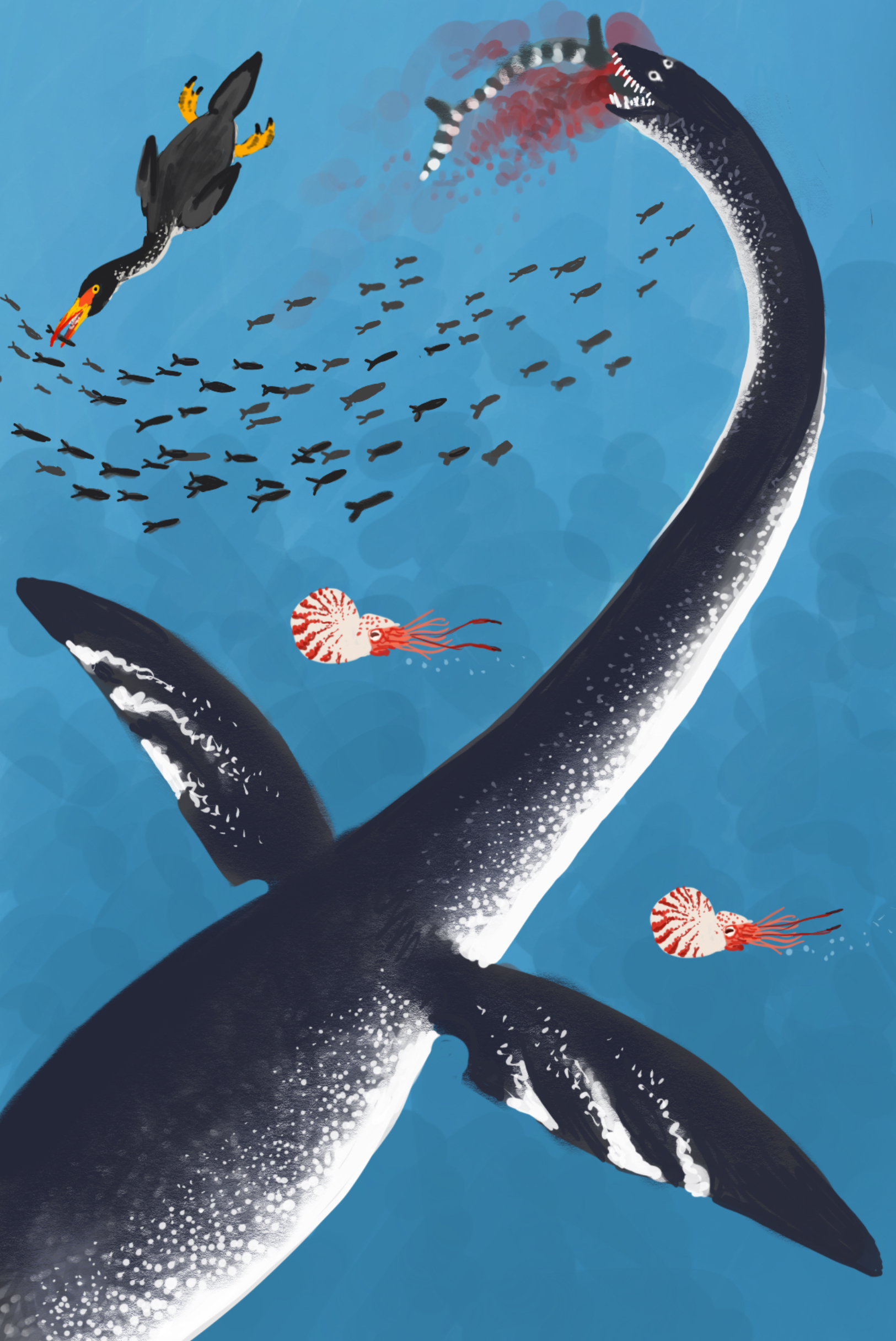
Some scientific mistakes are famous because they were disastrous. This one is famous because it was funny — and because, more than a century and a half later, most people still get the ending wrong.
A neck mistaken for a tail
The animal is Elasmosaurus platyurus, a marine reptile — not a dinosaur — that swam the shallow sea splitting North America in the Late Cretaceous. Its defining feature is its neck: absurdly long, built from dozens of vertebrae, longer than the rest of the body put together. It is one of the most extreme necks any backboned animal has ever grown.
That neck is exactly what caused the trouble. When the first bones reached the East Coast in the late 1860s, the person studying them had never seen anything like it — and made a very human assumption about which end was which.
Cope, in a hurry
The person was Edward Drinker Cope, a brilliant, prolific, and famously fast-working paleontologist at the Academy of Natural Sciences in Philadelphia. The fossil had been dug out of the chalk near Fort Wallace, Kansas, by an army surgeon named Theophilus Turner, who shipped the bones east. Cope raced a description into print in 1868 and set about reconstructing the skeleton.
Working at speed, he laid the long chain of neck vertebrae out as a tail — and put the short end, with the skull, at the front. It was a reasonable guess for the time and completely backwards.
The skull on the wrong end
Cope's published reconstruction shows Elasmosaurus with its head mounted on the tip of what is really its tail, the enormous neck trailing off behind the body like the tail of a giant lizard. The most striking anatomical feature of the whole animal — that impossible neck — had been folded into the wrong place entirely.
Joseph Leidy caught it — in public
The correction came at a meeting of the Academy of Natural Sciences on 8 March 1870. The man who made it was Joseph Leidy, the senior naturalist who had helped train Cope, and one of the most careful anatomists in America. Leidy pointed out that the skull sat at the wrong end of the vertebral column, and moved the head to what Cope had been calling the tail. It was not a quiet note passed in private. It happened in the room, in front of Cope's colleagues.
Cope, mortified, is reported to have tried to buy back and reprint the copies of his rushed paper to bury the error — a story repeated for over a century, though it traces to a later biography rather than a contemporary record, so treat it as likely-but-not-proven. Either way, the corrected skeleton is the one that survived.
The man who took the credit
Here is where the popular version goes off the rails. Ask most people who caught Cope's blunder and you'll hear the name of his great rival, Othniel Charles Marsh — the other half of the "Bone Wars," the decades-long feud between the two men. Marsh, the story goes, spotted the reversed skull and humiliated Cope with it.
He didn't. Marsh was present at the 1870 meeting, but the public correction was Leidy's, not his. Marsh's claim to have personally caught the mistake surfaces only about twenty years later, in an 1890s newspaper war with Cope, when both men were airing every grievance they could dredge up. Historians who have gone back to the record read Marsh's version as self-serving revisionism — a story he told about himself long after the fact, not something he did at the time.
Why we remember it wrong
The blunder is real; the credit is usually misassigned. It's a small, clean example of how history gets flattened: a memorable mistake, a famous rivalry, and a tidy narrative that puts the two rivals directly against each other. The truth is messier and better — the person who actually caught Cope was his old mentor, correcting him gently and publicly, while the rival who gets the credit simply outlived him and rewrote the story.
We've told the story of that rivalry itself in The Bone Wars — and if you like a good scientific mistake, the Piltdown Man hoax is the one that fooled everyone for forty years. At PaleoDex we care about getting these details right, because the record is more interesting when it's accurate than when it's convenient.
Sources
Every fact above is drawn from primary and institutional sources:
- Cope, E. D. (1868). Original description of Elasmosaurus platyurus. Proceedings of the Academy of Natural Sciences of Philadelphia 20:92–93.
- Leidy, J. (1870). The public correction of the reconstruction. Proceedings of the Academy of Natural Sciences of Philadelphia 22:9–10.
- Davidson, J. P. (2002). "Bonehead Mistakes: The Background in Scientific Literature and Illustrations for Edward Drinker Cope's First Restoration of Elasmosaurus platyurus." Proceedings of the Academy of Natural Sciences of Philadelphia 152. (researchgate.net)
- Everhart, M. J., "The Tale of a Tail" and "Elasmosaurus platyurus — Rest of Story," oceansofkansas.com (Turner's discovery near Fort Wallace; Leidy's 1870 correction; Marsh's much later claim). (oceansofkansas.com)
- Wikipedia, "Elasmosaurus" (the reconstruction error, the reversed skull, and the historiography of who corrected it). (en.wikipedia.org)
The real record, in your pocket.
PaleoDex catalogues the real fossil record: sourced, and honest about what is still disputed. Get the app.
GET IT ON GOOGLE PLAY →