Is Nanotyrannus a baby T. rex?
PALEODEX · 25 August 2026 · 6 min read
One small skull from Montana spent decades filed as a teenage Tyrannosaurus rex. Then, in the space of five weeks in late 2025, two independent teams cut into the bones — and both found an adult.
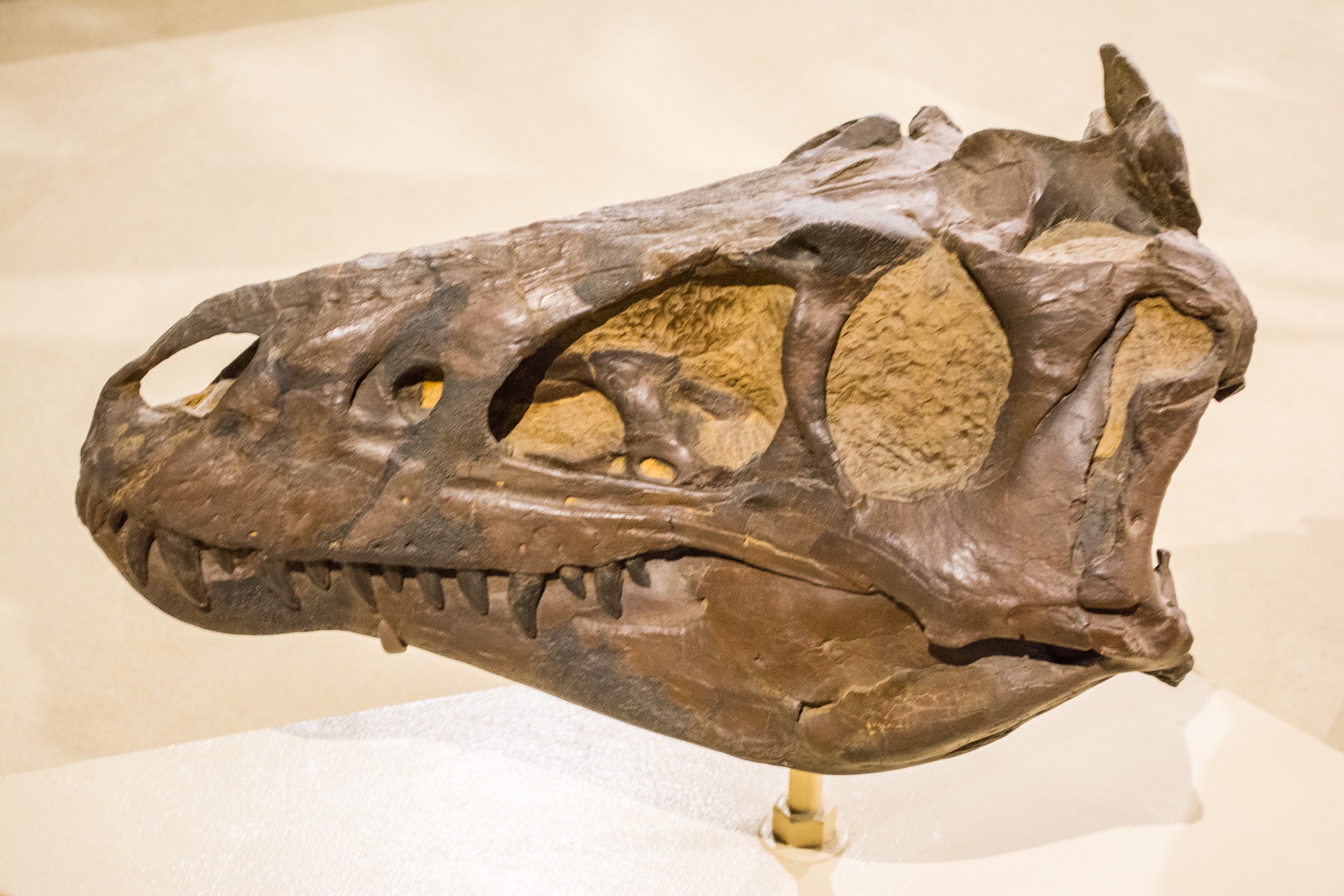
Paleontology has a special shelf for identity crises. Brontosaurus spent a century on it. Oviraptor was convicted of a crime it didn't commit. And since 1988, the shelf's most stubborn resident has been Nanotyrannus — the "dwarf tyrant" that most of the field insisted was no separate dinosaur at all, just a teenage Tyrannosaurus rex that hadn't finished growing. In late 2025 that argument finally met something it couldn't outtalk: growth rings.
A skull with too many teeth
The story starts in 1942, when a field crew led by David Dunkle pulled a small, elegant tyrannosaur skull out of the Hell Creek Formation of Montana — the same end-Cretaceous rocks that produced the Tanis site and most of the famous T. rex specimens. Catalogued as CMNH 7541 at the Cleveland Museum of Natural History, it was first described in 1946 as a species of Gorgosaurus. It didn't look much like a young T. rex: the snout was low and narrow, and the jaws carried more tooth positions than any Tyrannosaurus rex. In 1988, Robert Bakker, Phil Currie and Michael Williams re-examined it, judged the skull bones fused — an adult trait — and gave it a new name built for headlines: Nanotyrannus lancensis, the dwarf tyrant.
The case for "just a teenager"
The counterargument was always serious, and for a quarter century it won. Tyrannosaurs transformed dramatically as they grew — slender, long-legged juveniles thickened into bone-crushing adults — so a strange-looking small tyrannosaur from T. rex country could simply be a growth stage. In 1999, Thomas Carr's detailed re-study concluded the Cleveland skull was ontogenetically immature. Then came Jane: the best small-tyrannosaur skeleton ever found, excavated by the Burpee Museum near Ekalaka, Montana in 2001. When Holly Woodward's team sectioned Jane's leg bones in 2020, the histology showed an animal still actively growing when it died. Small skulls, immature bone, a species famous for extreme growth: the field filed Nanotyrannus under juvenile T. rex, and the textbooks followed.
The Dueling Dinosaurs open their bones
The specimen that reopened the case is the most famous barely-studied fossil in North America: the Dueling Dinosaurs, a complete small tyrannosaur entombed alongside a Triceratops, discovered in Montana in 2006 and acquired by the North Carolina Museum of Natural Sciences in 2020. In October 2025, Lindsay Zanno and James Napoli published its long-awaited analysis in Nature. Reading growth rings in the limb bones alongside spinal fusion and developmental anatomy, they found the animal was around 20 years old and physically mature when it died — at roughly six meters long, dwarfed by any adult T. rex. It also carried traits that are set early in growth and don't match Tyrannosaurus at any age: proportionally longer arms with a vestigial third finger, more teeth, fewer tail vertebrae, distinct skull nerve pathways. Their conclusion: this is an adult of a separate lineage, Nanotyrannus lancensis — and Jane, they argued, belongs to a second species of the same genus, which they named Nanotyrannus lethaeus, after the mythological river of forgetting.
Five weeks later, the original skull answered too
What makes late 2025 a turning point rather than one more volley is independent replication. In December, a separate team led by Christopher Griffin sectioned a rarely studied bone — the ceratobranchial, part of the throat's hyoid apparatus — preserved with the original 1942 Cleveland skull, and published the results in Science. The growth record inside, including the tightly bunched outer layers of a skeleton that has essentially stopped growing, indicated an animal at or near full maturity. Two teams, two different fossils, two different bones, five weeks apart: both mature. Several longtime skeptics moved — Thomas Holtz allowed that the new work made the case better than anyone had before, and Steve Brusatte accepted the genus outright.
The strange gap it leaves behind
Here is the twist that makes this more than a naming dispute. For twenty years, the "teenage T. rex" specimens — Jane above all — were the raw material for how science described T. rex growing up: its growth spurts, its changing bite, its adolescent body plan. If those specimens are Nanotyrannus, those studies were unknowingly written about a different animal, and confirmed juvenile T. rex fossils become vanishingly rare. The most famous dinosaur on Earth may have a childhood science has barely seen. Candidate juveniles are already being re-examined — including a specimen in preparation at the Denver Museum of Nature & Science — and whatever they show, Hell Creek's final million years now looks busier at the top of the food chain: not one tyrant but two, hunting the same floodplains until the day it all ended.
Identity fights like this one are why we keep writing about contested fossils: the arguing is not a bug in paleontology, it's the method. The PaleoDex catalogue holds claims like these the same way the literature does — sourced, dated, and left blank where the evidence runs out.
Sources
Sourced, not assumed — the papers and their context below.
- Zanno & Napoli 2025 — "Nanotyrannus and Tyrannosaurus coexisted at the close of the Cretaceous" — Nature 648: 357–367
- Griffin et al. 2025 — "A diminutive tyrannosaur lived alongside Tyrannosaurus rex" — Science
- NC State University — "Nanotyrannus Confirmed: Dueling Dinosaurs Fossil Rewrites the Story of T. rex"
- Woodward et al. 2020 — "Growing up Tyrannosaurus rex" — Science Advances (the histology of Jane)
- Science News — "Nanotyrannus was not a teenaged T. rex" (reactions, and the juvenile-T. rex gap)
- Live Science — researchers respond, including Thomas Carr's continued dissent
The real record, in your pocket.
PaleoDex catalogues the real fossil record, and every fact in it is sourced. Get the app.
GET IT ON GOOGLE PLAY →