Homo floresiensis: Twenty Years of Arguing She Was Sick
Homo floresiensis · LB1 · Liang Bua, Flores
PALEODEX · 21 August 2026 · 6 min read
A grown woman about a metre tall, with a brain the size of a chimpanzee's, found beside stone tools. Was she a new human species — or one very sick modern human? Settling that took two decades, and it wasn't settled by argument.
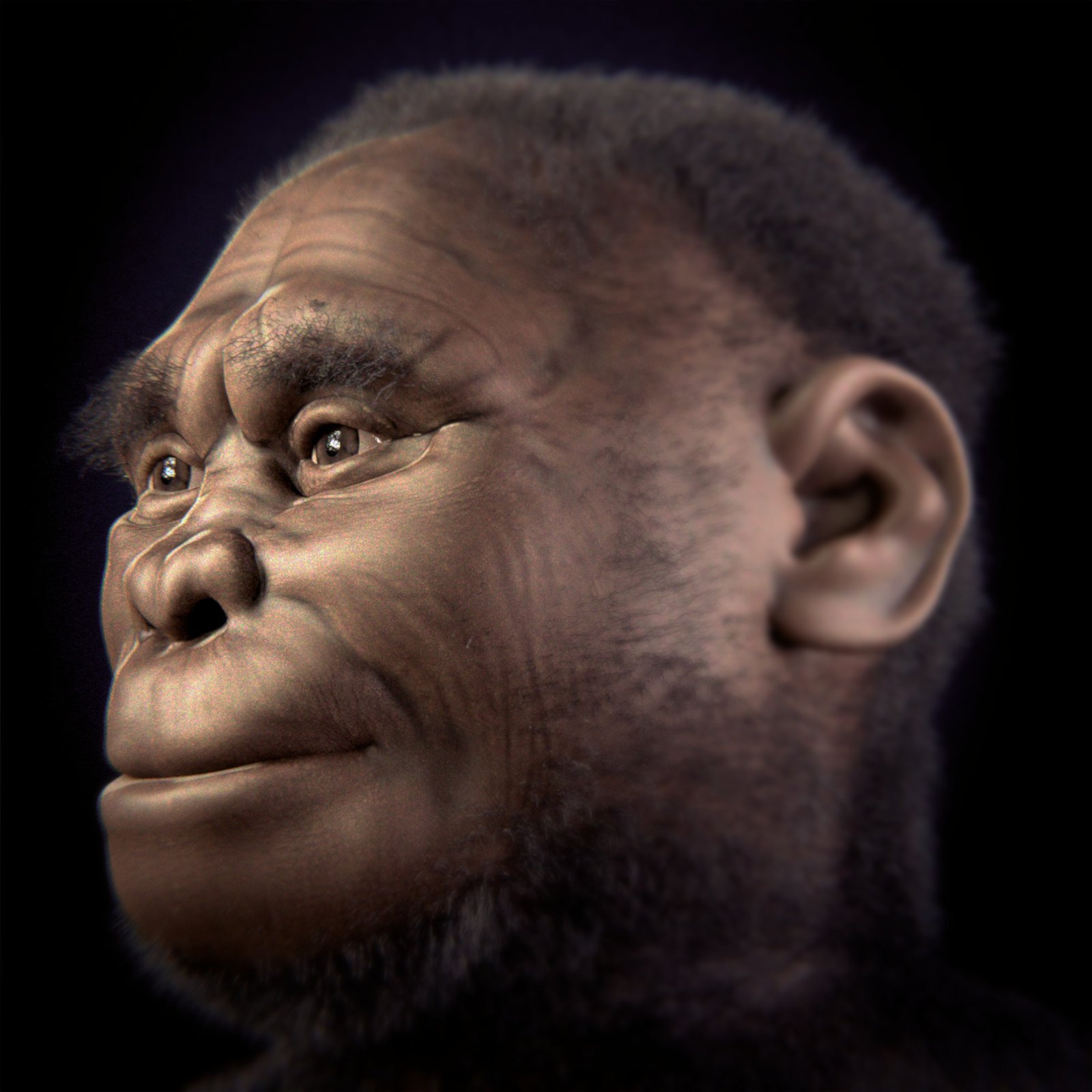
In 2004, a team working in Liang Bua cave on the Indonesian island of Flores described something the textbooks had no slot for: an adult human relative with a stature of roughly one metre and an endocranial volume the describers put at about 380 cm³ — chimpanzee territory — found in deposits that also carried stone artefacts. They named her Homo floresiensis, and proposed that she descended from Homo erectus through long isolation and island dwarfing. The press immediately reached for a different name: "the hobbit."
The pushback was serious science
It is tempting to tell this as a story of a bold discovery versus closed minds. It wasn't — and after Piltdown Man, paleoanthropology has earned its reflex of treating too-strange skeletons with suspicion. The counter-case was published in top journals and it was specific. LB1's skeleton, the skeptics pointed out, shows marked craniofacial and postcranial asymmetries — signs of abnormal growth and development — and 140 of her cranial features sit within the range of variation of modern humans, resembling Australomelanesian populations. On that reading she was a modern human, from a small-bodied population, with a developmental abnormality that may have included microcephaly. A later paper by a different group went further and argued her anatomy specifically fits Down syndrome.
And here is the honest problem: with a single skeleton, that is genuinely hard to rule out by argument alone. Only one skull has ever been found. Science has rejected strange hominins before — it happened to the Taung Child too — and it has also been right to be suspicious. One individual can always be an exception. A population cannot.
The number everyone still gets wrong
If you read about her years ago, you probably remember one detail: that these tiny humans were still alive 18,000 years ago, practically shaking hands with modern humans. That number is retired. A 2016 re-study of Liang Bua's stratigraphy showed the dated charcoal that produced the young ages came from different deposits than the bones. The revised chronology puts the skeletal remains at about 100,000 to 60,000 years old, with stone artefacts attributable to the species running from about 190,000 to 50,000 years ago. Still astonishingly recent for a metre-tall archaic human — but if an article tells you "18,000 years," it is quoting a superseded figure.
Mata Menge ends the argument
What closed the sick-individual debate was not a better argument. It was a second site. At Mata Menge, about 75 km east of Liang Bua, excavations in the So'a Basin produced hominin fossils dating to about 700,000 years ago — first a mandible fragment and teeth described in 2016, and then, in 2024, three more fossils including the find that mattered most: an adult humerus (upper-arm bone) estimated to be 9–16% shorter and thinner than LB1's. That makes it smaller than any other adult hominin humerus in the entire Plio-Pleistocene fossil record.
Think about what that does to the pathology hypothesis. A developmental disorder can explain one strange individual. It cannot explain a population of even smaller adults living on the same island 700,000 years earlier — half a million years before our own species existed anywhere. Small was not a disease on Flores. Small was normal, and it had been normal for a very, very long time.
The question that is still open
None of this settled where she came from — and that fight is genuinely live. The original description proposed a dwarfed descendant of Asian Homo erectus, and the Mata Menge team still reads the evidence that way. But a major 2017 analysis of cranial, dental and postcranial characters recovered Homo floresiensis as closest to Homo habilis — a far older and more primitive lineage — which would mean an early human relative left Africa long before anyone has traced, crossed half the planet, and survived on one island into the age of modern humans. Both hypotheses have serious evidence behind them. Nobody should tell you this one is finished.
Either way, the bigger lesson stands: within the last hundred thousand years, we were not alone. Flores had its metre-tall people. Siberia had Neanderthals and Denisovans sharing a cave. The human family tree was recently crowded — and we only started meeting the neighbours in 2004.
Meet her in PaleoDex
Homo floresiensis is in the PaleoDex catalogue alongside the rest of the hominin record — real specimens, real localities, and a source for every fact. Browse the Fossil Library and find her between the giants.
Sources
If a fact isn't sourced, we leave it blank. These are the papers behind every claim above.
- Brown, Sutikna, Morwood et al. (2004) — A new small-bodied hominin from the Late Pleistocene of Flores, Indonesia — Nature
- Jacob et al. (2006) — Pygmoid Australomelanesian Homo sapiens skeletal remains from Liang Bua: population affinities and pathological abnormalities — PNAS
- Henneberg, Eckhardt et al. (2014) — Evolved developmental homeostasis disturbed in LB1, denotes Down syndrome — PNAS
- Sutikna, Tocheri et al. (2016) — Revised stratigraphy and chronology for Homo floresiensis at Liang Bua — Nature
- van den Bergh, Kaifu et al. (2016) — Homo floresiensis-like fossils from the early Middle Pleistocene of Flores — Nature
- Kaifu, Kurniawan, Mizushima et al. (2024) — Early evolution of small body size in Homo floresiensis — Nature Communications
- Argue, Groves, Lee & Jungers (2017) — The affinities of Homo floresiensis based on phylogenetic analyses — Journal of Human Evolution
The real record, in your pocket.
PaleoDex catalogues the real fossil record, and every fact in it is sourced. Get the app.
GET IT ON GOOGLE PLAY →