Oviraptor Was Not an Egg Thief
PALEODEX · 2 August 2026 · 8 min read
A skull, a nest, and four inches of sandstone between them. That was the entire case — and the name stuck for seventy years before anyone tested it.
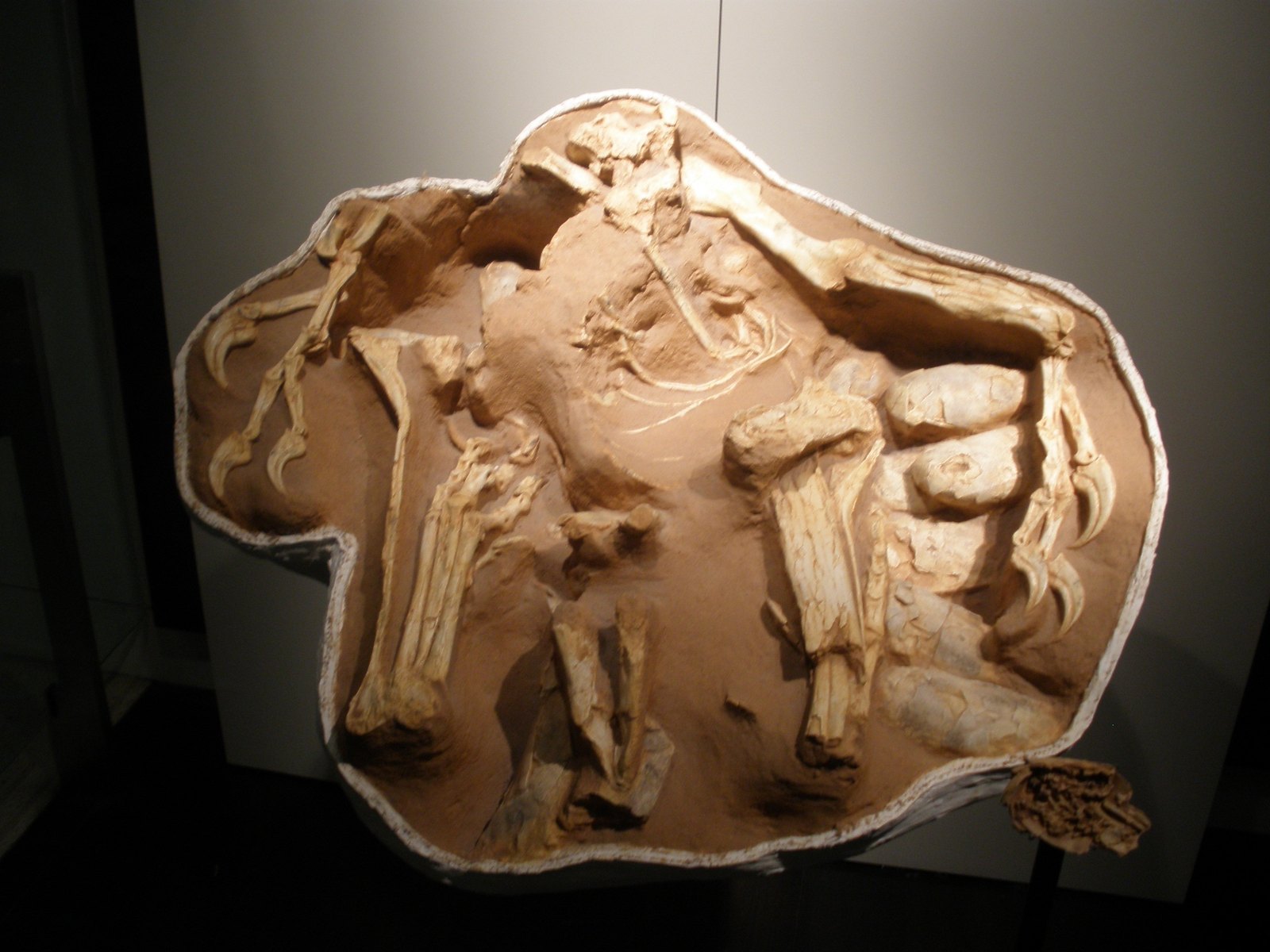
Almost no other animal carries its own accusation in its name. Oviraptor means "egg seizer." The species name, philoceratops, means "fond of ceratopsians" — that is, fond of eating their eggs. It was named that way in 1924, on the strength of one skull found lying above one nest, and the name has never been changed.
The evidence turned out to be pointing at the opposite conclusion.
1923: the skull and the nest
On 13 July 1923, at the locality the American Museum of Natural History's Central Asiatic Expedition called the Flaming Cliffs — Bayn Dzak, in the Mongolian Gobi — George Olsen worked a small, toothless dinosaur skull out of the red sandstone. It was lying directly above a clutch of eggs. Henry Fairfield Osborn, describing it the following year, recorded the separation precisely: the skull was "actually separated from the eggs by only four inches of matrix."
That locality was thick with Protoceratops. Skeletons of it were the most abundant vertebrate material at the site, and eggs of this shape were common there too. So the eggs were filed as Protoceratops eggs. As Clark, Norell and Chiappe put it in 1999, looking back: "Because eggs similar to those in this nest are abundant at Bayn Dzak, and because of the preponderance of skeletal material of Protoceratops andrewsi at this locality, the eggs were identified as belonging to Protoceratops."
Nobody tested that. It was a reasonable inference from what was lying around, and it went into the literature as a fact. Everything that followed rests on it.
1924: the name as a verdict
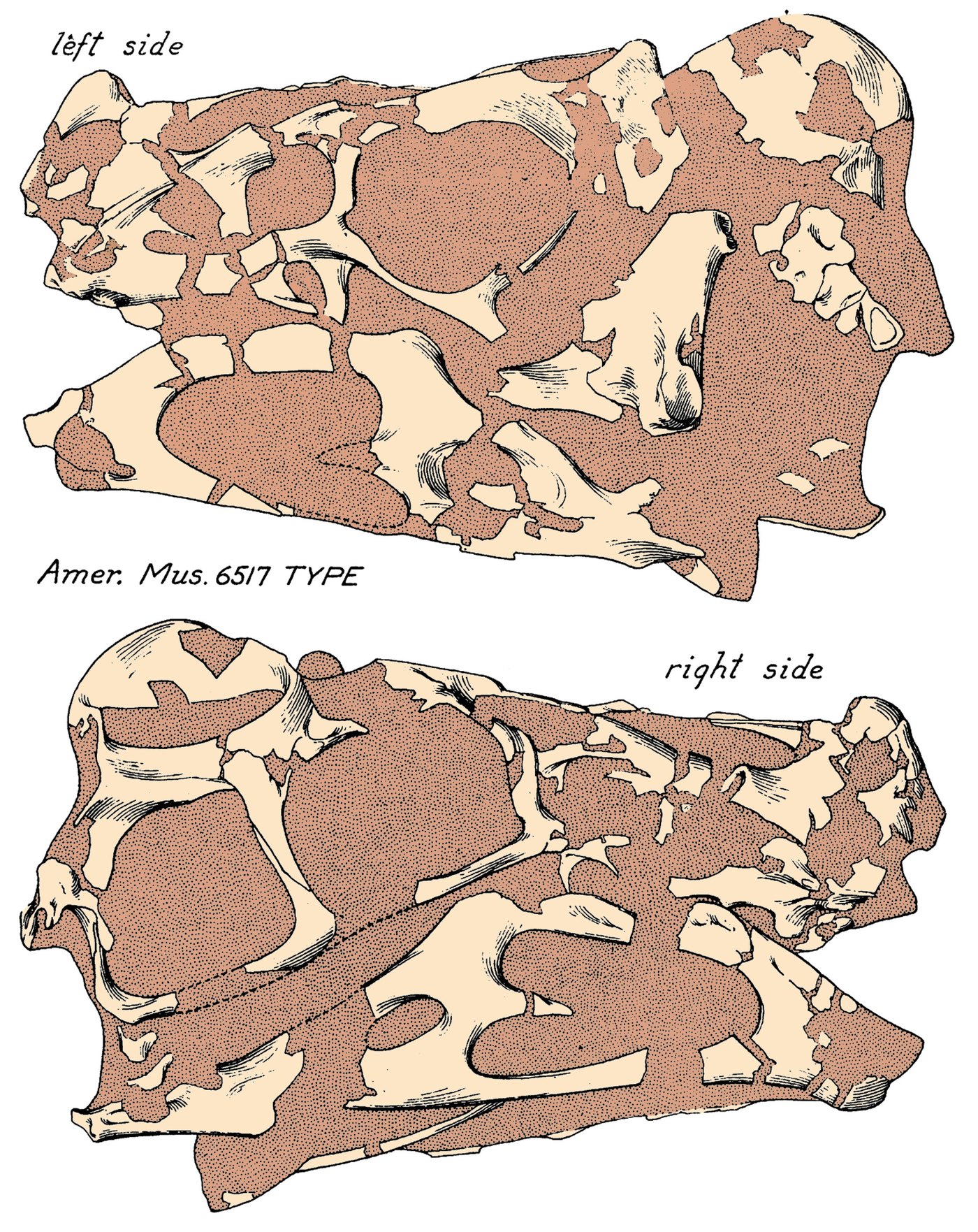
On 7 November 1924, Osborn published the skull in American Museum Novitates 144 as Oviraptor philoceratops. In the section headed HABITS he explained the reasoning in one sentence: the position of the skull over the eggs "immediately put the animal under suspicion of having been overtaken by a sandstorm in the very act of robbing the dinosaur egg nest."
It is worth noticing what that sentence actually contains. There is no bite mark, no broken shell, no gut content, no tooth — the animal is toothless. There is a body lying near some eggs, and a story built to explain why. Clark and colleagues would later note, dryly, that Osborn speculated the animal had died robbing the nest "although there was no evidence to indicate predation."
The part of the paper nobody quotes
Here is what makes this more interesting than a simple case of an old palaeontologist getting it wrong: Osborn flagged the problem himself, in the same paragraph, before anyone else had the chance.
"The generic and specific names of this animal, Oviraptor, signifying the 'egg seizer,' philoceratops, signifying 'fondness for ceratopsian eggs,' may entirely mislead us as to its feeding habits and belie its character."
He wrote that, and then published the names anyway. The caveat was forgotten almost immediately. The accusation was not — it went into museum labels, textbooks and popular books, and stayed there for seventy years.
1994: somebody finally opened an egg
The break came from a different site. Ukhaa Tolgod, discovered in 1993, is another Djadokhta-age locality in the Gobi, extraordinarily rich in exactly the kind of material the Flaming Cliffs had produced in smaller numbers.
In 1994, Norell and colleagues published an egg from Ukhaa Tolgod with an embryo still inside it — an egg of the same type as the ones the Oviraptor holotype had been found above. They identified the embryo from its skull, and their abstract states the result plainly: "Cranial features identify the embryo as a member of Oviraptoridae."
Not Protoceratops. The eggs were an oviraptorid's. Which means the animal at the Flaming Cliffs, lying four inches above a clutch of eggs, was lying above eggs of its own kind — and the 1994 paper says so in its final line: the 1923 discovery "suggests that this dinosaur may have been a brooding adult."
Two dromaeosaurid embryo-sized skulls were also recovered from that nest, which is its own strange story and remains unexplained.
1995: caught in the act of the opposite crime
A year later the same group described a skeleton from Ukhaa Tolgod preserved over a nest of those eggs. It is the specimen at the top of this page, IGM 100/979, and the full description published in 1999 puts the posture beyond argument: the animal lies "over the center of the nest in direct contact with eggs and with its legs folded beneath it and its arms spread around the perimeter of the nest."
That is not an incidental position. It is, in the authors' words, "the same as that commonly taken only by birds among tetrapods that brood their nest." Fifteen eggs are exposed beneath the skeleton, with roughly as many again estimated to remain in the matrix. The nest was undisturbed, meaning the animal died where it sat.
It is worth being precise about which animal this is. IGM 100/979, and the 1994 embryo, are both referred to Citipati osmolskae — a different genus from Oviraptor philoceratops, though also an oviraptorid. So the specimen caught brooding is a close relative of the accused, not the accused itself. What it establishes is that animals of this group sat on their own nests in a bird-like posture, which is exactly what the Flaming Cliffs skull now looks like it was doing.
What this does not settle
Two limits, and the researchers drew both of them themselves.
Sitting on a nest is not the same as incubating it. The 1999 paper is explicit that the posture "does not necessarily imply that they were endothermic and provided heat to the eggs on a regular basis, as birds do through their brooding patch," and goes further: "There is no evidence available to test this hypothesis, and the assumption that the behavior associated with brooding and the act of brooding itself was correlated in oviraptorids is just that — an untestable assumption." Shading, shelter and clutch protection are all live possibilities, and the eggs were partly buried, which complicates contact incubation further. The honest description is that it sat on the nest the way a bird does — not that it was keeping the eggs warm.
And this clears the evidence, not the animal. The diet of Oviraptor philoceratops is genuinely unknown. It was toothless, with a deep, powerfully built beaked skull, and arguments have been made for eggs, shellfish, plants and general omnivory. What collapsed in 1994 was the specific reason anyone believed it ate eggs — the nest it was found on. Nobody has shown it never ate one. Nobody knows what it ate at all.
Why it is still called Oviraptor
Zoological names do not change when they turn out to be misleading. Once a name is validly published it is fixed, whatever it means and however wrong the reasoning behind it was — a rule that exists so the literature stays stable rather than being rewritten every time an interpretation shifts. Basilosaurus is a whale, not a lizard. Oviraptor is an animal that appears to have died on its own nest.
So the name is permanent, and the caveat Osborn attached to it is now the most accurate thing in the original paper.
Why this matters for the fossil record
This is a story about how quietly an assumption can become a fact. The eggs were identified by what else was lying nearby; a name was built on that identification; the name became the animal's reputation. None of the steps were dishonest, and the first person to flag the weak link was the man who named it.
Every specimen in the Fossil Library carries the same kind of chain — an identification, an inference, a date, each traceable to someone who published it. Some of those chains will turn out to have a soft link in them too. That is what a fossil record looks like when it is being worked on rather than recited. As always, every date and figure above traces to a named source — see where every fact comes from.
Sources
Every claim above traces to one of these — sources below.
- Osborn, H.F. (1924), "Three new Theropoda, Protoceratops zone, central Mongolia," American Museum Novitates 144:1–12
- Norell, M.A. et al. (1994), "A theropod dinosaur embryo and the affinities of the Flaming Cliffs dinosaur eggs," Science 266(5186):779–782
- Norell, M.A., Clark, J.M., Chiappe, L.M. & Dashzeveg, D. (1995), "A nesting dinosaur," Nature 378:774–776
- Clark, J.M., Norell, M.A. & Chiappe, L.M. (1999), "An oviraptorid skeleton from the Late Cretaceous of Ukhaa Tolgod, Mongolia, preserved in an avianlike brooding position over an oviraptorid nest," American Museum Novitates 3265:1–36
- Clark, J.M., Norell, M.A. & Rowe, T. (2002), "Cranial anatomy of Citipati osmolskae (Theropoda, Oviraptorosauria), and a reinterpretation of the holotype of Oviraptor philoceratops," American Museum Novitates 3364:1–24
The real record, in your pocket.
PaleoDex catalogues the real fossil record, and every fact in it is sourced. Get the app.
GET IT ON GOOGLE PLAY →