Two Neanderthals, One Cave, 10,000 Years Apart
PALEODEX · 27 July 2026 · 6 min read
One is known from a single toe bone. The other from a fragment too shapeless to identify by eye. Together, they rewrote how different Neanderthals really were from each other.
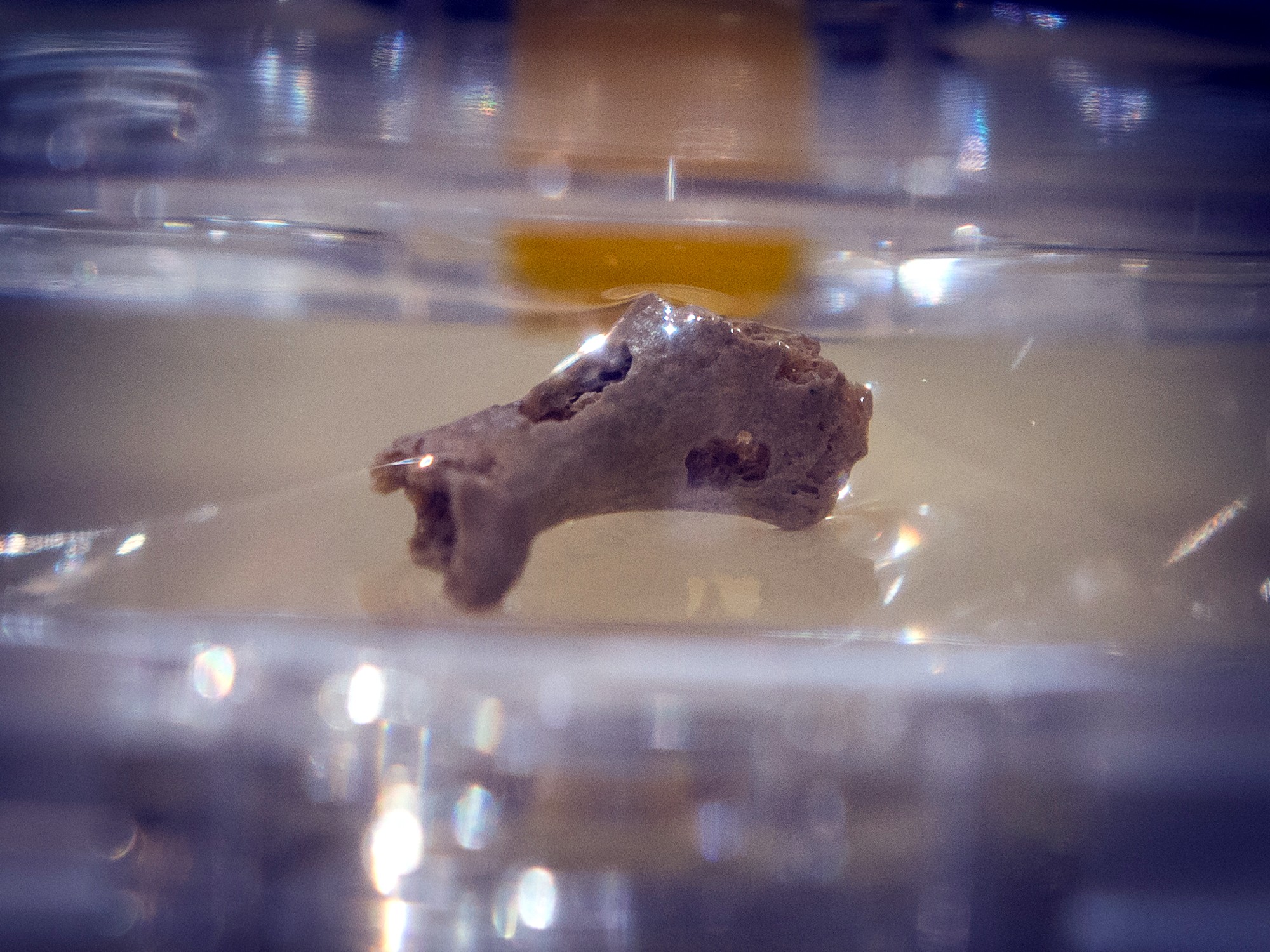
Denisova Cave, in Siberia's Altai Mountains, is already the strangest address in human evolution. It gave us Neanderthals. It gave us an entirely separate group of ancient humans, the Denisovans, found almost nowhere else on Earth. It even gave us a girl who was half of each — a first-generation Neanderthal–Denisovan hybrid. Now a new high-coverage genome adds two more Neanderthals from that same cave, separated by about ten thousand years — and the comparison between them is the real story.
Meet D17: identified before anyone saw it
D17 wasn't a skull, or even a recognizable bone. It was a fragment with no shape a person could identify by eye. Scientists confirmed it was even human by fingerprinting its proteins — a technique called ZooMS — before they had any idea what they'd actually found. Only the DNA inside told them the rest: a man, roughly 110,000 years old, sequenced to about 37-fold coverage, one of the highest-quality Neanderthal genomes ever produced.
Meet Denisova 5: a woman, not a man
The older individual, by about ten thousand years, is Denisova 5 — first described back in 2014, known from a single toe phalanx. She's a woman: the paper describing her opens on exactly that, "a Neanderthal woman from Siberia." Not "two men," as this story sometimes gets told — a man, and ten thousand years before him, a woman.
Two Neanderthals, not one population
Both D17 and Denisova 5 turn out to be Eastern Neanderthals — genetically closer to each other than either is to the well-known Neanderthals of Europe. Both carry real Denisovan DNA folded into their own genome: chromosomal segments too young to be explained by shared ancestry alone, the genetic fingerprint of actual interbreeding. And both are strikingly inbred. D17 has roughly a sixth the heterozygosity of an early modern human, with close to a quarter of his genome sitting in long identical stretches inherited from both sides of his family — the signature of a small, isolated population, generation after generation. Whether that reflects how small Neanderthal groups generally were, or one band pushed into an unusually tight corner, is still an open question.
As different as our most different
Here's the payoff. Compare these Eastern Neanderthals to the Western ones from Europe, and the two groups are as genetically different from each other as the most different human populations alive today — the Mbuti of Central Africa and the Papuan highlanders of New Guinea. That's not a loose comparison; it's measured the same way, with the same statistic (FST): 0.30 between Eastern and Western Neanderthals, against 0.27 between Mbuti and Papuan Highlanders. Not "more different than" any two living humans — the paper's own framing is careful about that, and so is this one.
We're the uniform ones
Neanderthals, it turns out, were never one people. They were scattered, isolated bands, drifting apart from each other for tens of thousands of years across their range. Which flips the story most people carry around: it's us, modern humans, who ended up strangely alike — one comparatively uniform species, spread across an entire planet.
Sources
Every number above traces to a named paper — read them yourself.
- Massilani, D. et al. (2026), "A high-coverage Neandertal genome from the Altai Mountains reveals population structure among Neandertals," PNAS 123(13):e2534576123
- Prüfer, K. et al. (2014), "The complete genome sequence of a Neandertal from the Altai Mountains," Nature 505:43–49
- Slon, V. et al. (2018), "The genome of the offspring of a Neandertal mother and a Denisovan father," Nature 561:113–116
The real record, in your pocket.
PaleoDex catalogues the real fossil record, and every fact in it is sourced. Get the app.
GET IT ON GOOGLE PLAY →