Piltdown Man: The 40-Year Hoax That Fooled Science
PALEODEX · 17 July 2026 · 7 min read
For more than forty years, the most famous fossil in Britain was the "missing link" between apes and humans. It sat in a London museum and in every textbook. And it was a fake — a human skull, glued to the jaw of an orangutan. Here's how the forgery worked, why so many experts believed it, how chemistry finally tore it apart, and why, a century on, nobody can say for certain who did it.
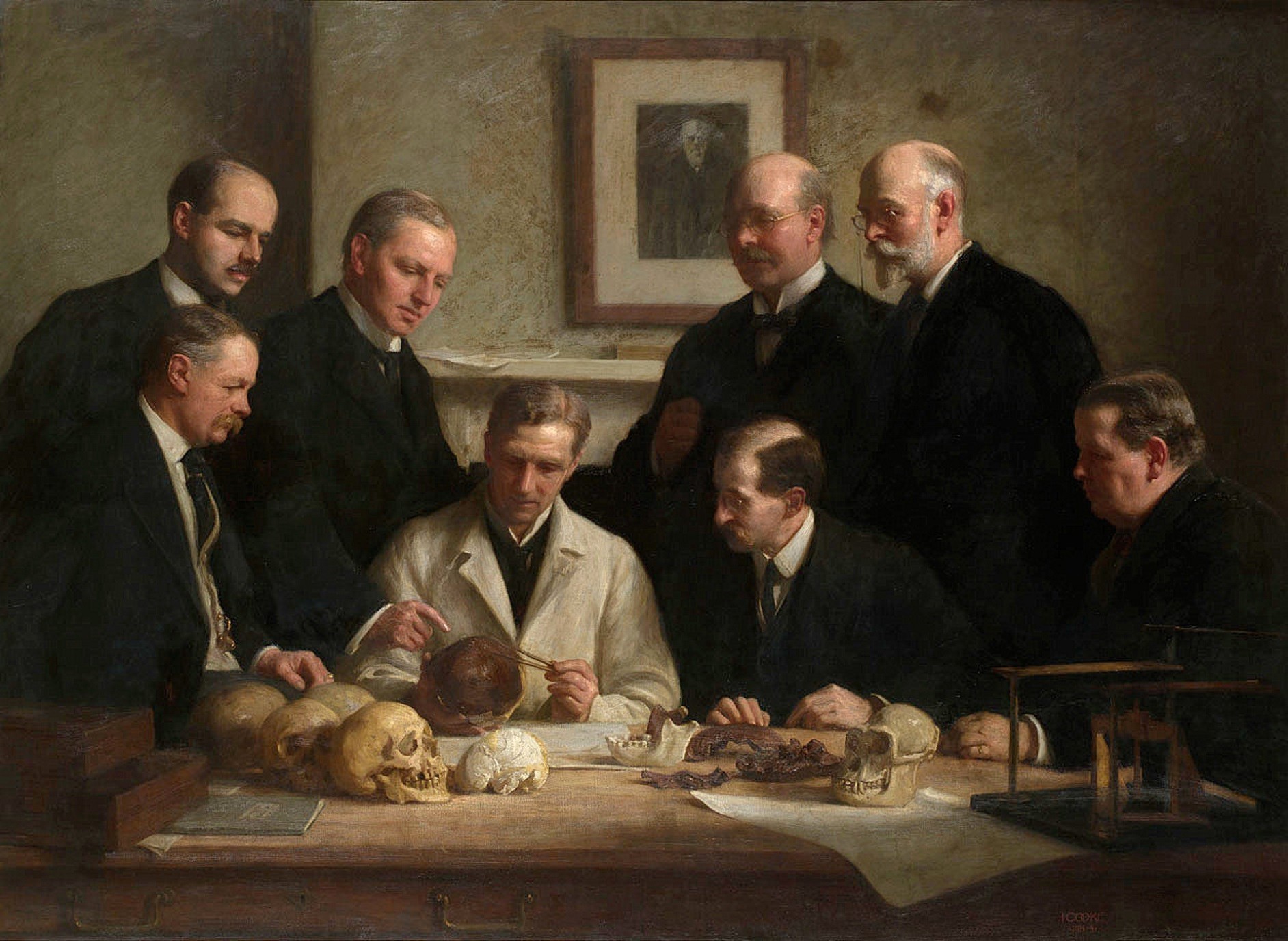
Every field has a story it tells new students as a warning. In human evolution, that story is Piltdown. It is not a tale of a lone crank fooling a couple of amateurs. It is the story of how the most respected anatomists in Britain looked at a crude forgery, saw exactly the ancestor they expected to see, and defended it for four decades.
A gravel pit and an ambitious amateur
It starts in a gravel pit outside Piltdown, a village in East Sussex, England. Charles Dawson was a country solicitor and an amateur fossil hunter with a real hunger to be taken seriously by professional science. Around 1912 he reported that workmen digging the pit had turned up pieces of a strange, unusually thick human skull.
Dawson brought the fragments to Arthur Smith Woodward, keeper of geology at the British Museum (Natural History) and a heavyweight of the field. The two dug the pit together through 1912, and it kept giving: more pieces of skull, a jawbone, isolated teeth, even crude stone tools and fossil animal remains that made the site look convincingly ancient.
"The earliest Englishman"
On 18 December 1912, at a meeting of the Geological Society of London, Dawson and Woodward unveiled their reconstruction. It combined a braincase that looked essentially human with a jaw that looked distinctly ape-like. They named it Eoanthropus dawsoni — literally "Dawson's dawn man." The press called it the missing link, and, crucially, it was British.
Three years later the artist John Cooke painted the scene at the top of this page: a semicircle of the era's most eminent scientists, gathered around the skull like clinicians around a patient, with a portrait of Charles Darwin looking on from the wall. It is a portrait of authority — and of a whole discipline being taken in at once.
Why such a clumsy fake worked
The forgery was not especially sophisticated. So why did it convince the experts? Because it told them exactly what they already believed.
The leading idea about human origins at the time was "brain-first": the assumption that our ancestors evolved big brains early, and that the rest of the body — the jaw, the teeth, upright walking — modernised later. A fossil with a large, human braincase and a primitive ape jaw was that theory made solid. It fit the expectation so neatly that its very implausibility became easy to overlook.
And there was national pride. Germany had its Neanderthals. France had a rich record of skeletons and cave art. Britain, in the middle of an imperial-era race for prehistoric prestige, had comparatively little. Suddenly it had the earliest human ancestor of all, found in an English gravel pit.
The doubters were there from the start
Here is the part the myth usually leaves out: Piltdown was challenged almost immediately. It was not a case of nobody noticing.
As early as 1913, the anatomist David Waterston of King's College London published in Nature his conclusion that the specimen was simply an ape's jaw paired with a human skull. The French palaeontologist Marcellin Boule reached the same verdict, and in 1915 Gerrit Miller of the Smithsonian argued in detail that the jaw and cranium could not belong to the same animal. Others, including Aleš Hrdlička and later Franz Weidenreich, added their doubts.
They were overruled — not by better evidence, but by the authority and confidence of Piltdown's champions. The dissent existed the whole time. It was simply brushed aside. That is what makes Piltdown a cautionary tale rather than a comedy: the science that could have caught it was already on the table, and got ignored.
The real fossils leave Piltdown stranded
What ultimately isolated Piltdown was the rest of the fossil record catching up with it. In 1924, a small skull was found at Taung, in South Africa — the "Taung Child," Australopithecus africanus. It had a tiny brain but strikingly human-like teeth: the exact opposite of Piltdown's pattern.
Over the following decades, more discoveries from Africa and Asia told the same consistent story. Human-like teeth and upright walking came first; the large brain came last. Every genuine fossil pointed one way. Piltdown pointed the other, and fit nowhere on the emerging family tree. For years it sat as an awkward anomaly nobody could place.
1953: chemistry ends it
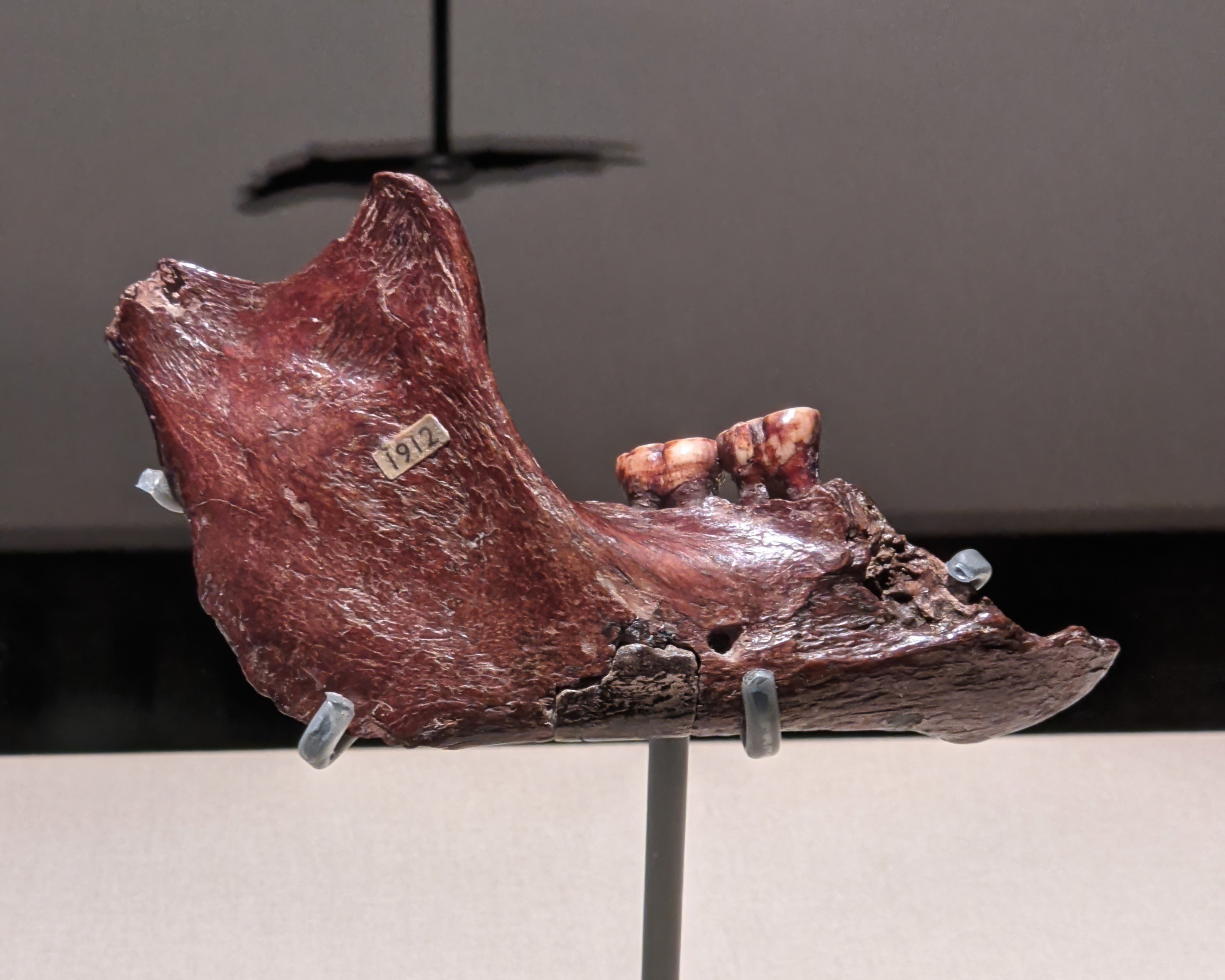
In 1953, three scientists finally took Piltdown apart: Kenneth Oakley, Joseph Weiner and Wilfrid Le Gros Clark. They didn't need a better theory of human origins. They needed chemistry.
Their key tools were fluorine and nitrogen content tests. Bones slowly absorb fluorine from groundwater and lose nitrogen as their protein decays, so both act as rough clocks for how long something has actually lain in the ground. The results were damning: the skull and the jaw had entirely different chemistry. They had never been buried together, let alone belonged to the same individual.
Then they put the teeth under a microscope. There were file marks. Someone had filed down the cusps of an orangutan's molars to flatten them into the shape of human teeth worn by a human diet — and had stained the whole assemblage a rich brown to match the Sussex gravel. The famous fossil was a human cranium and an ape's jaw, deliberately altered, artificially aged, and planted. Their paper, "The Solution of the Piltdown Problem," ended a forty-year embarrassment.
2016: one orangutan, one method
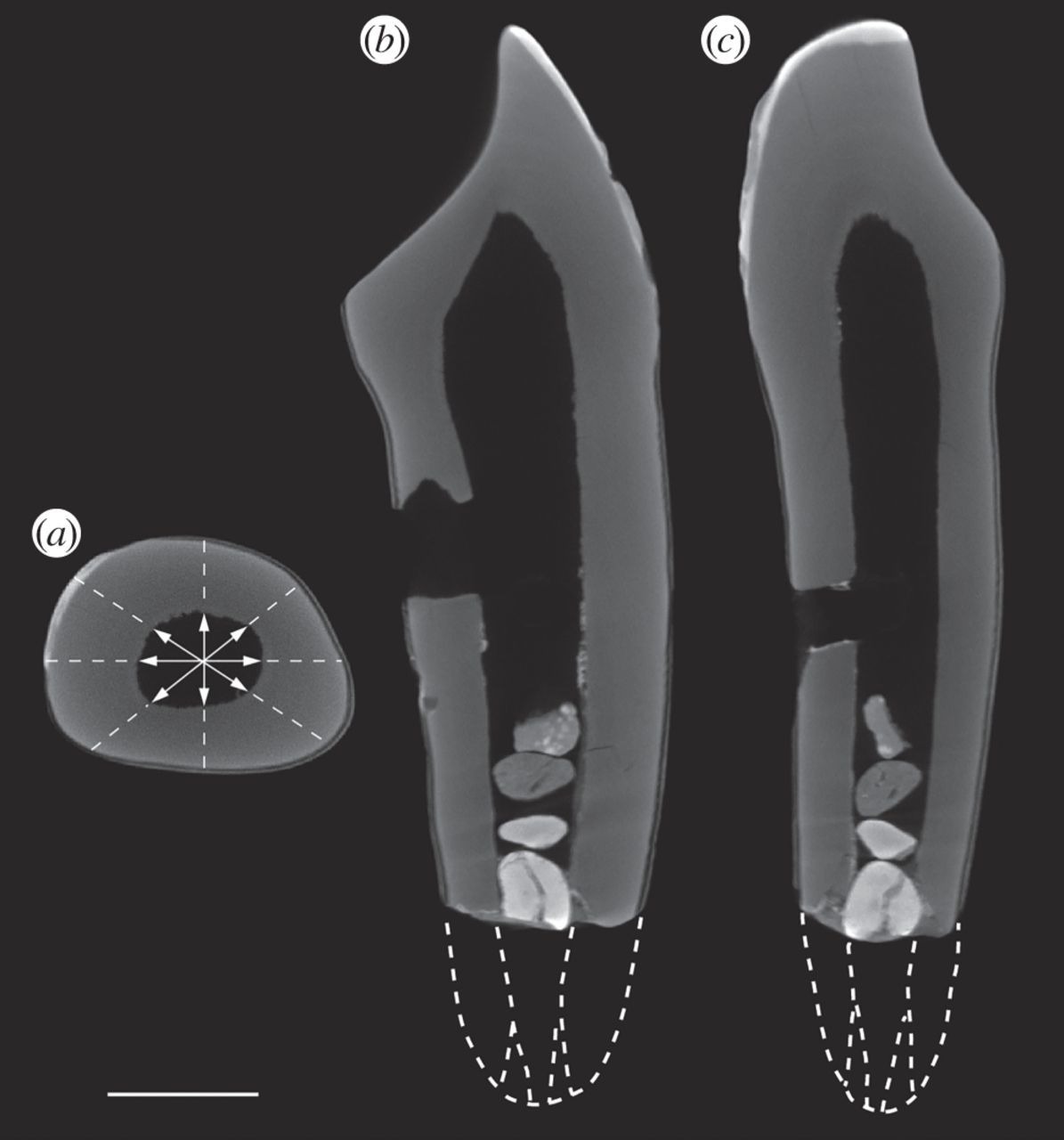
The story got a modern coda in 2016, when a team led by Isabelle De Groote re-examined the material with tools the 1953 team never had: DNA analysis, micro-CT scanning, and three-dimensional shape analysis.
They found that every piece of ape in the entire collection — the jaw, the isolated teeth, even the material from a supposed "second site," Piltdown II — came from a single orangutan, most likely from Borneo. The same putty, rich in zinc, packed the same way. The same reddish stain. The same fabrication method, repeated across every specimen. It was, unmistakably, the consistent handiwork of one forger.
So who did it?
This is where the story refuses to close. The 2016 study concluded that the consistency pointed to a single forger, and that this was "most likely Charles Dawson" — the man present at every discovery, with a documented hunger for scientific recognition. It's the most evidence-based answer we have.
But the same paper is careful to add, in its own words, that "whether Dawson acted alone is uncertain." That caveat matters, and popular retellings tend to drop it. Over the years suspicion has also fallen on the priest and palaeontologist Pierre Teilhard de Chardin, who dug at the site; on the anatomist Sir Arthur Keith; on the museum zoologist Martin Hinton; and even, improbably, on Arthur Conan Doyle, the creator of Sherlock Holmes, who lived nearby. None of these has been proven, and none has been fully ruled out.
So the honest summary is a split verdict. The fraud is completely settled — how it was made, what from, and how it was caught. The identity of the forger is not. Science destroyed the fake conclusively, and never quite closed the case on who made it.
Why this belongs in PaleoDex
Piltdown is the perfect PaleoDex story precisely because it separates the settled from the unsettled. The forgery, the chemistry, the 2016 genetics — those are done, and we say so plainly. The culprit is a genuine open question, so we leave it open, rather than handing you a tidy villain the evidence can't support. That line between "this is proven" and "this is still argued" is the whole point of the record. Read more myth-versus-record deep dives from the record.
Sources
Every fact above is drawn from the primary and authoritative literature:
- Dawson, C. & Woodward, A.S. (1913). "On the discovery of a Palaeolithic human skull and mandible in a flint-bearing gravel…" Quarterly Journal of the Geological Society 69:117–151. (the original announcement)
- Waterston, D. (1913). "The Piltdown mandible." Nature 92:319. (early identification of an ape jaw)
- Weiner, J.S., Oakley, K.P., & Le Gros Clark, W.E. (1953). "The Solution of the Piltdown Problem." Bulletin of the British Museum (Natural History), Geology 2(3):139–146. (the exposure)
- Oakley, K.P. & Hoskins, C.R. (1950). "New Evidence on the Antiquity of Piltdown Man." Nature 165:379–382. (the earlier fluorine study)
- De Groote, I. et al. (2016). "New genetic and morphological evidence suggests a single hoaxer created 'Piltdown man'." Royal Society Open Science 3(8):160328. (doi.org/10.1098/rsos.160328)
- Natural History Museum, London — "Piltdown Man" collection feature and 2016 news release. (nhm.ac.uk)
The real record, in your pocket.
PaleoDex catalogues the real fossil record, and every fact in it is sourced. Get the app.
GET IT ON GOOGLE PLAY →