The Taung Child: The Discovery the Experts Rejected
PALEODEX · 22 July 2026 · 8 min read
In 1925 a young anatomist in South Africa held up the skull of a child and said it was an early ancestor of the human family. The world's leading experts didn't just doubt him. They dismissed the discovery and went on ignoring it for more than twenty years, and it took a rival's fossils and a famous forgery to prove him right.
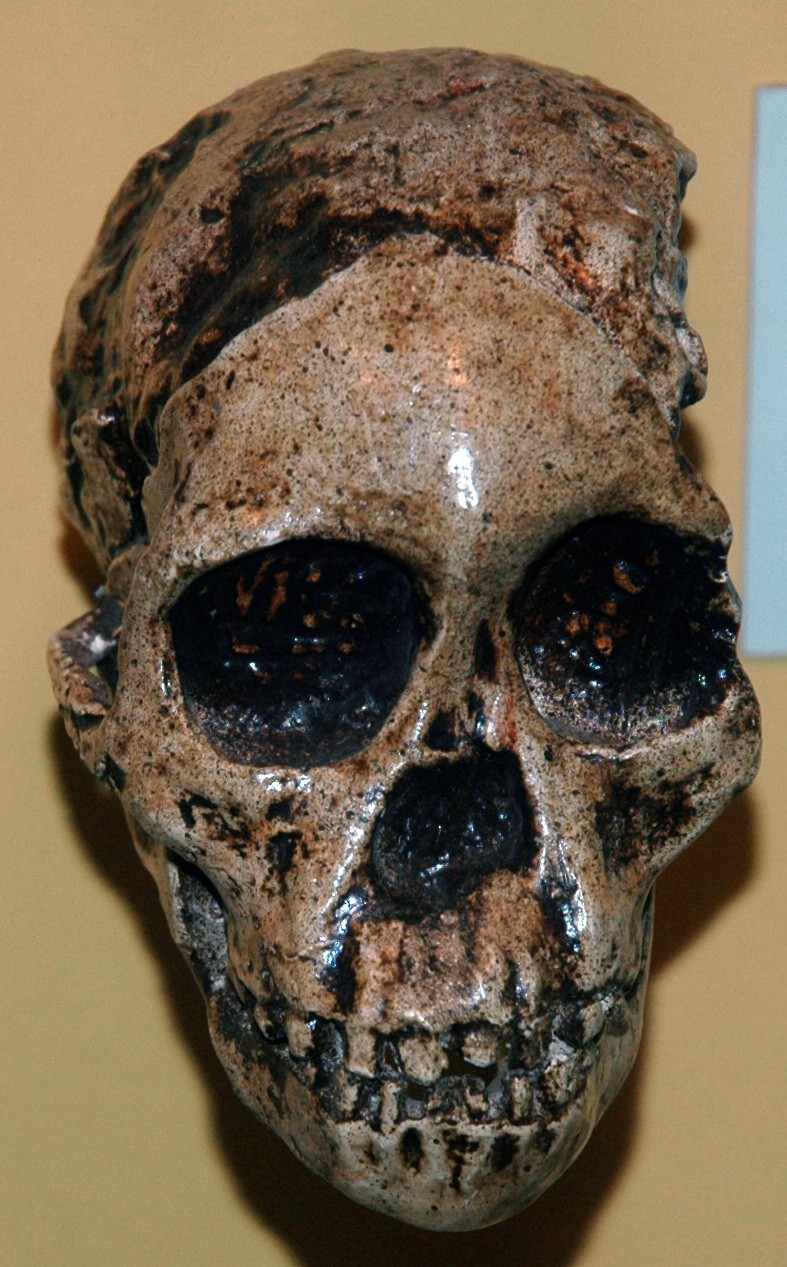
The fossil at the centre of this story is small enough to hold in one hand: the face and braincase of a child who died at about three years old, turned to stone in a South African limestone quarry. It is one of the most important fossils ever found in the study of human origins. And for two decades, the people best equipped to recognise that looked straight at it and turned away.
A brain, turned to stone
It began in 1924, at the Buxton limeworks near the town of Taung. Workers were blasting rock for lime when a fossil turned up in the debris. Through a chain of local contacts it reached Raymond Dart, a young anatomy professor at the University of the Witwatersrand in Johannesburg, packed in a crate of stone.
Inside, Dart found two things that fit together: a natural endocast (a lump of rock that had formed inside the braincase and hardened into the exact shape of a brain) and, in a second block, the face and jaw that belonged in front of it. He spent about 73 days chipping the skull free from the surrounding rock, reportedly with a sharpened knitting needle. What emerged was a child's face looking back at him across millions of years.
An ape's brain, a human's teeth
The details were the argument. The brain was small, no bigger than a chimpanzee's. But the milk teeth were almost human, the eye sockets faced forward, and, crucially, the opening where the spinal cord enters the skull sat underneath rather than toward the back: the arrangement you see in an animal whose head is balanced on top of an upright body, not slung in front of it.
Dart named it Australopithecus africanus, the "southern ape of Africa," and published it in the journal Nature in February 1925. His claim was blunt and, for the time, outrageous: this was a creature between ape and human, and it came from Africa.
The wrong skull, from the wrong continent
That was exactly the problem. In 1925, almost everyone who studied human origins expected the answer to lie in Europe or Asia, and expected a large brain to have evolved first, before an upright body. A small-brained child from Africa was the opposite of what they were looking for on both counts.
Britain's leading anatomists brushed it aside. To many of them it was simply a young ape, an interesting fossil monkey with nothing to do with the human line. Dart's grand claim, they felt, ran far ahead of a single juvenile skull.
Piltdown Man stood in the way
There was also another fossil in the room. For years, England had celebrated its own earliest human: Piltdown Man, "unearthed" from a gravel pit in Sussex. Piltdown had a large braincase and an ape-like jaw: brain first, exactly as the theory predicted, and conveniently European. Beside that, the Taung Child looked wrong. Piltdown didn't create the resistance to Dart on its own, but it gave the sceptics a model to point to: a "proper" ancestor that made Taung look like an outlier.
Robert Broom found the adults
Dart had one determined ally: the veteran paleontologist Robert Broom. Over the following two decades Broom went looking, and from the cave deposits at Sterkfontein and Kromdraai he pulled out adults of the same kind of creature, including the famous skull nicknamed "Mrs Ples". A single odd juvenile is easy to wave away. A series of grown australopiths, from more than one site, is not.
The tide turned in 1947. The eminent British anatomist Wilfrid Le Gros Clark travelled to South Africa, examined the fossils first-hand, and declared that Dart had been right all along. That same year, even Arthur Keith, who had led the doubters, publicly admitted he had been wrong.
And Piltdown was a fake
Then came the twist that removed the last obstacle. In 1953, Piltdown Man was exposed as a deliberate forgery: a human skull married to the jaw of an orangutan, filed to fit and chemically stained to look ancient. The "ancestor" that had helped make the Taung Child look wrong had never been real at all. (If you want the full story of that hoax, we told it in Piltdown Man: The 40-Year Hoax.)
The little skull that was right
Raymond Dart read the Taung Child correctly in 1925, decades before the consensus caught up: humankind's deep roots are in Africa. The idea that our lineage began there, now overwhelmingly supported by fossils and genetics, was in the 1920s the claim of one young anatomist that the establishment would not hear. The Taung Child still sits at the University of the Witwatersrand, the small skull the experts rejected and the one that turned out to be right.
Sources
Every fact above is drawn from primary and institutional sources:
- Dart, R. A. (1925). "Australopithecus africanus: The Man-Ape of South Africa." Nature 115:195–199. doi:10.1038/115195a0 (nature.com)
- Weiner, J. S., Oakley, K. P. & Le Gros Clark, W. E. (1953). "The solution of the Piltdown problem." Bulletin of the British Museum (Natural History), Geology 2(3). (biodiversitylibrary.org)
- Wikipedia, "Taung Child" (discovery, the 73-day preparation, cranial capacity, current repository at Wits). (en.wikipedia.org)
- National Geographic, "Why the 'missing link' fossil was almost missed" (the quarry, the crate, and the reception of Dart's claim). (nationalgeographic.com)
- South African History Online, "Raymond Arthur Dart" (the Johannesburg years and the preparation of the skull). (sahistory.org.za)
- Wikipedia, "Robert Broom" and "Mrs Ples" (the Sterkfontein and Kromdraai adults). (en.wikipedia.org)
- Wikipedia, "Piltdown Man" (the forgery: human cranium, orangutan jaw, staining; exposed 1953). (en.wikipedia.org)
The real record, in your pocket.
PaleoDex catalogues the real fossil record: sourced, and honest about what is still disputed. Get the app.
GET IT ON GOOGLE PLAY →