The Last Thylacine Died in 1936, and Then the Museum Lost the Body
PALEODEX · 10 August 2026 · 7 min read
It was never stolen and never thrown out. It was in the building the whole time — going out to schools, in a box, with no label on it.
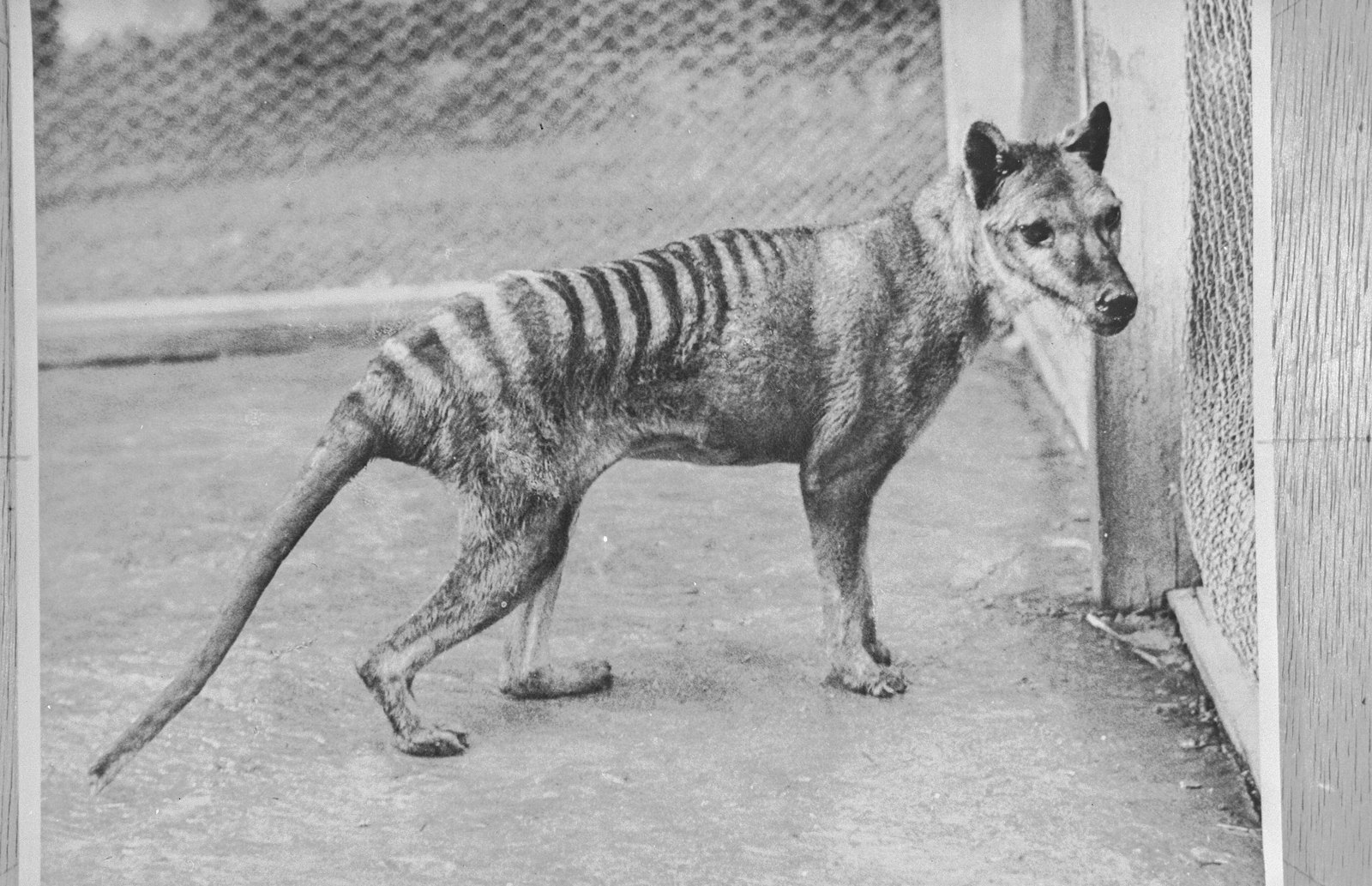
On the night of Monday 7 September 1936, at a zoo on Hobart's Queen's Domain, the last thylacine anyone had alive in captivity died. Its body was sent to the Tasmanian Museum and Art Gallery. And then, for eighty-six years, nobody could say which specimen it was.
That sentence sounds like negligence, and it isn't quite. The museum had the animal the whole time. The failure was subtler, and stranger, than losing something.
Fifty-nine days of legal protection
On 10 July 1936, the Tasmanian government — acting on the advice of its fauna board — declared the thylacine wholly protected. It is worth being precise about this, because it is usually reported loosely: this was a government declaration under existing law, not an act of parliament.
The animal died fifty-nine days later.
Behind that number sits a longer one. Tasmania had spent roughly the previous century paying a bounty to have thylacines killed, a programme running from the 1830s. The protection did not arrive late in the sense of being a near miss. It arrived after the outcome was already fixed.
How you lose a body you are holding
In 2023, Robert Paddle and Kathryn Medlock published the answer in Australian Zoologist. Their account of the failure is the interesting part: the search failed because it was aimed at the wrong specimen. Generations of researchers had been looking for the much-photographed, much-filmed animal — the one everybody pictures when they picture a thylacine — and on Paddle and Medlock's reading, that animal was the penultimate one, not the last.
The remains that were in the collection had come in without the paperwork that would have marked them out. They were catalogued as an unremarkable specimen, and then used as one.
Which animal was it? Still unsettled
This is the part most retellings flatten, and it should not be flattened. Two papers, in the same journal, in the same year, reach opposite conclusions.
THE DISAGREEMENT
| Paddle & Medlock (2023) | An aged adult female, caught in a snare by a trapper and sold to the zoo in May 1936. Ground-based snaring was illegal, which is why the purchase was never entered in the register — and why the arrival left no trace. |
| Linnard & Sleightholme (2023) | Reviewing five competing provenances that had been proposed over ninety years, they conclude the opposite: a juvenile male taken at Penney's Flats on the Arthur River in July 1930 — and that the famous footage does show the last one. |
| What they agree on | The date of death: the evening of Monday 7 September 1936, at the Beaumaris Zoo. Very little else. |
Note what that disagreement reaches. It is not a quarrel over a specimen number. It decides whether the most famous piece of wildlife footage in Australian history — a thylacine pacing a concrete yard, filmed by David Fleay in 1933 — shows the last one or the second-to-last one. There is no consensus, and this article is not going to invent one.
The cupboard, and the handling kit
What finally ended the search was paperwork: an unpublished report by the museum's own taxidermist, written across 1936 and 1937. It told two researchers what to look for, and the remains turned out to be in a cupboard in the museum's education department.
A skin, and a skeleton. Eighty-six years after the animal died, they were photographed for the first time.
And here is the detail that tends to stay with people. The skin and skeleton had not been sitting untouched in the dark. They had spent decades going out to schools, as part of a handling collection — the sort of material a museum educator carries into a classroom and passes around. There was no label saying what they were. Children were allowed to touch them.
On parts of the pelt, the fur is still flattened where their hands went.
Why this is a record problem, not just a sad story
It is tempting to file this under tragedy and move on. The more useful reading is that it is a documentation failure with a documentation cause. An animal arrived without a record because the transaction that produced it was illegal. The absence of that one line of paperwork outlasted the species itself, and cost most of a century.
That is the same reason we are stubborn about provenance in how PaleoDex handles its data: an entry with a source is a fact, and an entry without one is a shape that looks like a fact. The thylacine spent eighty-six years as the second thing while sitting in a drawer as the first.
If you want the wider version of the problem — why the record is patchy at all, and why absence of evidence is so often just absence — we wrote about why fossils are not everywhere. And for a case where the record was read exactly backwards for decades, there is Oviraptor.
Sources
Both 2023 papers are in Australian Zoologist and they disagree; both are listed.
- Paddle, R.N. & Medlock, K.M. (2023) "The discovery of the remains of the last Tasmanian tiger (Thylacinus cynocephalus)", Australian Zoologist 43(1): 97–108. doi:10.7882/az.2023.017
- Linnard, G. & Sleightholme, S.R. (2023) "An exploration of the evidence surrounding the identity of the last captive Thylacine", Australian Zoologist 43(2): 287–338. doi:10.7882/az.2023.034
- Sleightholme, S.R. (2011) "Confirmation of the gender of the last captive Thylacine", Australian Zoologist 35(4): 953–956. doi:10.7882/az.2011.047
- TMAG's 'lost' last Tasmanian tiger remains — Council of Australasian Museum Directors
- Extinction of thylacine — National Museum of Australia
The real record, in your pocket.
PaleoDex catalogues the real fossil record, and every fact in it is sourced. Get the app.
GET IT ON GOOGLE PLAY →