If Dinosaurs Were Everywhere, Where Are All the Bones?
PALEODEX · 3 August 2026 · 7 min read
165 million years of dinosaurs, and nobody trips over a femur in the garden. The answer is not that we haven't looked hard enough.
It is the most-argued question in paleontology comment sections, and it deserves a straight answer. Dinosaurs held this planet for more than 160 million years. Every single one of them died somewhere. So why does nobody turn over their garden and hit a femur?
The intuition behind the question is reasonable. Dinosaur bone is not subtle — a sauropod thigh bone stands like a fence post. If the ground were genuinely full of them, we would not need palaeontologists to go and find them. And yet new genera are still described at a steady clip, which tells you the record is thin.
Here is what the question is missing. Becoming a fossil is not the default fate of a body. It is the rare exception, and we know roughly how rare because somebody went out and measured it.
Somebody actually timed it
In the 1970s the palaeobiologist Anna K. Behrensmeyer worked in the Amboseli Basin in southern Kenya, where large animals die in the open and stay there. What made the site scientifically valuable was not the bones themselves but the paperwork: she could find carcasses whose date of death was already on record. Thirty-five of them, in fact, with the dates supplied by the ecologist David Western.
That turns a vague process into a clock. Behrensmeyer returned over successive years and recorded what open air does to a skeleton of known age, and in 1978 she published the result in Paleobiology.
Six stages, and a clock
Bone left lying on the surface does not simply sit there waiting to be buried. It goes through a sequence that Behrensmeyer sorted into six descriptive stages. First it cracks, along the grain of its own fibre structure. Then the outermost concentric layers begin to flake away. Then the surface turns rough and fibrous as the outer bone is lost altogether. Then it splinters, with cracks opening and fragments loose enough to fall away when the bone is moved. In her own words, at the last stage the bone is "falling apart in situ" — shedding pieces around whatever is left of the original shape.
Her headline finding: most bones there decompose beyond recognition in 10 to 15 years.
That figure deserves its fine print, because it is easy to over-read. It describes bone lying exposed on the ground surface in the Amboseli Basin — a specific tropical, semi-arid setting. It is not a global decay rate. Behrensmeyer also noted that the driver is not simply sunlight: bones projecting more than 10 cm above the ground were often less weathered than those lying against it, which points at the daily swing of temperature and moisture at the soil surface as the real engine. Buried bone, she found, frequently showed no weathering at all even when the exposed parts of the same skeleton had reached the worst stages.
That last observation is the whole story in miniature.
What has to happen instead
If bone on the surface is on a clock measured in years, then anything that survives to become a fossil had to be buried fast enough to beat it. That is the entire filter. It is not about how tough the animal was, how big it was, or how many of them there were — it is about whether sediment arrived in time.
And that does not happen in most places on most days. It takes a specific kind of accident: a flood, a collapsing dune, an ash fall, a storm surge. The fossil record is a record of accidents, not a record of life.
Forty years near Trieste
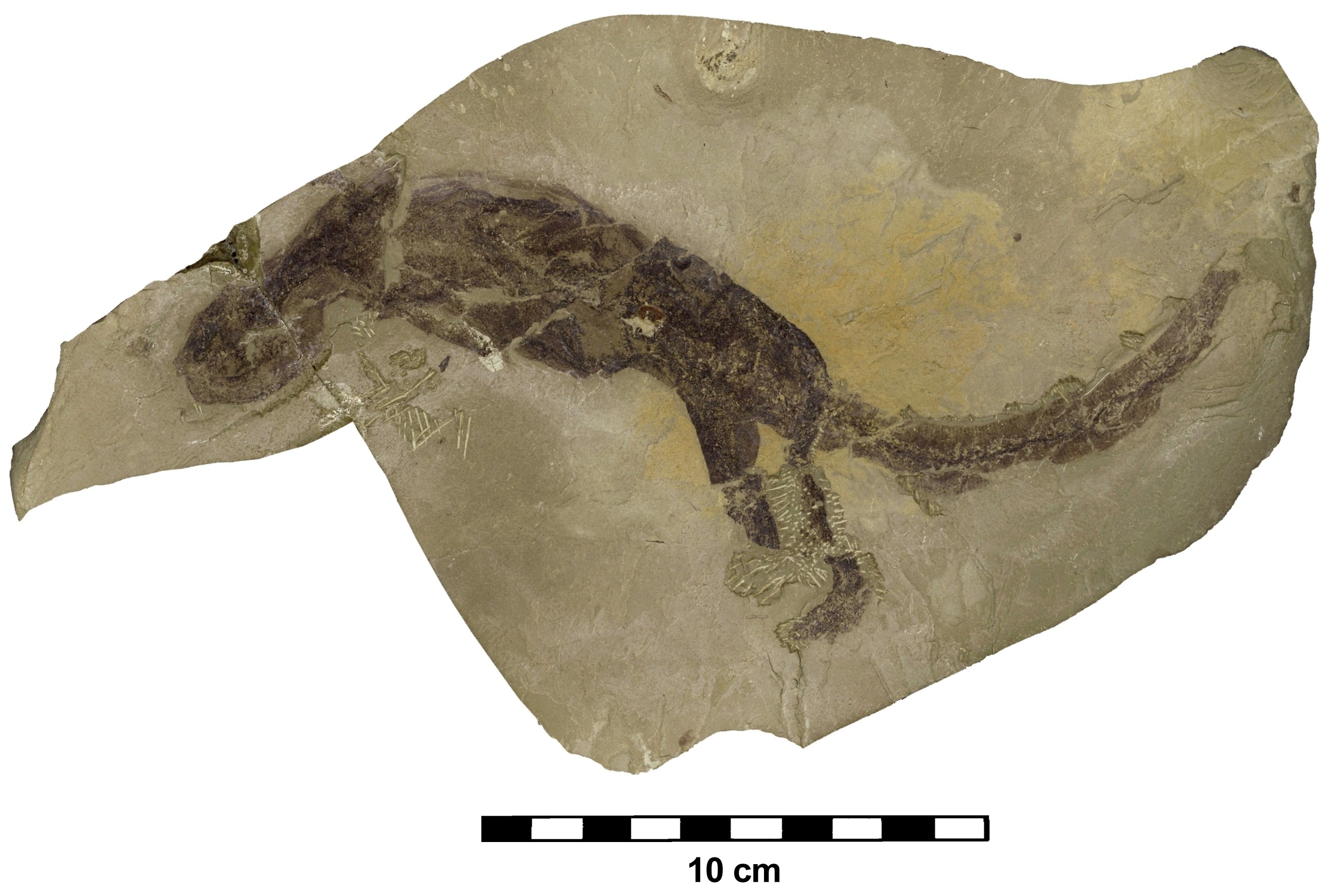
In 2026 a team led by Federico Fanti published a result that makes the filter uncomfortably concrete. Their subject was the Villaggio del Pescatore site near Trieste in north-eastern Italy — a Konservat-Lagerstätte, one of those rare deposits that preserves exceptional detail, and the source of two remarkably complete dinosaur skeletons nicknamed Antonio and Bruno. Both belong to the hadrosauroid Tethyshadros insularis; Antonio is the specimen SC 57021, Bruno the larger SC 57247.
About 80 million years ago that spot was a tropical tidal flat on the edge of a shallow sea, and it was being hammered by monsoon rains and tropical cyclones. Monsoon-driven floods and cyclone surges pushed pulses of sediment, plant debris and animal carcasses out onto the flat. The tides trapped the material, and mats of microbes moved in and stabilised it before it could disperse.
The striking part is the timing. Because the deposit is a tidal rhythmite — layered by the tides themselves — the team could count those laminae and date the accumulation directly. The entire fossil-bearing pile built up in about 40 years. A single human lifetime, as one of the co-authors put it, frozen in stone.
A world-class dinosaur site is not a slow, patient record of deep time. It is four decades of freak weather.
A handful of still frames
Once you see the filter, the shape of the record makes sense. It is not a continuous film of the past with some frames missing. It is a handful of still frames, taken at wildly uneven intervals, with almost everything between them simply gone.
There is a number for how much. In 2006 Steve Wang and Peter Dodson estimated total non-avian dinosaur diversity at roughly 1,850 genera, against the 527 described at the time — which puts at least 71% of dinosaur genera in the "never found" column. Treat that as the best published estimate rather than a fact about the world: it is a statistical model, and later work using different methods lands on different totals. What is not in dispute is the direction. Most of it is missing, and most of it always will be.
Which is a strange thing to find cheering, but it is. Every mounted skeleton you have ever stood underneath is an accident that went right — a body that happened to fall somewhere sediment was arriving fast enough, in a world where that almost never happened. The next time you walk through a museum hall, that is what is on the plinths: not a representative sample of the past, but the survivors of a filter almost nothing survives.
If you want to see how uneven the record is across the map and across time, our Fossil Dex catalogues real specimens with their localities and ages, and Continental Drift puts them back on the world as it was when they were buried. For a site that shows this filter working at its most extreme, see our piece on Tanis and the day the dinosaurs died. Where our data comes from is set out in About the Data.
Sources
- Behrensmeyer, A.K. (1978). "Taphonomic and ecologic information from bone weathering." Paleobiology 4(2):150–162. doi:10.1017/S0094837300005820
- Fanti, F. et al. (2026). "Climate-extreme-driven genesis of a Cretaceous dinosaur Lagerstätte." Global and Planetary Change 265:105589. doi:10.1016/j.gloplacha.2026.105589
- Chiarenza, A.A. et al. (2021). "An Italian dinosaur Lagerstätte reveals the tempo and mode of hadrosauriform body size evolution." Scientific Reports 11:23295. doi:10.1038/s41598-021-02490-x
- Wang, S.C. & Dodson, P. (2006). "Estimating the diversity of dinosaurs." PNAS 103(37):13601–13605. doi:10.1073/pnas.0606028103
The real record, in your pocket.
PaleoDex catalogues the real fossil record, and every fact in it is sourced. Get the app.
GET IT ON GOOGLE PLAY →