The Fighting Dinosaurs: What the 1971 Block Actually Shows
PALEODEX · 19 September 2026 · 7 min read
Two animals, one block of Gobi sandstone, and an argument that is still open. What the block records is clear. How it came to be buried is not.
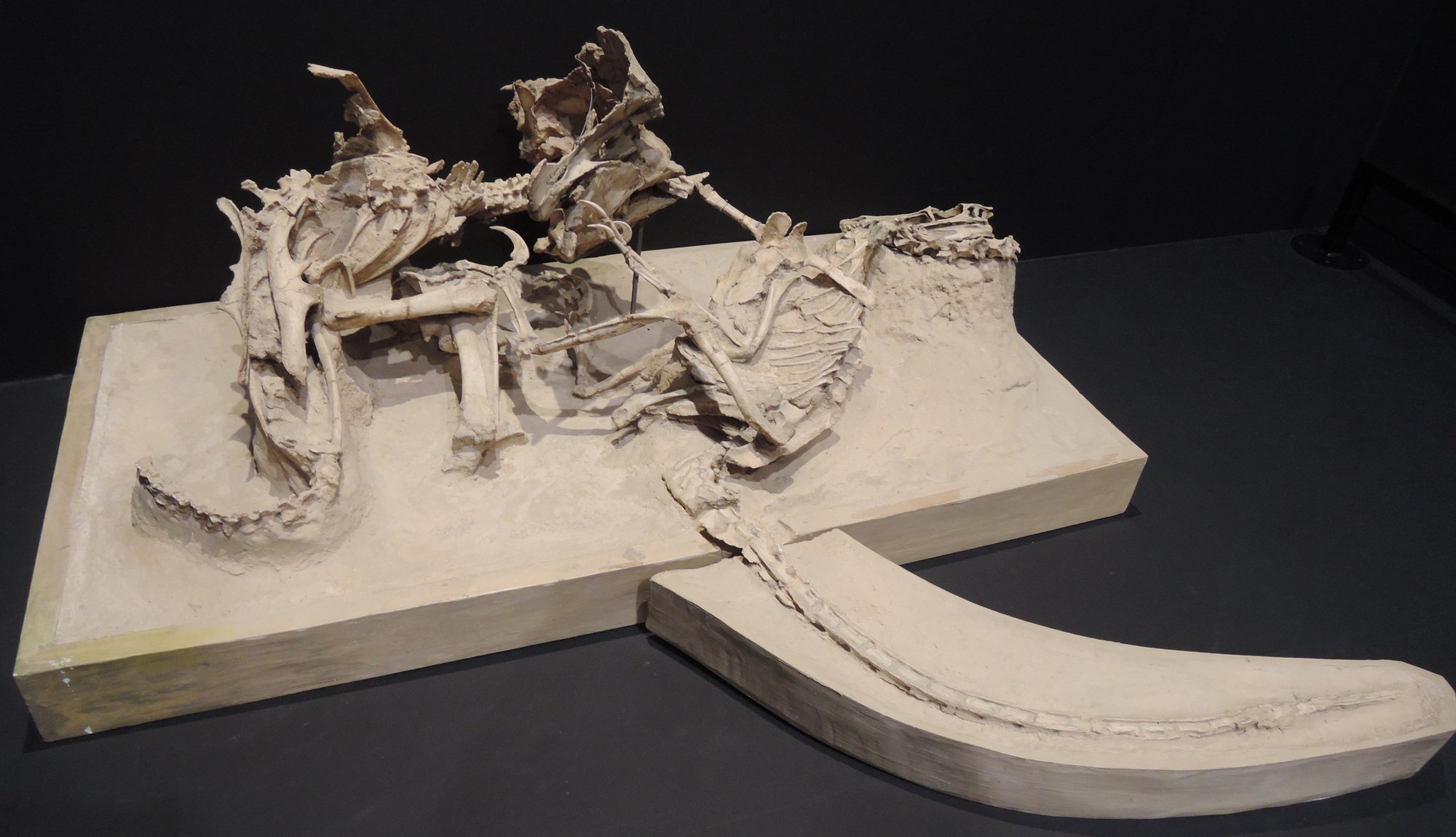
In 1971 a joint Polish and Mongolian expedition dug two dinosaurs out of the Gobi Desert in Mongolia and found them still holding onto each other. They are catalogued as MPC-D 100/25, a Velociraptor mongoliensis, and MPC-D 100/512, a Protoceratops andrewsi, and they are usually just called the Fighting Dinosaurs. Bones record anatomy easily. Behaviour they almost never record at all, which is why this one block has been argued over for more than fifty years.
It began with fragments lying on the surface
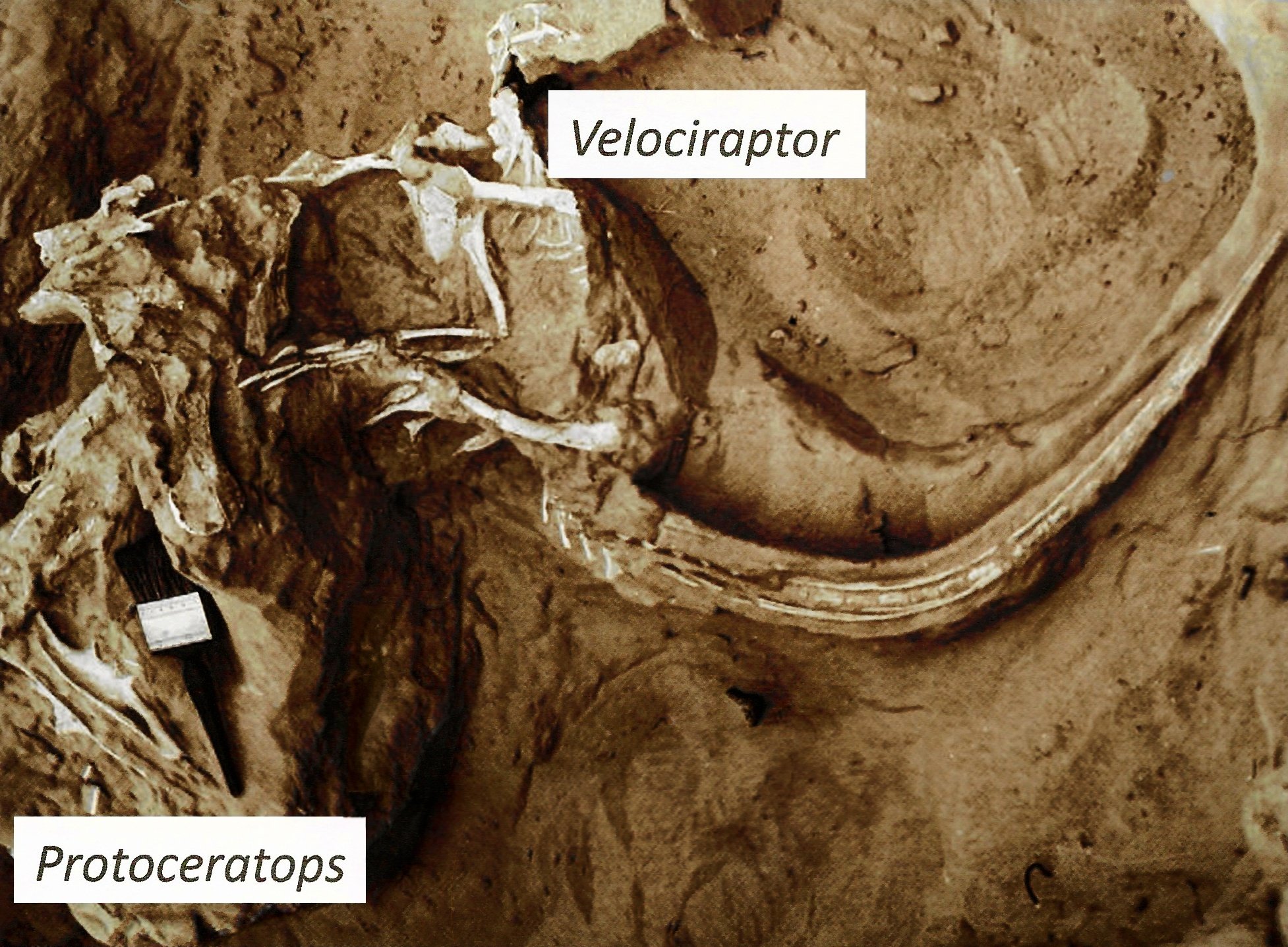
Nothing about the find was subtle detective work underground. As Kenneth Carpenter put it in his 1998 review of predatory behaviour in dinosaurs, "it was Protoceratops skull fragments on the ground surface that led to the discovery of the specimens". The expedition was working at Toogreeg, also written Tugrikin Shireh, some 30 km west of the Bayn Dzak cliffs, and it dug down from those fragments to two skeletons preserved together.
The expedition wrote up its own seasons the following year. Zofia Kielan-Jaworowska and Rinchen Barsbold record the 1971 party collecting "the skeleton of a Velociraptor mongoliensis preserved together with the skeleton of Protoceratops andrewsi", and the caption to one of their plates describes the pair, plainly, as "preserved in a fighting position".
What the block records
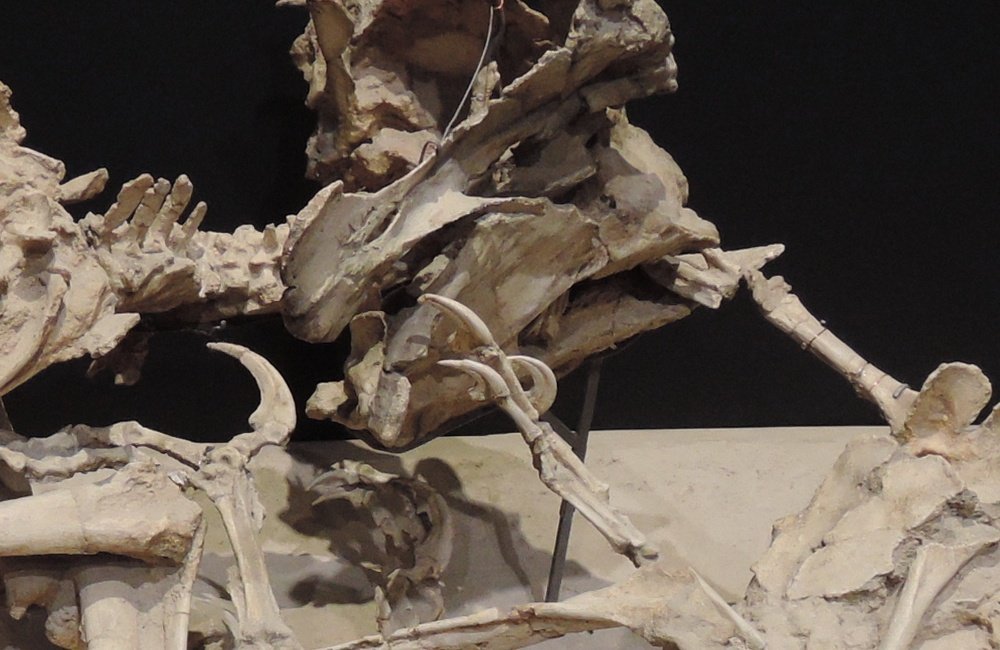
Carpenter went through the contact bone by bone. A raptor hand rests on the Protoceratops face, just in front of the horn on its cheek bone. The large sickle-like claw of one foot lies "in what appears to have originally been the throat of Protoceratops". And the upper part of the raptor's forearm, just past the elbow, "is clenched in the beak of the Protoceratops", a plant-eater with a horny beak at the front of its jaws.
That last detail is the one that makes the specimen strange. It is not a predator on top of a carcass. Both animals have hold of each other, and the plant-eater is holding on with the part of its body that it ate with.
The 1971 expedition had already drawn the obvious conclusion. Their report says the two skeletons "were preserved in association" and that "their preservation in association is not accidental and ... they possibly died during the fight".
What is not there
The Protoceratops is not a complete skeleton. Both shoulder girdles are present, though displaced, but both forelimbs, one hind limb and the end of the tail are missing. That absence sounds like housekeeping and is actually the hinge of the whole argument, because any explanation of how these two animals were buried also has to explain where those bones went.
When did the sand arrive?
The rock around them is wind-blown dune sand. The Djadokhta Formation is a fossil dunefield in the Ulan Nur Basin, estimated at roughly 75 to 71 million years old, and Carpenter notes there is "little doubt about the eolian nature of the Djadokhta sands". An older reading of the setting as a swamp or lake bottom does not fit those sediments.
Agreement ends there. One reading has a bank of sand collapsing on the two animals while they were still struggling. Another has them buried alive by a sandstorm. Carpenter rejects both, and the third fast-burial variant with them, on the grounds that they "fail to explain the missing limbs of the Protoceratops", and argues the sequence ran the other way: the Protoceratops bled out; its body pinned the raptor, which eventually died and dried out; scavengers removed the missing limbs; and only then did drifting sand cover what was left.
So the fight, in his reading, is real, and the burial is late. In the other readings the burial is the thing that stopped the fight. The block is compatible with both, and that is why the question is still open.
Was it a fight at all?
That has been asked in print too. In 1993 Halszka Osmólska published two pages in Revue de Paléobiologie under the title "Were the Mongolian 'Fighting Dinosaurs' really fighting?". We have not read those two pages, which are not available online, so we will not tell you what she concluded. What we can tell you is that the question was being put by a palaeontologist who worked on this material, two decades after the specimen came out of the ground.
As close as the record gets
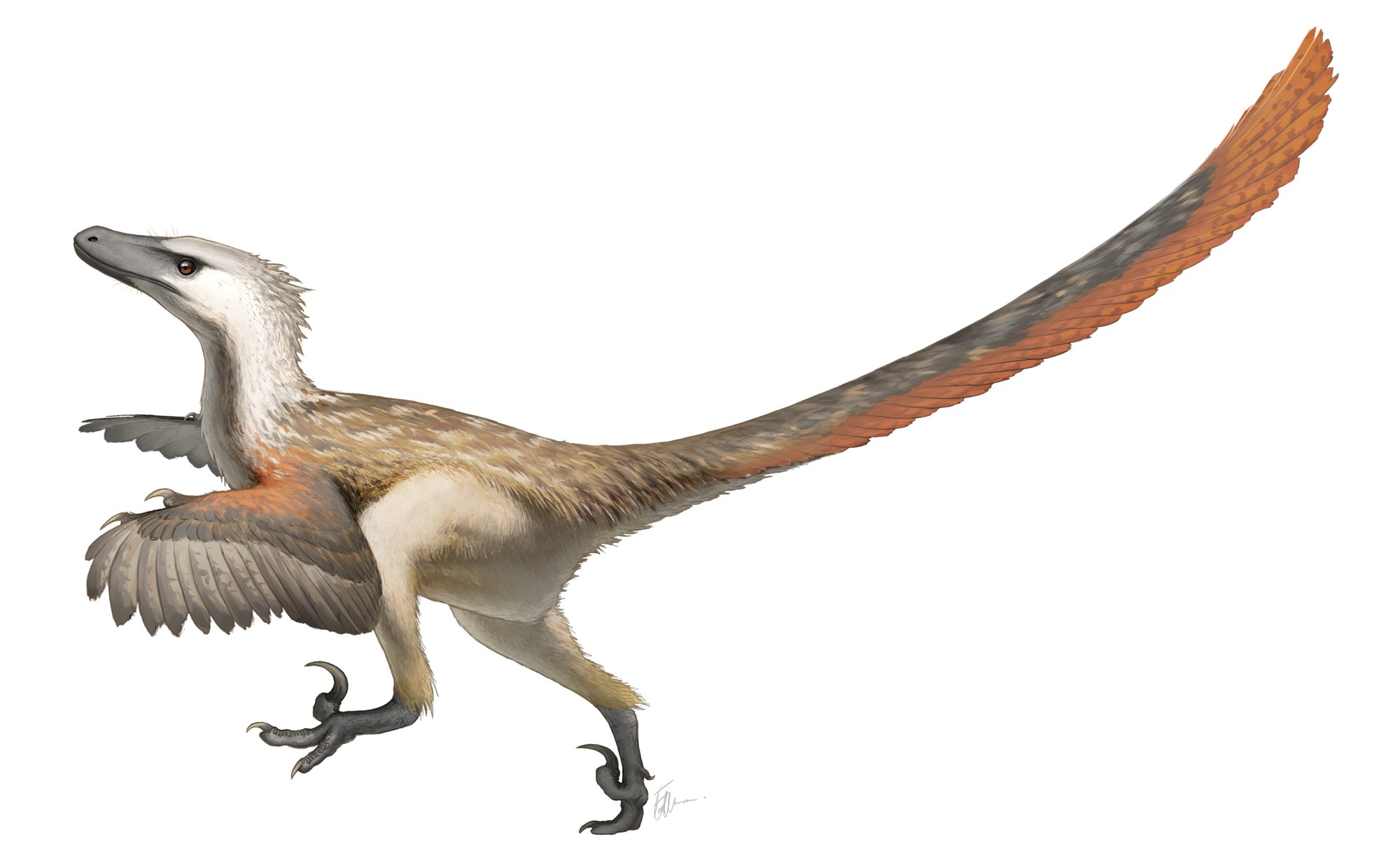
No one has ever seen a Velociraptor move. Every restoration of one is an interpretation, and every claim about how it hunted is an inference from anatomy. Except here. Whichever burial reading turns out to be right, the positions in the rock are real, and Carpenter calls this specimen the best evidence there is for what the sickle claw was actually used for.
That is the whole reason this block matters to us. It is the rare case where the fossil record preserves two animals doing something, rather than simply being shaped a certain way. We have written before about a specimen whose behaviour was read wrong for seventy years and about injuries that record what dinosaurs did to each other. The wider catalogue lives in the Fossil Dex, and how we handle sourcing is set out in about the data.
Sources
Every claim above traces to the sources below. Where we relied on someone else's reading of a source, we say so.
- Carpenter, K. (1998). "Evidence of predatory behavior by carnivorous dinosaurs." Gaia 15: 135–144. Read in full as a PDF from the Gaia archive of the Museu Nacional de História Natural e da Ciência, Lisbon. Source for the grip, the missing limbs, the burial sequence, the eolian sediments, the quotations from the fast-burial readings, and the assessment of the sickle-claw evidence.
- Kielan-Jaworowska, Z. & Barsbold, R. (1972). "Narrative of the Polish-Mongolian Palaeontological Expeditions 1967–1971." Palaeontologia Polonica 27: 5–13, plates I–II. Journal archive. Source for the 1971 season, the locality and the expedition's own conclusion.
- Osmólska, H. (1993). "Were the Mongolian 'Fighting Dinosaurs' really fighting?" Revue de Paléobiologie, vol. spéc. 7: 161–162. Cited for its title only; we could not read the paper, and Carpenter's summary of its burial mechanism is his, not ours.
- Unwin, D.M., Perle, A. & Trueman, C. (1995). "Protoceratops and Velociraptor preserved in association: evidence for predatory behaviour in dromaeosaurid dinosaurs?" Journal of Vertebrate Paleontology 15 (suppl. to no. 3): 57A–58A. Record. Abstract; the sandstorm reading reaches us through Carpenter's summary.
- Dashzeveg, D., Dingus, L., Loope, D.B., Swisher, C.C., Dulam, T. & Sweeney, M.R. (2005). "New Stratigraphic Subdivision, Depositional Environment, and Age Estimate for the Upper Cretaceous Djadokhta Formation, Southern Ulan Nur Basin, Mongolia." American Museum Novitates 3498. Full text. Source for the dunefield setting and the 75–71 million year age estimate.
- Natural History Museum, London. "Protoceratops." Dino Directory. Source for the horny beak and the plant diet.
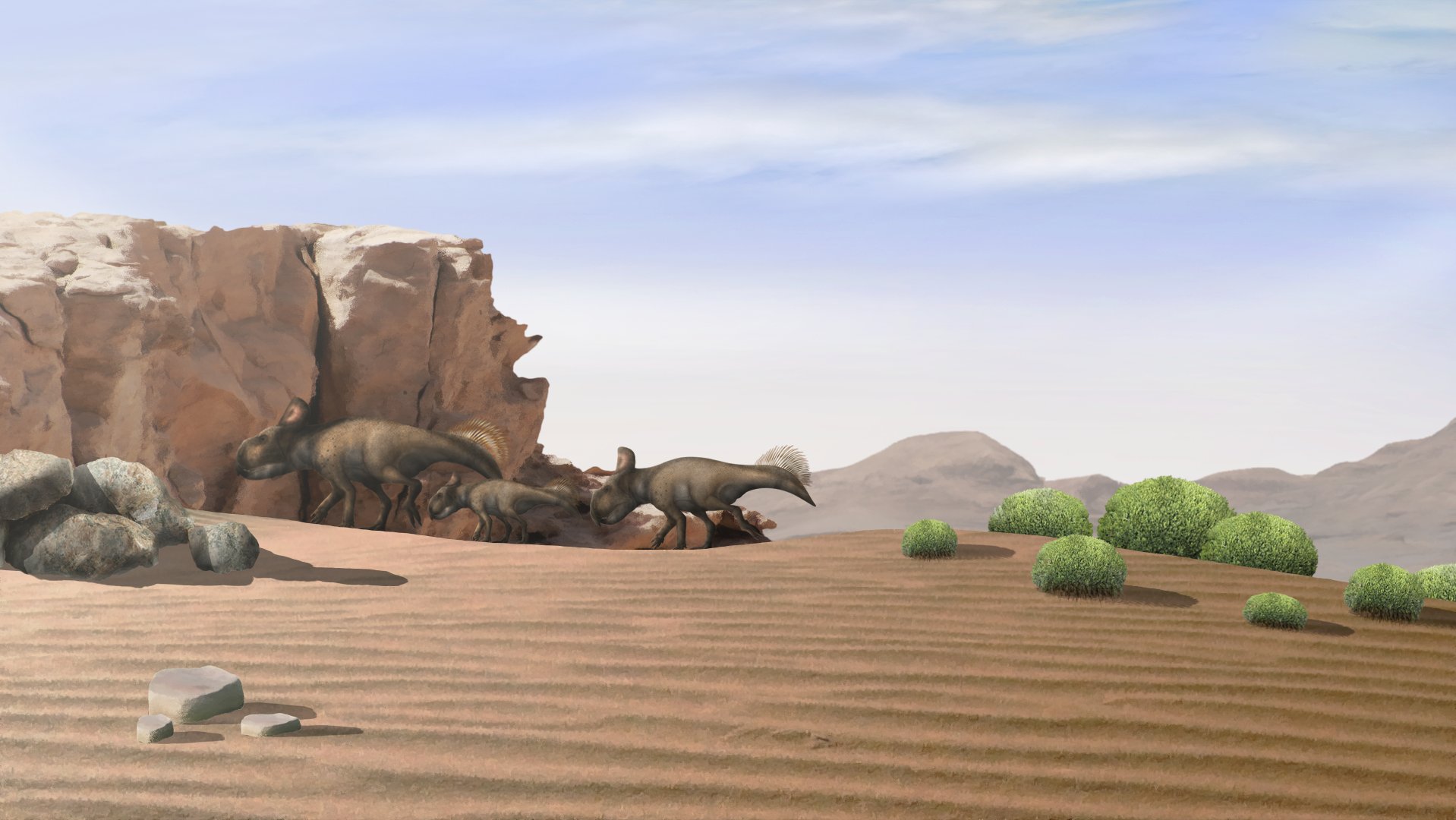
- Turner, A.H., Makovicky, P.J. & Norell, M.A. (2007). "Feather quill knobs in the dinosaur Velociraptor." Science 317: 1721. DOI. Source for the quill knobs on IGM 100/981, cited only in the caption of the reconstruction.
The real record, in your pocket.
PaleoDex catalogues the real fossil record, and every fact in it is sourced. Get the app.
GET IT ON GOOGLE PLAY →