Triceratops Horns Weren't Just For T. rex
PALEODEX · 2 September 2026 · 6 min read
For decades the assumed answer was predator defense. A 2009 statistical comparison of hundreds of skulls, and a single healed wound found in 2022, point somewhere else — at another Triceratops.
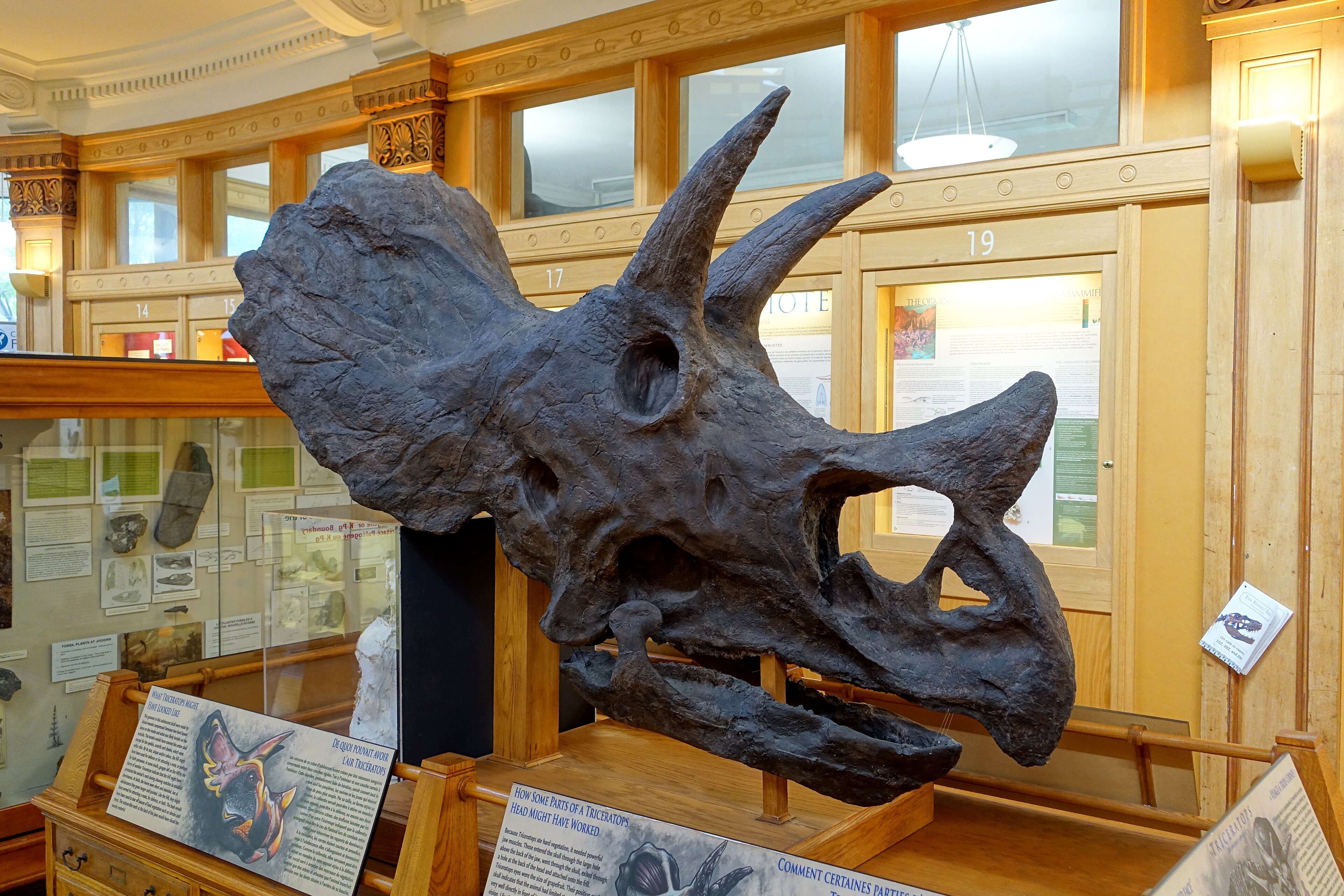
Two long horns over the eyes, a shorter one on the nose, and a solid bony shield fanning out over the neck. The textbook explanation for that arrangement has always been simple: it was for fighting Tyrannosaurus rex.
The fossil record complicates that story. Not by ruling out predator defense entirely — nobody has done that — but by pointing, statistically, at a different and more specific target: other Triceratops.
A 2009 study asked the question the hard way
In 2009, paleontologists Andrew Farke, Ewan Wolff and Darren Tanke published "Evidence of Combat in Triceratops" in PLoS ONE. Rather than speculate from a handful of dramatic-looking scars, they surveyed cranial specimens systematically — comparing Triceratops against a related horned dinosaur, Centrosaurus, which carried the opposite horn arrangement: a large nose horn and small brow horns.
They scored four bones — the nasal, jugal, squamosal and parietal — across many individuals of both genera for lesions: periosteal reactive bone and healed fractures, the kinds of injury that leave a permanent mark on the skeleton. Three of the four bones showed no meaningful difference between the two animals. The fourth did, and it was not a small effect.
The squamosal — one bone of the bony frill — was scarred in 10 of 58 Triceratops specimens (17.2%) against just 1 of 62 in Centrosaurus (1.6%). That is roughly a tenfold difference, and it is statistically significant (P = 0.002). The authors checked an obvious alternative explanation — that the squamosal is simply a bigger bone in Triceratops and so more likely to get hurt by chance — by re-testing the whole frill as a single unit. The gap held (P = 0.012).
Why this points away from predators
The reasoning that rules out T. rex and its relatives as the primary cause is straightforward, and it's the authors' own: Centrosaurus lived alongside the same tyrannosaurid predators Triceratops did. If a hunting theropod were responsible for the scarring, both genera should show a similar pattern of injury. Only one of them does.
That leaves combat with other members of the same species — and the frill, on this reading, is not just a display structure but a shield, positioned exactly where a rival's horn would land in a head-on confrontation.
How violent was it, actually? The 2009 paper cites Farke's own earlier scale-model testing (2004), which found the lesion pattern consistent with head-to-head, horn-locking pushing contests — closer to how bighorn sheep spar today than to open goring. That detail matters: paleontologist Jack Horner has publicly questioned the combat interpretation on exactly this point, arguing that real horn-to-horn goring should leave more, and more severe, puncture wounds than are actually observed. A shoving-and-locking contest, rather than repeated stabbing, is consistent with both the injury pattern and that objection.
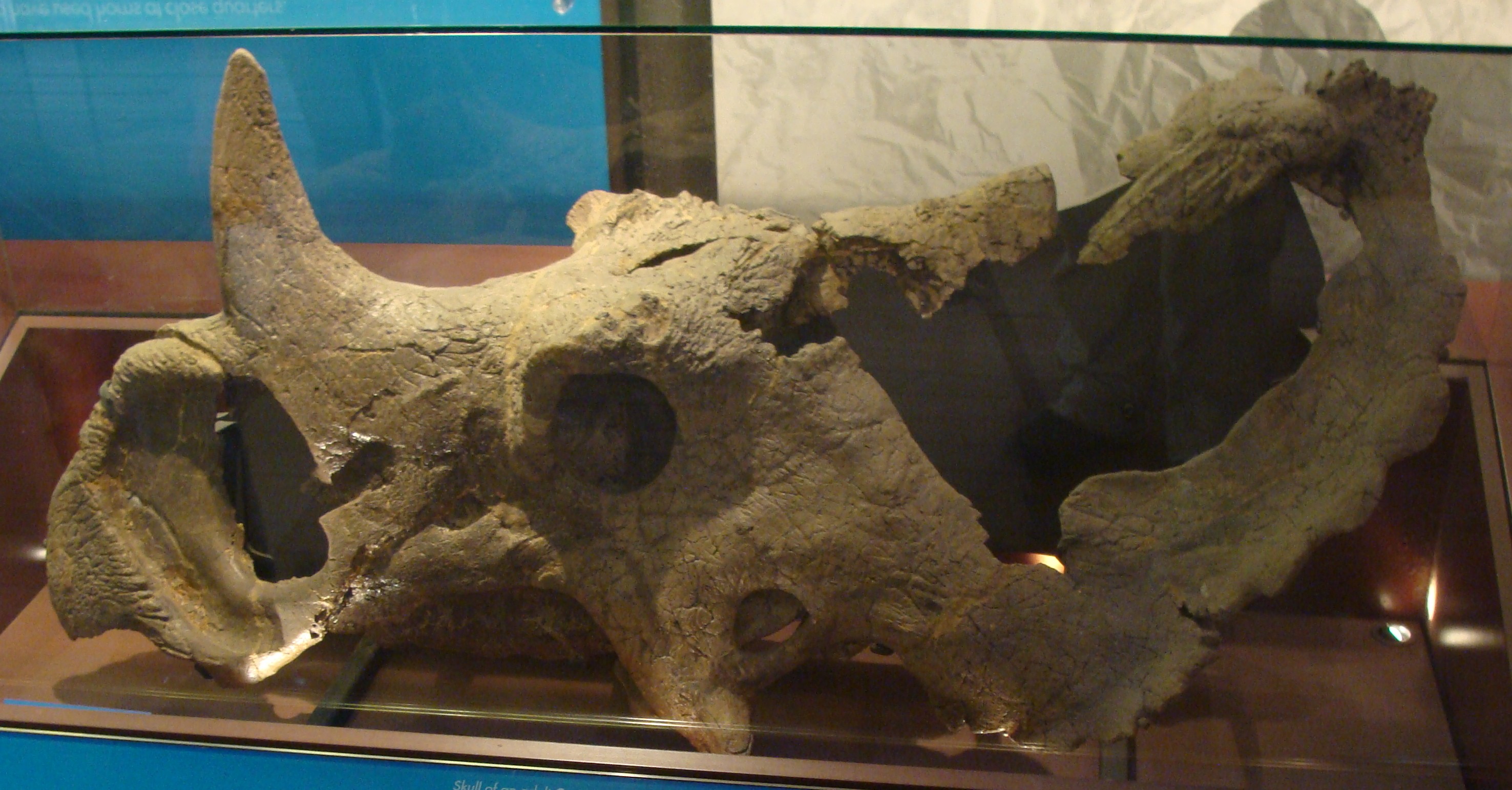
Big John: the clearest single case
Statistics describe a pattern across many specimens. In 2022, a team led by Ruggero D'Anastasio published a case study of one individual wound, and it is the most direct piece of evidence to date.
The specimen is "Big John," a Triceratops horridus discovered in 2014 in the Hell Creek Formation of South Dakota. Guinness World Records certifies him as the largest documented Triceratops skeleton — more than 60% complete, with a skull over 75% complete and brow horns exceeding 1.1 metres. His right squamosal carries a striking feature: a keyhole-shaped opening, 20 centimetres long by 5 centimetres wide.
D'Anastasio's team examined it with histology and elemental (chemical) analysis. Both pointed the same direction: the bone around the opening showed active remodeling, and sulfur consistent with the glycosaminoglycans present during bone healing — meaning this was a wound that was healing, not fresh, and not something that happened after death. To test the shape, the researchers built a cast of a Triceratops horn tip and used it in a physical impact simulation. It reproduced the hole's size and shape.
The authors' own conclusion is carefully hedged, and worth quoting exactly: the lesion "might indeed have occurred during combat with another Triceratops." Not proof. The clearest case on record — one animal that, on the evidence, fought and lived.
What this doesn't settle
None of this rules out display as a function of the horns and frill too — the two are not mutually exclusive, and the same structure plausibly did both jobs, the way antlers signal status and get used in real contests among deer today. What the evidence does put to rest is the idea that a hunting T. rex is the obvious, sufficient explanation for why Triceratops carried the specific weaponry it did. The frill-scarring pattern doesn't match predator attacks. It matches something facing the same threat repeatedly, from the same direction, throughout its life — and the study's own logic says that threat wore horns just like its own.
Why this belongs in PaleoDex
Because the honest version of this story has three separate pieces of evidence carrying three separate weights: a statistical pattern across dozens of specimens, a mechanical model for how the injuries were likely inflicted, and one individually diagnosed wound. Collapsing those into a single flat claim — "Triceratops fought Triceratops, proven" — would overstate what any one of them shows on its own. Read more of the record here.
Sources
Every fact above is drawn from the primary and authoritative literature:
- Farke, A.A., Wolff, E.D.S. & Tanke, D.H. (2009). "Evidence of Combat in Triceratops." PLoS ONE 4(1): e4252 — the statistical comparison against Centrosaurus, read from the paper's own Figure 1 and Discussion.
- Farke, A.A. (2004). "Horn use in Triceratops (Dinosauria: Ceratopsidae): testing behavioral hypotheses using scale models." Palaeontologia Electronica 7 — the scale-model combat-style testing cited in the 2009 paper.
- D'Anastasio, R., Cilli, J., Bacchia, F., Fanti, F., Gobbo, G. & Capasso, L. (2022). "Histological and chemical diagnosis of a combat lesion in Triceratops." Scientific Reports 12, 3941 (Author Correction 2022, discovery-location field only — no change to any finding).
- Guinness World Records — certification of "Big John" as the largest documented Triceratops skeleton; contemporaneous press coverage of the October 2021 Paris auction (skeleton >60% complete, skull >75% complete, brow horns >1.1 m).
- Farlow, J.O. & Dodson, P. (1975). "The behavioral significance of frill and horn morphology in ceratopsian dinosaurs." Evolution 29: 353–361 — the foundational display-vs-combat framing this build's "textbook assumption" traces to.
The real record, in your pocket.
PaleoDex catalogues the real fossil record, and every fact in it is sourced. Get the app.
GET IT ON GOOGLE PLAY →