Did Stegosaurus Have a Second Brain?
PALEODEX · 15 September 2026 · 6 min read
There really is a hollow in the hips of Stegosaurus, and it really is bigger than the space that held its brain. The second brain is the part that came later.
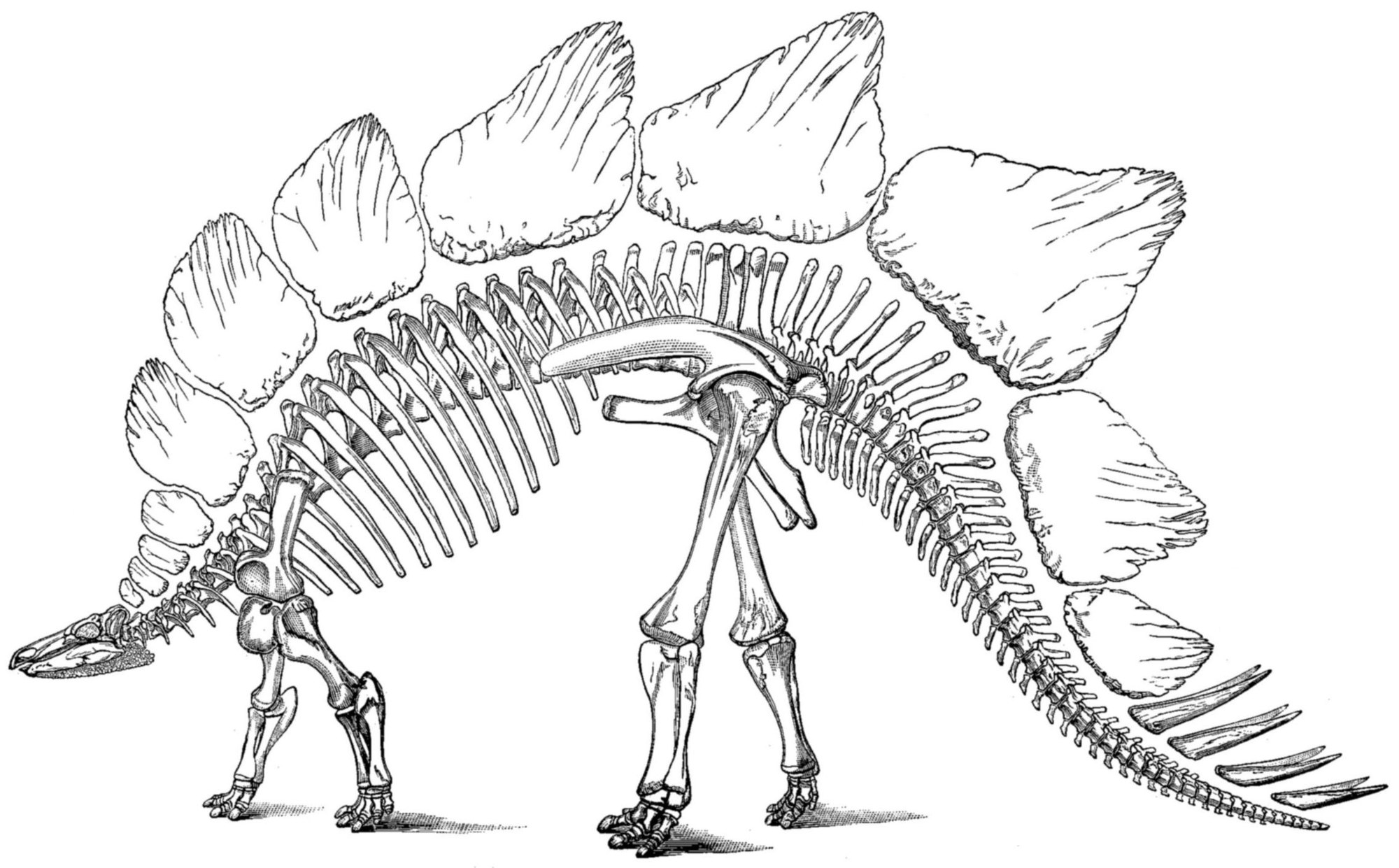
The story goes that Stegosaurus had a second brain in its hips to run its back end. Every piece of that story has a source, and the sources do not all say the same thing. Here they are, in order.
A small brain for a big animal
The small brain is the famous part, and it has a source. In his 1896 monograph The Dinosaurs of North America, Othniel Charles Marsh compared the brain of Stegosaurus with an alligator's, scaled to body size, and concluded that "Stegosaurus had thus one of the smallest brains of any known land vertebrate." That is a claim about proportion: a small brain for the size of the animal.
The chamber in the hips
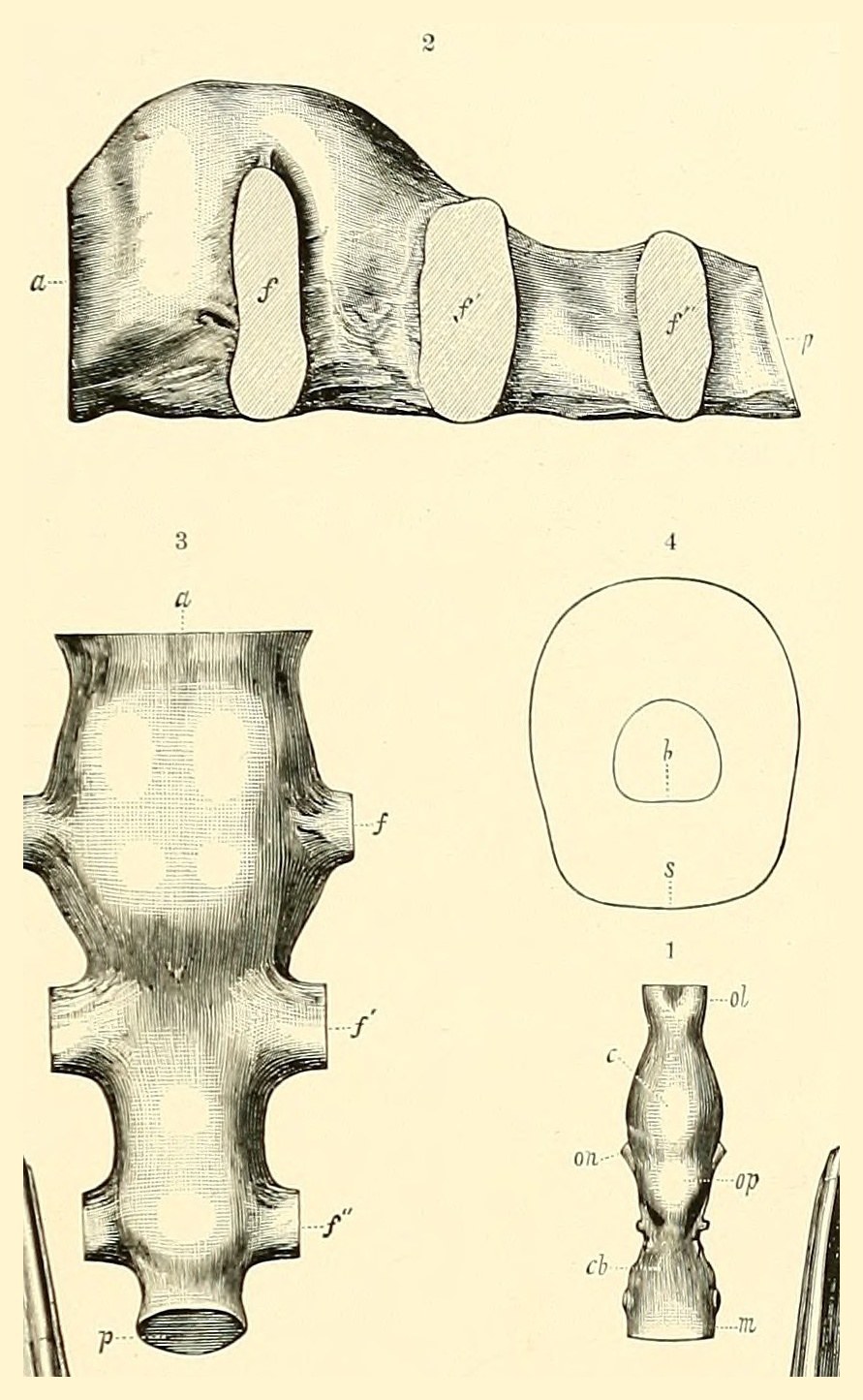
The surprise was at the other end of the spine. In an 1881 paper in the American Journal of Science, Marsh wrote that he had found "a very large chamber in the sacrum, formed by an enlargement of the spinal canal." The sacrum is the part of the spine that sits inside the hips. "This chamber was ovate in form," he went on, "and strongly resembled the brain case in the skull, although very much larger, being at least ten times the size of the cavity which contained the brain."
Two details are worth keeping straight. The paper is signed at Yale College in January 1881, and a footnote says its facts were first read to the National Academy "in November last", so the chamber was known by late 1880 and described in print in 1881. And when Marsh reused the passage in his 1896 monograph, "at least ten times" became "at least twenty times". Both figures are his. This post uses the earlier one.
What Marsh actually wrote
Marsh named the chamber and hedged the name in the same sentence: "The remarkable feature about this posterior brain-case, if so it may be called, is its size, in comparison with that of the true brain of the animal." Further down the same page, he went past the hedge: "The physiological effects of a posterior nervous center, so many times larger than the brain itself is a suggestive subject, which need not here be discussed. It is evident, however, that in an animal so endowed, the posterior part was dominant."
So Marsh was not simply being careful. He called the chamber a nervous center and judged the back half of the animal to be in charge. What he never wrote is the phrase "second brain".
How it became a second brain
That phrase arrived later. One well-documented stop on the way is a newspaper poem. The Linda Hall Library traces Bert Taylor's "The Dinosaur" to the Chicago Tribune of 26 February 1903, where it joked about a dinosaur with "two sets of brains". The library notes that a Brachiosaurus vertebra at the Field Museum prompted the poem, and that it is usually retold as dating from 1912 and as being about Stegosaurus. The misremembered version is a fair picture of how the idea travelled.
By 1932 the second brain was a popular misconception. Wikipedia's Stegosaurus article cites the paleontologist Barnum Brown describing it, and disputing it, that year. We have not read Brown's text ourselves, so it is marked as secondhand in the sources.
The same space, in living birds
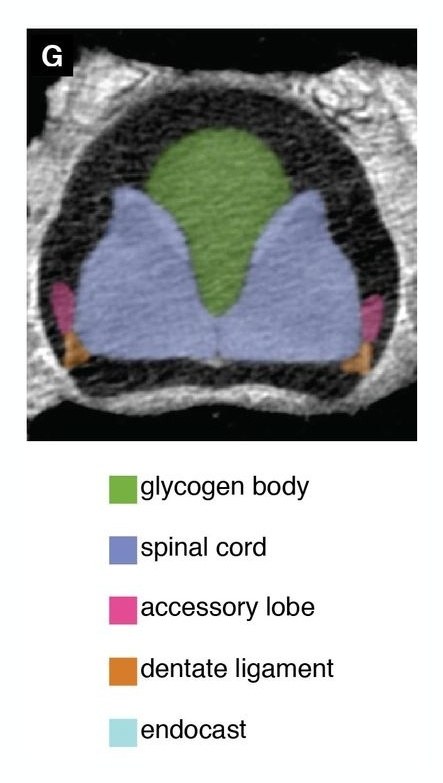
The best clue to what really filled the chamber is still walking around. Birds are dinosaurs, a point the University of California Museum of Paleontology makes without hedging, and birds have an enlarged space in the same part of the spine. There, the top of the spinal cord opens into a groove that, in the words of a 2020 study, "houses an egg-shaped glycogen body".
A glycogen body is a cluster of large cells packed with glycogen, the form in which animals store sugar. Its cells are a specialized kind of glia, the support cells of the nervous system, not the neurons that do a brain's work. A 2025 study of this part of the bird spine draws the line back to dinosaurs itself: "A similar structure was documented by Marsh in 1881 in Stegosaurus."
Best match, not proof
So did the chamber in Stegosaurus hold a glycogen body? In 1991, E. B. Giffin reviewed enlarged sacral canals across dinosaurs, mostly sauropods and stegosaurs, and concluded that a glycogen body like a bird's fit the evidence best. The paper is not online, so this post relies on two accounts of it that agree: a 2019 explainer on Sauropod Vertebra Picture of the Week, and the 2025 study quoted above.
That is a strong comparison, and it is still a comparison. Only the bone around the chamber survives, not what was inside it, so its contents are inferred from living birds rather than seen.
The birds leave a question open too. The 2020 study found "no consistent evidence that the glycogen body has a role in body metabolism", and experiments that starved birds to test the idea gave mixed results. Other jobs have been proposed for it, and none is settled, even in chickens.
Put together, the honest answer is short. A glycogen body is the best match for the Stegosaurus chamber, not a certainty, and nothing in the evidence makes it a brain.
Why this belongs in PaleoDex
Because the second brain shows how a fact drifts. The hole is real, Marsh's measurement is real, and his own words went further than caution. The phrase that stuck came later, and the best modern reading comes from animals that are still alive. Marsh has a much bigger part in the Bone Wars and turns up again in the Brontosaurus story, and the case for birds as dinosaurs is laid out in Are birds dinosaurs? For the wider catalogue, see the Fossil Dex, and for how we handle sourcing, about the data.
Sources
Every claim above traces to the sources below. Where we relied on someone else's reading of a source, we say so.
- Marsh, O.C. (1881). "Principal characters of American Jurassic dinosaurs. Part IV. Spinal cord, pelvis, and limbs of Stegosaurus." American Journal of Science ser. 3, 21(122): 167–170. DOI. Source for the chamber, its size against the brain cavity, the "posterior brain-case", the "posterior nervous center", the dominant posterior part and the dating footnote. Read on the scanned pages.
- Marsh, O.C. (1896). The Dinosaurs of North America. U.S. Geological Survey, 16th Annual Report, Part I. Internet Archive. Source for the small-brain comparison, "at least twenty times", the skeletal restoration and Plate XLVI.
- Linda Hall Library, "Scientist of the Day: Bert Taylor". Link. Source for the 1903 poem, its date, the Brachiosaurus vertebra and the later retellings.
- Wikipedia, "Stegosaurus". Link. Source for Barnum Brown describing and disputing the second brain in 1932. Secondhand: Brown's 1932 text was not read.
- University of California Museum of Paleontology, "Dinobuzz: Dinosaur-Bird Relationships". Link. Source for birds being dinosaurs.
- Stanchak, K.E., French, C., Perkel, D.J. & Brunton, B.W. (2020). "The balance hypothesis for the avian lumbosacral organ and an exploration of its morphological variation." Integrative Organismal Biology 2(1): obaa024. DOI. Source for the egg-shaped glycogen body, the metabolic evidence, the starvation studies and the balance hypothesis for other parts of the organ.
- Stanchak, K.E., Miller, K.E., Shikiar, D., Brunton, B.W. & Perkel, D.J. (2023). "Mechanistic hypotheses for proprioceptive sensing within the avian lumbosacral spinal cord." Integrative and Comparative Biology 63(2): 474–483. DOI. Source for the glycogen body's cells being a specialized kind of glia.
- Pelletan, I., Cornette, R. & Abourachid, A. (2025). "Ecomorphological analysis of the bird lumbosacral organ in an evolutionary context." Journal of Morphology 286(8): e70073. DOI. Source for the split in the spinal cord, the glycogen body as a cluster of glycogen-rich cells, the link to Marsh's Stegosaurus and its reading of Giffin 1991.
- Giffin, E.B. (1991). "Endosacral enlargements in dinosaurs." Modern Geology 16: 101–112. Not read: cited as summarised by Wedel (2019) and Pelletan et al. (2025).
- Wedel, M. (2019). Sauropod Vertebra Picture of the Week, post of 18 January 2019 on dinosaur "second brains". Link. Source for the summary of Giffin 1991, glial cells rather than neurons, and the glycogen body's job being unknown even in chickens.
- Wedel, M. (2019). Sauropod Vertebra Picture of the Week, post of 23 January 2019 on balance organs in birds. Link. Source for the canals not having been reported in non-avian dinosaurs.
- Atterholt et al. (2025). The Anatomical Record 308(5): 1349–1368. DOI. Source for the balance organ being described in birds only, beside spinal-cord enlargements in sauropods, stegosaurs and birds.
The real record, in your pocket.
PaleoDex catalogues the real fossil record, and every fact in it is sourced. Get the app.
GET IT ON GOOGLE PLAY →