How Did Smilodon Kill Without Snapping Its Sabres?
PALEODEX · 16 September 2026 · 6 min read
The sabres of Smilodon pierced deep and handled a sideways blow badly. Its skull and its arm bones suggest how it worked around that.
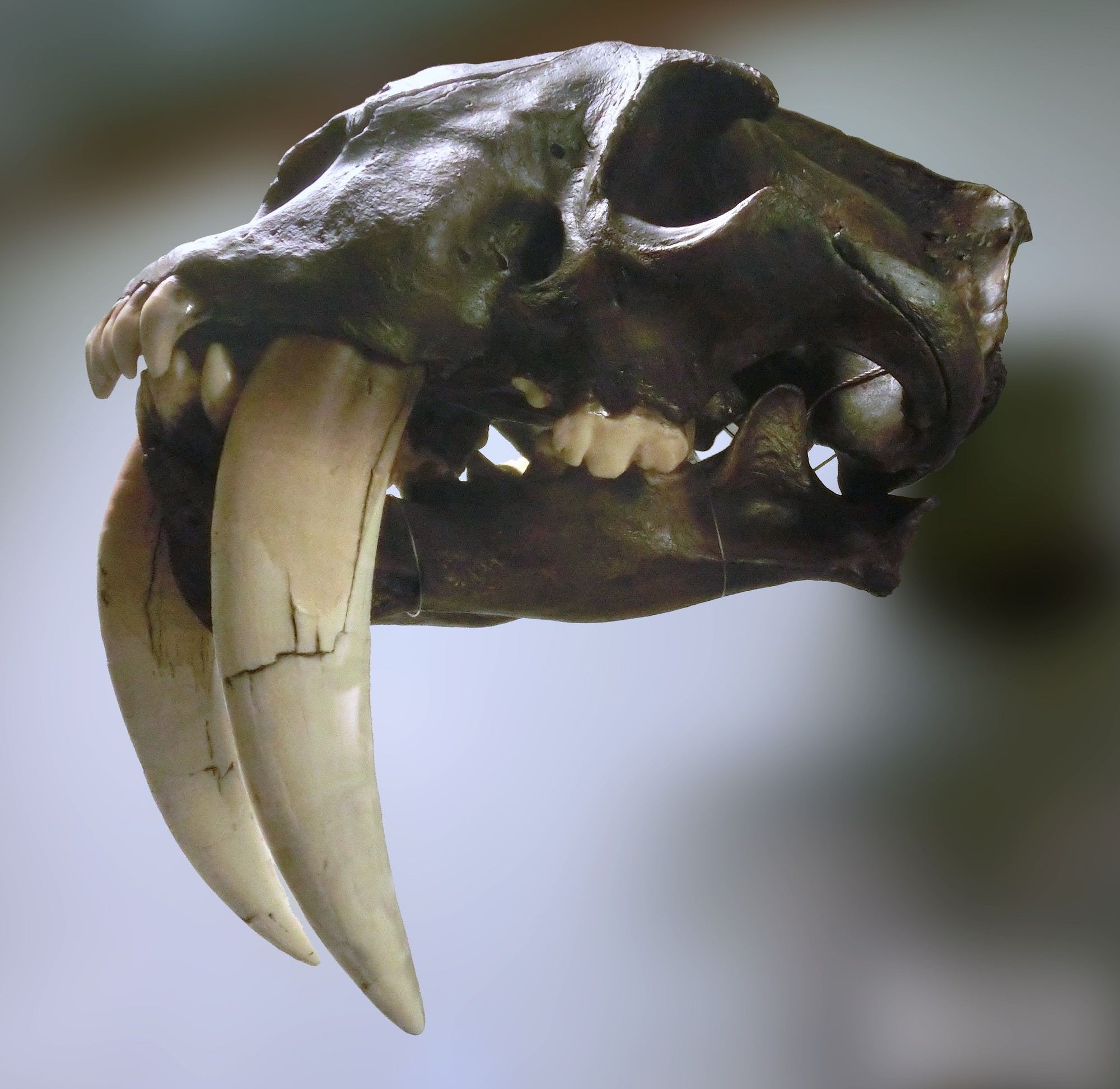
The sabres are why everyone knows Smilodon. They were also a liability. Every piece of the answer below comes from a published study, and a later section covers the part scientists still argue about.
Blades built for piercing
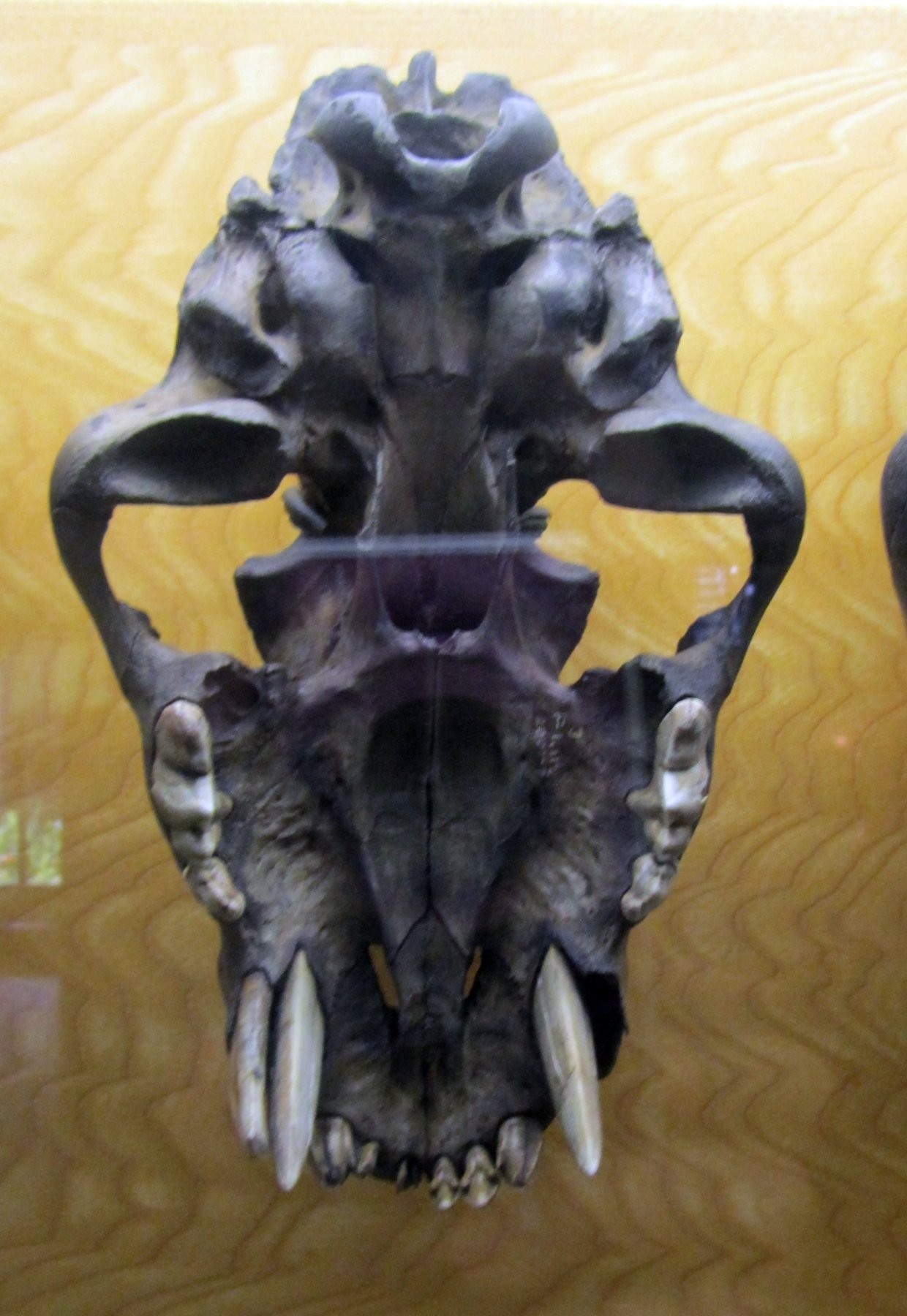
A lion's canines are cone-shaped. The upper canines of Smilodon were long, flattened from side to side and edged like blades. In 2025, a team led by Tahlia Pollock compared the 3D shapes of canine teeth from 95 species, 25 of them sabre-toothed, and for a subset of them measured how well each shape punctures and how well it resists breaking. Their conclusion: "extreme saber teeth optimize puncture performance at the expense of breakage resistance". A separate 2025 review by Pollock and Philip Anderson counts Smilodon among those extreme forms and reads its long, slender, edged teeth as "a bite that prioritizes puncture with relatively deep penetration".
Strong one way, weak the other
Flattening does not make a tooth weak in every direction. Pollock and Anderson put the engineering this way: "Rounder cross sections are better able to tolerate multidirectional loads, while more flattened/laterally compressed ovoid cross sections are better able to tolerate high stresses along their longest axis." A 1987 study by B. Van Valkenburgh and C. B. Ruff treated canine teeth as beams. It found that the canines of living cats are stronger than those of the dog family, especially against bending from side to side, while the canines of sabre-toothed cats were "more similar in shape and strength characteristics to those of living canids than felids". Z. Jack Tseng, who simulated sideways loads on Smilodon canines in 2025, starts from the same fact: laterally compressed canines "are mechanically weakest in the mediolateral bending direction", that is, from side to side.
That matters in a fight, because a large animal twisting against a bite can push on the teeth from the side. A 2010 study of Smilodon's arm bones starts from exactly this point: its "elongate canine teeth were more vulnerable to fracture than those of modern felids, making it imperative for them to immobilize prey with their forelimbs when making a kill."
A weak bite
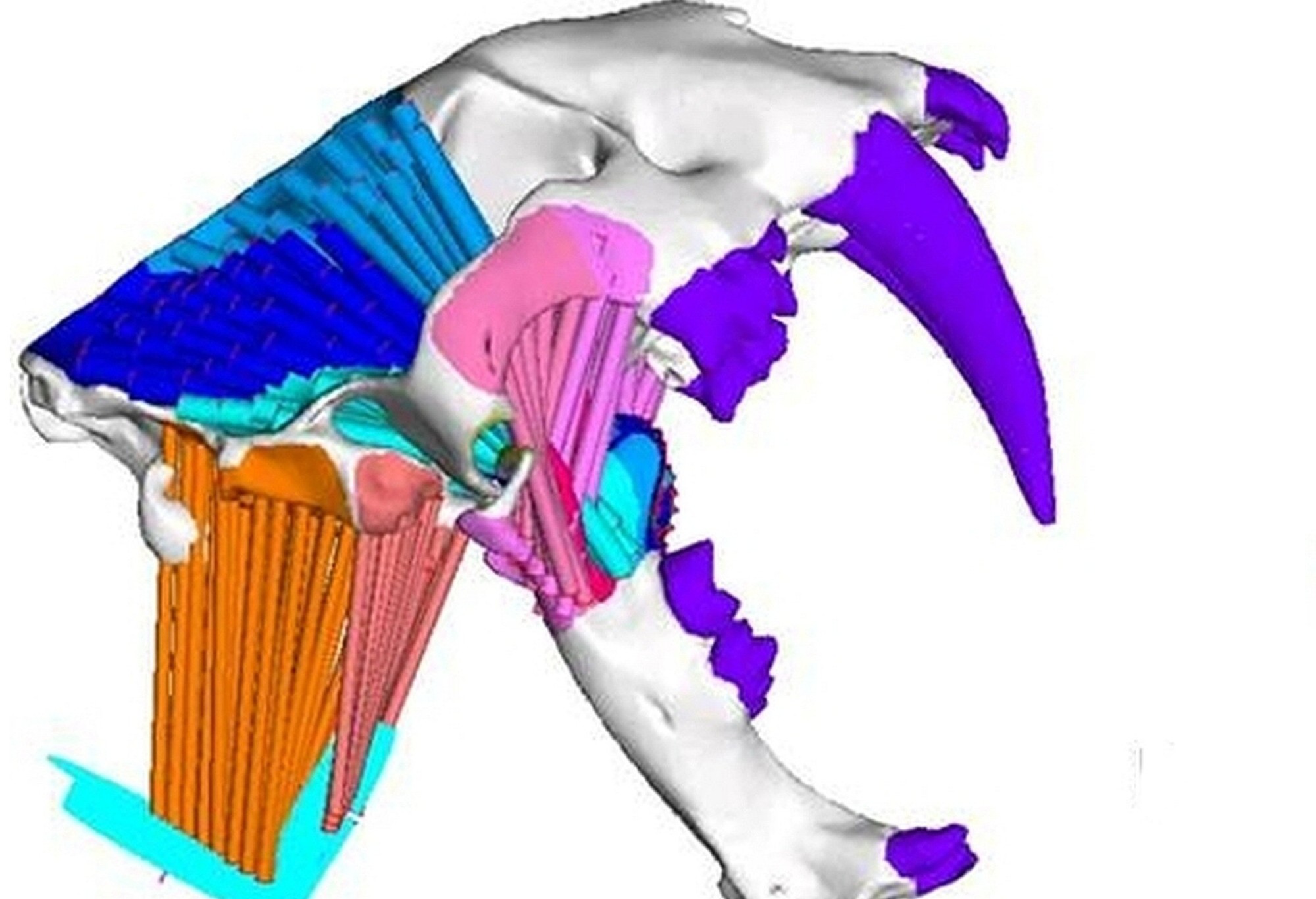
The jaws did not make up for it. In 2007, Colin McHenry and colleagues built detailed 3D computer models of a Smilodon skull and a lion skull and loaded them in different ways. The bite that the jaw muscles of Smilodon could deliver came out "relatively weak", at "one-third that of a lion (Panthera leo) of comparable size". The same models found its skull "poorly optimized to resist the extrinsic loadings generated by struggling prey", but "better optimized for bites on restrained prey where the bite is augmented by force from the cervical musculature", meaning the muscles of the neck.
Two limits come with that result. It is a computer model, so one-third is an estimate, not a measurement. And the sabres in the scanned skull were restorations, and the authors note that the stresses shown in them "do not reflect the actual mechanical performance of real teeth". The model tested the skull, not the teeth.
Arms like no living cat's
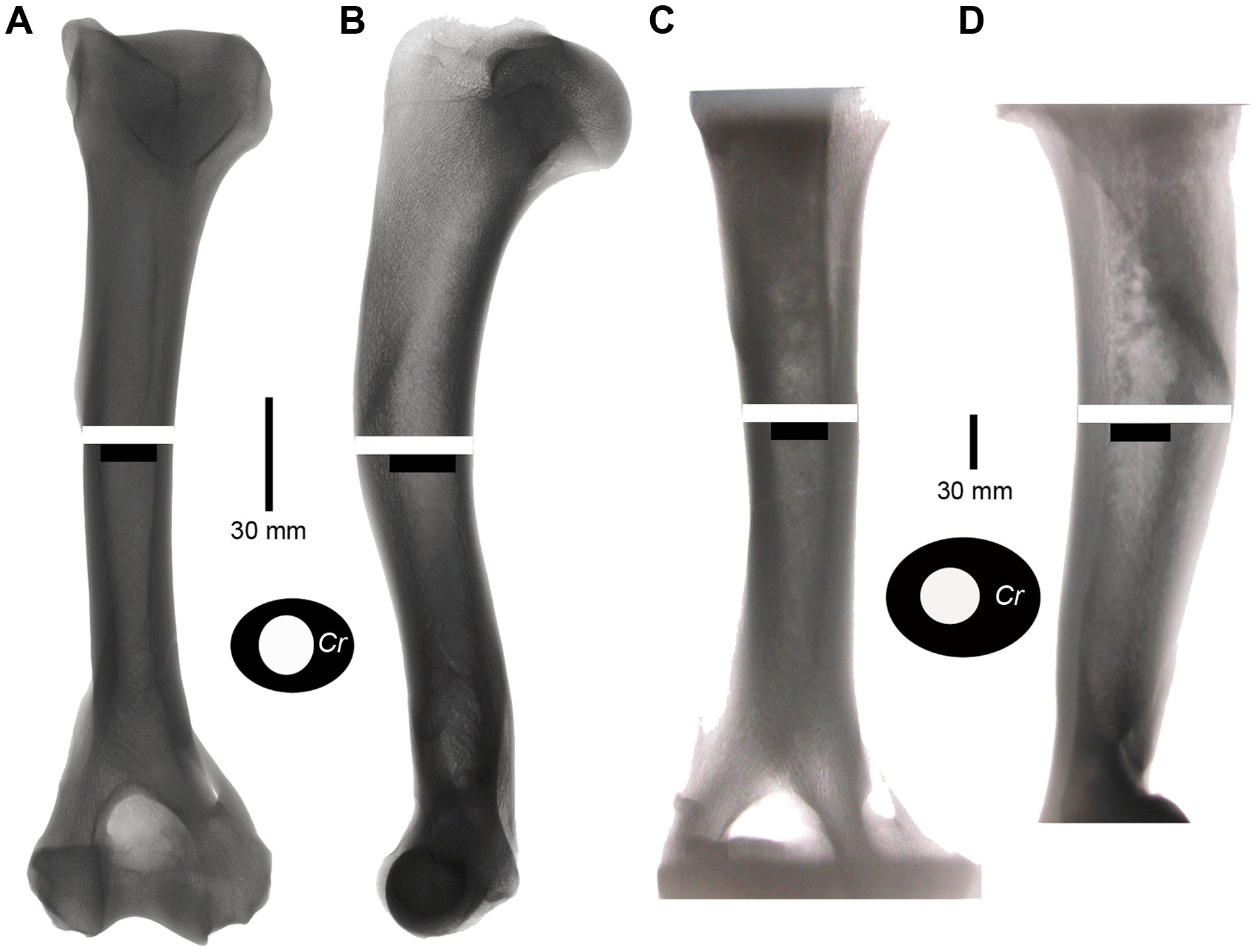
The arm bones tell the other half of the story. Julie Meachen-Samuels and Blaire Van Valkenburgh compared X-rays of the upper arm bones and thigh bones of Smilodon, of 28 living cat species and of the larger extinct American lion. The upper arm bones of Smilodon "were reinforced by cortical thickening to a greater degree than those observed in any living felid, or the much larger P. atrox". In plain terms, their walls were thicker than any living cat's. Its thigh bone was thickened too, "but not beyond the normal variation found in any other felid measured", so the extra strength sat in the front limbs.
What most researchers conclude
Researchers who put these results together describe the kill step by step. McHenry's team concluded that "prey were brought to ground and restrained before a killing bite, driven in large part by powerful cervical musculature". Meachen-Samuels and Van Valkenburgh read the arm bones the same way: their strength was "part of an adaptive complex driven by the need to minimize the struggles of prey in order to protect the elongate canines from fracture and position the bite for a quick kill." A 2013 study led by Stephen Wroe summed up where the field stood, with "most researchers accepting the canine-shear bite hypothesis, wherein both head-depressing and jaw closing musculatures played a role in delivery of the fatal bite." The neck added force. It did not replace the jaws.
What is still argued
That reading is the majority view, not a closed case. In 2014, Jeffrey Brown worked with digitized images of a replica Smilodon skull and neck and reported that rotating the head with the neck muscles "will not result in jaw closure". Brown proposed a different lever, with the push coming from the forelimbs. Pollock and Anderson's 2025 review describes "broad consensus" that sabre-toothed predators bit differently from cone-toothed ones like the lion, while "the precise mechanics and variability of this bite remain debated".
Where on the prey the bite landed is argued too, and this post does not pick a side.
Why this belongs in PaleoDex
Because the famous part of an animal is not always its strongest part. The sabres of Smilodon are easier to understand alongside its weak bite and its unusually strong arms, and that picture comes from teeth, computer models and X-rays rather than from any single fossil. For predators ranked by the strength of their bites, see the deadliest carnivore in the fossil record. The wider catalogue is in the Fossil Dex, and how we handle sourcing is in about the data.
Sources
Every claim above traces to the sources below. Where we relied on someone else's reading of a source, we say so.
- Pollock, T.I. et al. (2025). "Functional optimality underpins the repeated evolution of the extreme 'saber-tooth' morphology." Current Biology 35(3): 455–467. DOI. Source for the 95 species, puncture performance and breakage resistance.
- Pollock, T. & Anderson, P.S.L. (2025). "Sharpening our understanding of saber-tooth biomechanics." The Anatomical Record 308(11): 3022–3040. DOI. Source for Smilodon as an extreme form, deep puncture, cross-section strength, the broad consensus and the open mechanics.
- Van Valkenburgh, B. & Ruff, C.B. (1987). "Canine tooth strength and killing behaviour in large carnivores." Journal of Zoology 212(3): 379–397. DOI. Source for the beam model, cats' canines being stronger against side-to-side bending, and sabre-tooth canines resembling those of canids. Read at abstract level.
- Tseng, Z.J. (2025). "Bending performance changes during prolonged canine eruption in saber-toothed carnivores: A case study of Smilodon fatalis." The Anatomical Record 308(11): 2994–3006. DOI. Source for sideways weakness.
- McHenry, C.R., Wroe, S., Clausen, P.D., Moreno, K. & Cunningham, E. (2007). "Supermodeled sabercat, predatory behavior in Smilodon fatalis revealed by high-resolution 3D computer simulation." PNAS 104(41): 16010–16015. DOI. Source for the one-third bite, the skull under struggling prey, the restored sabres and restraint before the bite.
- Meachen-Samuels, J.A. & Van Valkenburgh, B. (2010). "Radiographs reveal exceptional forelimb strength in the sabertooth cat, Smilodon fatalis." PLoS ONE 5(7): e11412. DOI. Source for the canines' vulnerability, the 28 living cat species and the thickened upper arm bones.
- Wroe, S., Chamoli, U., Parr, W.C.H., Clausen, P., Ridgely, R. & Witmer, L. (2013). "Comparative biomechanical modeling of metatherian and placental saber-tooths: a different kind of bite for an extreme pouched predator." PLoS ONE 8(6): e66888. DOI. Source for most researchers accepting the canine-shear bite, with neck and jaw muscles both involved.
- Brown, J.G. (2014). "Jaw function in Smilodon fatalis: a reevaluation of the canine shear-bite and a proposal for a new forelimb-powered class 1 lever model." PLoS ONE 9(10): e107456. DOI. Source for the rival forelimb-powered model.
- Andersson, K., Norman, D. & Werdelin, L. (2011). "Sabretoothed carnivores and the killing of large prey." PLoS ONE 6(10): e24971. DOI. Source for the competing ideas about where on the prey the bite landed.
The real record, in your pocket.
PaleoDex catalogues the real fossil record, and every fact in it is sourced. Get the app.
GET IT ON GOOGLE PLAY →