The Deadliest Carnivore in the Fossil Record
PALEODEX · 11 July 2026 · 8 min read
Not the biggest — the deadliest. Ranked by the only things a fossil can actually prove: bite force, feeding traces, crushed bone. Three predators, three worlds, one brutal trend line — and the animal at the top isn't the one on the lunchbox.
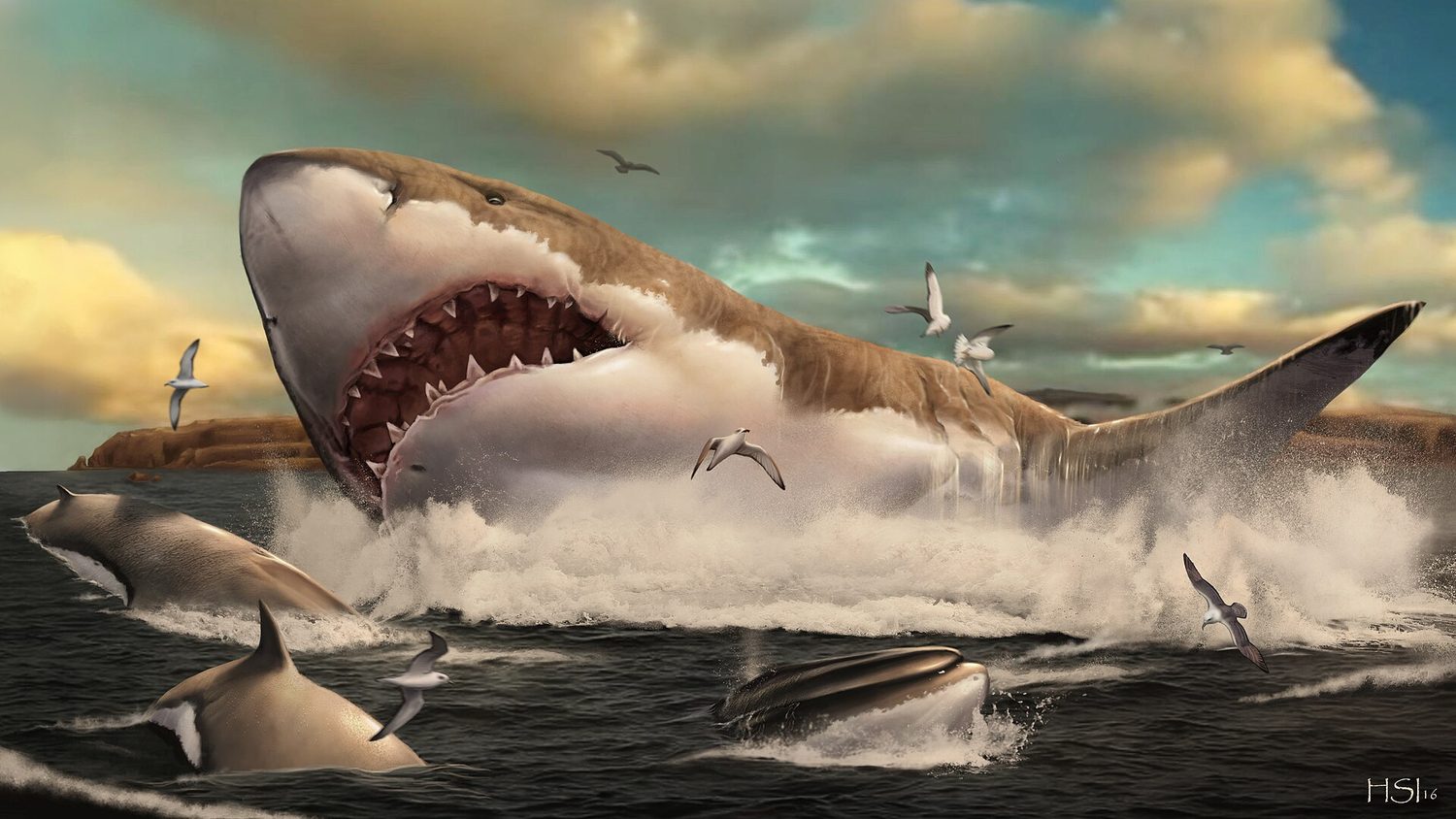
Ask "what's the deadliest predator that ever lived?" and most people picture a T-Rex. Fair guess. Wrong answer. The trouble is that "deadliest" is a bar-fight of a word, so let's pin it to something the fossil record can actually measure: bite force you can model from a skull, tooth marks left on a victim, bone crushed and swallowed. Rank three predators that way — spanning 360 million years — and the trend line is almost comic. Counting down, least-mentioned first.
No. 3Dunkleosteus, the first superpredator
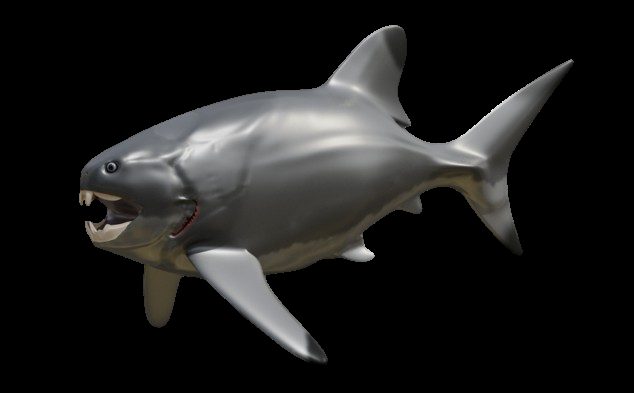
Before the dinosaurs. Before anything with a backbone had crawled onto land, the ocean already had a monster. Around 360 million years ago, the apex predator of the Devonian seas was Dunkleosteus — an armored fish with no teeth at all. It didn't need them. Its jaws were self-sharpening bony plates that held a bladed edge as they wore down, a built-in guillotine.
And they were quick. A biomechanical model of the skull found the jaws could go from open to shut in about a fiftieth of a second, snapping with a force of more than 5,000 newtons at the rear plates — one of the most powerful bites of any fish, living or extinct (Anderson & Westneat, 2007). It could also open that fast, generating suction that yanked prey in before it snipped it in half.
Here's the honest footnote paleontology owes you: Dunkleosteus was drawn for decades as a 6-to-10-meter leviathan. A 2023 reanalysis using a new body-length method cut that down hard — to roughly 3.4 meters for a typical adult, maybe 4 for the largest (Engelman, 2023). Shorter than the legend. Still the first vertebrate on Earth that could bite another animal clean in two.
No. 2T-Rex, the bone-crusher
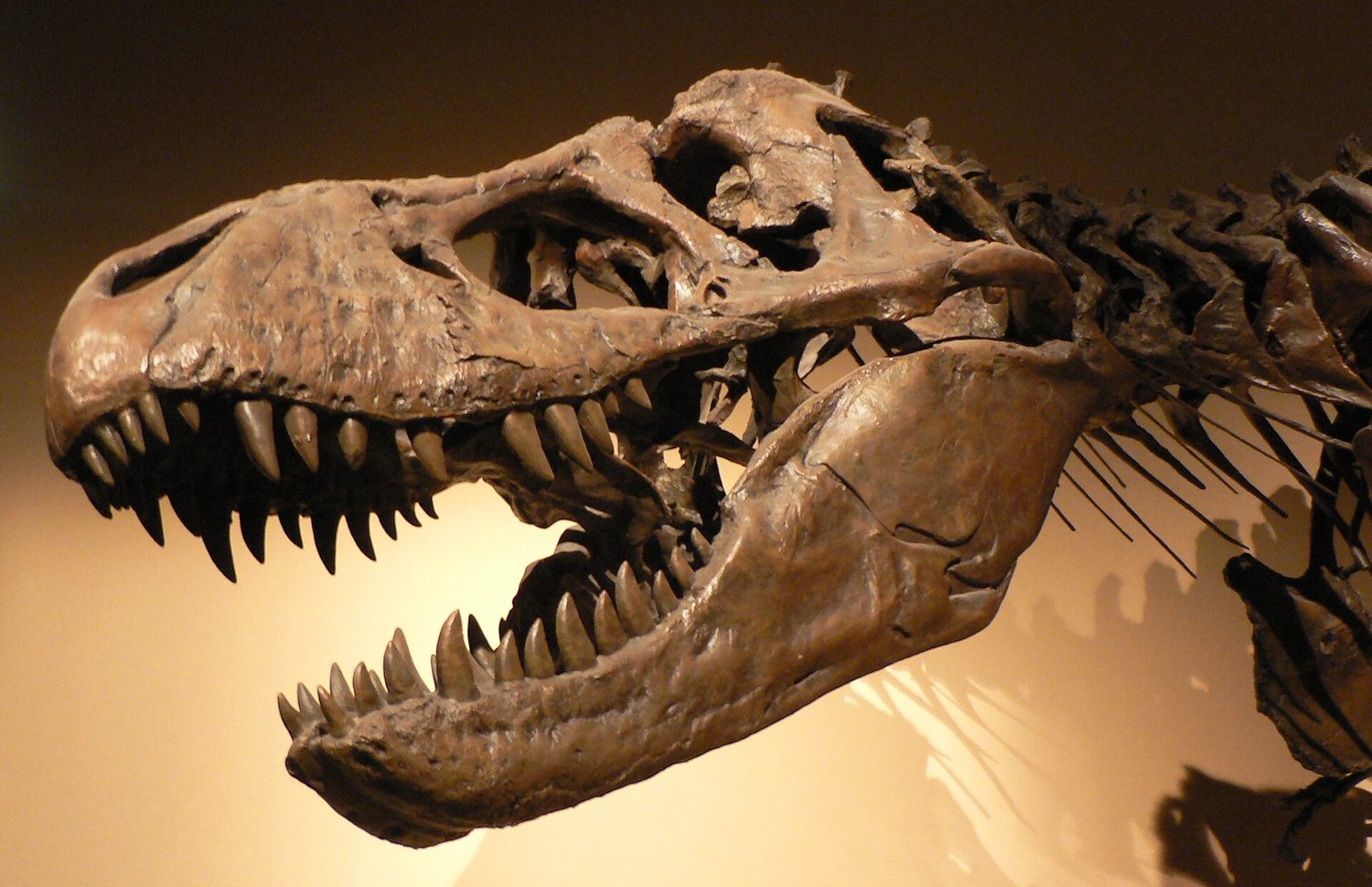
You saw this one coming — but probably for the wrong reason. Yes, T-Rex has the strongest bite of any land animal ever measured: models put it at 35,000 to 57,000 newtons at a back tooth, comfortably the record for anything that walked (Bates & Falkingham, 2012). But the number isn't the frightening part. What it did with it is.
T-Rex is the only reptile known to have habitually pulverized bone — cracking it, crushing it into swallowable chips, and digesting the marrow, a feat otherwise seen only in mammals like hyenas. And it pulled that off without the interlocking teeth mammals rely on, driving tooth pressures high enough to shatter bone outright (Gignac & Erickson, 2017). The proof is written on its prey: one Triceratops carries roughly 80 T-Rex bite marks, and bone-packed coprolites show the crushed bone went all the way through. This was a predator that treated a skeleton as part of the meal.
No. 1Megalodon, the deadliest of all
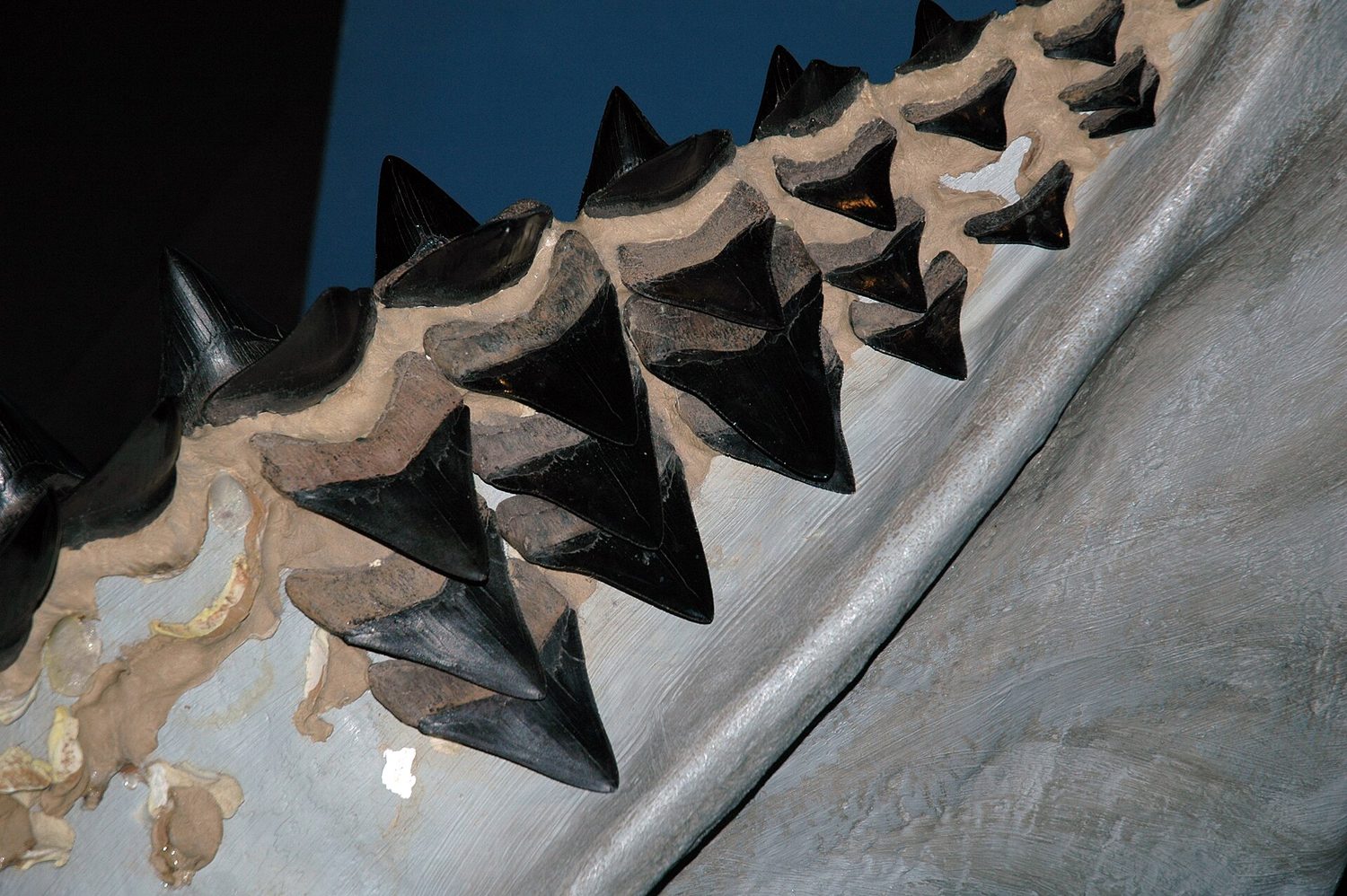
And then there's the one that makes the T-Rex look tame. Otodus megalodon — the megalodon — had the strongest bite force ever estimated for any animal, full stop: 108,000 to 182,000 newtons (Wroe et al., 2008). That's roughly ten times a modern great white and three times a T-Rex — and because sharks thrash side to side as they feed, the damage done to prey was worse than the raw figure suggests.
It backed that bite with sheer scale. Recent work rebuilt megalodon not as a super-sized great white but as a longer, leaner cruiser — somewhere from 15 meters up to a possible 24, weighing on the order of a large whale (Sternes et al., 2024). That reconstruction is not settled. Working from the same fossil evidence, Cooper et al. (2022) modelled a stockier, more white-shark-like animal, and the two teams still disagree. We are not calling it for either. And whales are exactly what it hunted: we have megalodon bite marks on fossil whale bones and nursery grounds carpeted with its teeth, some as long as your hand. It even shared its seas with a rival built to the same terrifying spec — the raptorial sperm whale Livyatan, whose teeth ran to 36 cm. Megalodon vanished around 3.6 million years ago. Take the win.
One brutal trend line
Line the three up and the escalation barely looks real: ~5,300 N (Dunkleosteus) → ~57,000 N (T-Rex) → ~182,000 N (megalodon). Each apex bit on the order of ten to thirty times harder than the last, across 360 million years and three separate worlds — a Devonian reef, a Cretaceous floodplain, an open Miocene ocean. "Deadliest" will always be an argument. But if you let the fossils settle it — bite force you can model, bones you can read — the ocean wins, and it isn't close.
Honorable mention: Livyatan
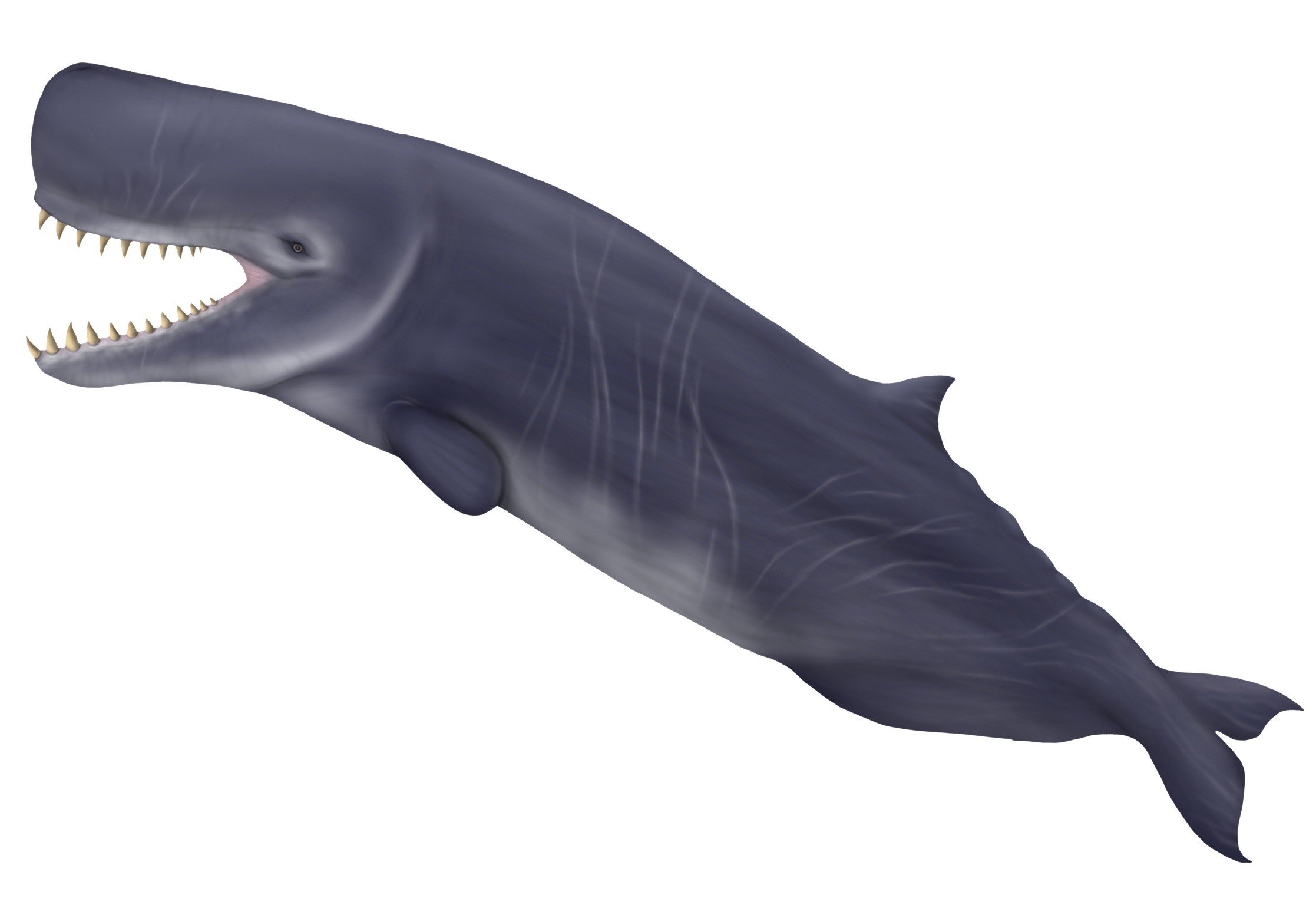
Megalodon didn't rule alone. In the very same Miocene seas swam Livyatan melvillei, a raptorial sperm whale 13.5 to 17.5 meters long, with a three-meter skull and the largest teeth of any predator known: over 36 centimeters, root and all (Lambert et al., 2010). The study that named it framed Livyatan and megalodon as co-apex predators of the same ocean, and their fossils turn up in the same Peruvian beds (Bianucci et al., 2016).
So why isn't it on the countdown? Because this list ranks measured bite force, and Livyatan's has never been calculated in a peer-reviewed study. The giant newton figures floating around online are guesswork, not science, so we won't pretend otherwise. What we can say is honest, and better: the strongest bite that ever lived shared its water with the biggest teeth that ever lived. If the two ever met, the fossil record stays silent; that fight lives in the imagination. Which is exactly why we're asking you: Megalodon or Livyatan, who takes the crown?
Why this belongs in PaleoDex
What ties these three together isn't the drama, it's the receipts. Every number here traces to a peer-reviewed study anchored to real fossils — a modeled skull, a bitten Triceratops, a tooth you could hold in your palm. That's the whole idea behind PaleoDex: the real record, not a monster manual. Browse the catalogue in the Fossil Library, watch these predators' worlds drift across eras on the Continental Drift map, and check where every fact comes from.
The three ranked here are settled by the fossils. The matchup everyone actually wants is the one science can't call: megalodon versus Livyatan. So tell us who wins. And the next time someone crowns the T-Rex the deadliest thing that ever lived, you've got a bigger, older, hungrier answer for whatever the fossils turn up next.
Sources
Every figure above comes from peer-reviewed work. Key references:
- Anderson & Westneat (2007), Biology Letters — Dunkleosteus feeding mechanics, bite force, and jaw speed.
- Engelman (2023), Diversity — the downward revision of Dunkleosteus body length.
- Bates & Falkingham (2012) — T-Rex maximum bite force via multi-body dynamics.
- Gignac & Erickson (2017), Scientific Reports — extreme osteophagy (bone-crushing) in T-Rex.
- Wroe et al. (2008), Journal of Zoology 276(4):336–342 — a jaw-mechanics study of the living great white, from which the megalodon figure above is extrapolated. It is a model, not a measurement of a megalodon.
- Sternes et al. (2024), Palaeontologia Electronica 27(1):a7 — the slender-body reconstruction, and Cooper et al. (2022), Science Advances 8(33) — the stockier one. Both are peer-reviewed, they disagree, and the question is open.
- Lambert et al. (2010), Nature — Livyatan melvillei description: 13.5–17.5 m body, 36 cm teeth, and its role as a co-apex predator alongside megalodon. Its bite force has never been formally measured.
The real record, in your pocket.
PaleoDex catalogues the real fossil record — every creature real, every fact sourced. Get the app.
GET IT ON GOOGLE PLAY →