When Did the Last Mammoth Actually Die?
PALEODEX · 4 August 2026 · 8 min read
The ice age ended. The mammoths didn't. And the reason they finally stopped is not the one everybody reaches for.
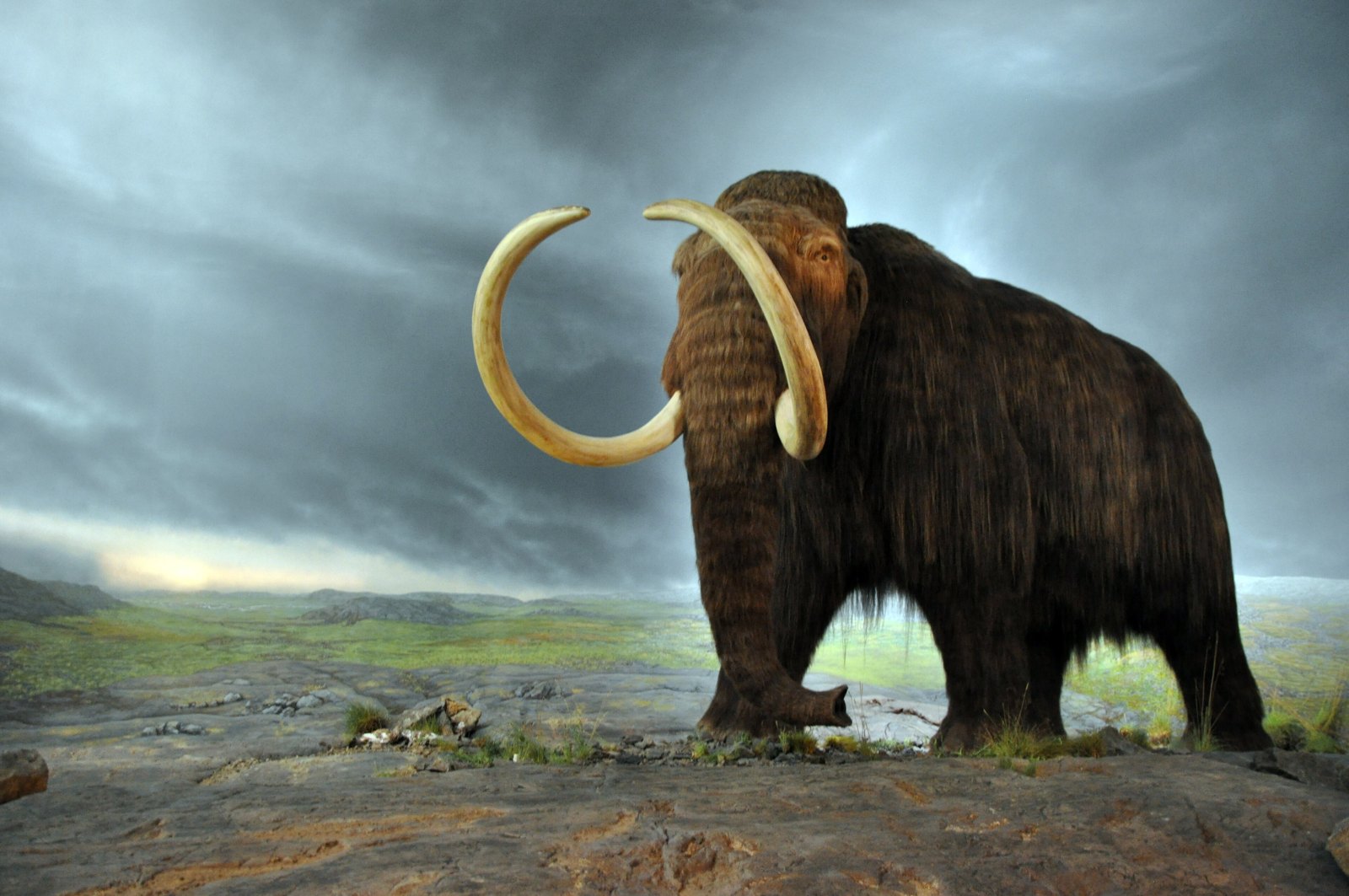
The woolly mammoth is filed in most people's heads next to the sabre-toothed cat and the glaciers: an ice age animal, gone when the ice went. That is close enough to be useful and wrong enough to be interesting, because there is a paper whose title says, flatly, that mammoths were on Wrangel Island until 2000 BC.
Not a hedge, not a maybe. That is the title.
What everyone thought until 1993
The old consensus was not sloppy — it was well-founded, and it is stated plainly in the very paper that overturned it. Writing in Nature in 1993, Sergey Vartanyan, Vadim Garutt and Andrei Sher noted that hardly anyone had doubted mammoths were extinct everywhere by around 9,500 years before present. Different researchers argued about the cause — climate at the Pleistocene–Holocene boundary, hunting by early humans, or some combination — but the date was not the controversial part.
Then the same paper reported mammoth teeth from Wrangel Island, in the Arctic Ocean off north-eastern Siberia, dated between 7,000 and 4,000 years before present.
An island that closed behind them
Wrangel's role in this is geographic accident rather than anything the animals did. As the last glaciation ended, sea level rose and severed the island from the Siberian mainland — the 1993 paper puts that separation by around 12,000 years before present. Whatever was standing on the island when the water closed stayed on the island.
Mammoths were standing on it. And where their mainland relatives disappeared, this population simply carried on, thousands of years into a world that had already moved on without them.
Two years later Vartanyan and colleagues published the radiocarbon dating in the journal Radiocarbon, under a title that does the work of an entire article: Radiocarbon Dating Evidence for Mammoths on Wrangel Island, Arctic Ocean, Until 2000 BC. The samples had been collected on the island between 1989 and 1991. Modern work still lands in the same place — the extinction is now generally put at about 4,000 calibrated years before present.
They were not dwarfs — and the man who said so took it back
The 1993 paper called them dwarf mammoths, and the label travelled far. It is still the first thing many people say about Wrangel: a shrunken, degenerate remnant, a species running down.
Its own first author disagreed, eventually, with himself. In 2008, working with a much larger dataset — 124 radiocarbon dates on mammoth bone, plus long bone measurements — Vartanyan and colleagues wrote in Quaternary Research that the Holocene Wrangel mammoths were comparable in size to those on the mainland. Not large animals, they were careful to say. But not classifiable as dwarfs either.
This matters more than a taxonomic nicety, because "degenerate island dwarfs" quietly supplies an explanation for the ending. It suggests a population already failing. Remove the label and you remove the assumption, and the actual question comes back sharper: these were ordinary mammoths, living ordinary mammoth lives, for another five and a half thousand years. So what stopped them?
The obvious answer
It writes itself. A small number of animals, cut off on an island, breeding only with each other for thousands of years. Inbreeding accumulates. Harmful mutations pile up. Genetic diversity drains away, and eventually the population cannot absorb another bad year.
It is intuitive, it matches everything conservation biology teaches about small populations, and it was the working assumption for decades. In 2024 a team finally had the data to test it directly.
21 genomes
Marianne Dehasque and colleagues, publishing in Cell, sequenced 21 woolly mammoth genomes: 14 from Wrangel Island, and 7 from the mainland population that predated the island's isolation. That design is the point — it lets you watch a genome change across a bottleneck rather than infer it from a single snapshot.
What they found does not read like a species winding down.
The island population originated from at most eight individuals. Within about 20 generations it had grown to 200–300 animals. And then it held there: demographically stable for the following six millennia and more than 200 generations, right up to the end.
The genetic side is more mixed, and the paper is careful about it. Mildly deleterious mutations did gradually accumulate — while the most severely harmful ones were purged by selection. The signature is of ongoing inbreeding depression lasting hundreds of generations, and of genetic recovery lagging far behind demographic recovery. The population got its numbers back quickly; its genome never fully caught up.
And it still is not enough
Here is the finding that reframes the whole story. Inbreeding and genomic erosion were real on Wrangel, and they were not sufficient to end the population. The team's own conclusion is that they can confidently reject the idea that the population was simply too small and doomed to go extinct for genetic reasons.
They were fine. For six thousand years, by every demographic measure available, they were fine. And then they were not.
Whatever ended the last mammoths looks abrupt, and it is genuinely unresolved. It is worth being precise about that rather than filling the gap: the researchers do not name a winner, and neither will we. There is also a real limit on the evidence — the sequenced genomes do not reach the final 300 years of the species' existence. Fossils from that last window have been recovered and are waiting to be sequenced, which means the most interesting part of this story has not been read yet.
Why the date is worth carrying around
The Wrangel population is the last one anywhere. Mammoths on St. Paul Island in the Bering Sea, the other famous late holdout, died out around 5,600 years ago — roughly sixteen centuries earlier. Wrangel is the end of the line.
So the honest answer to "when did mammoths go extinct" is not a round number attached to the end of the ice age. It is about 4,000 years ago, on one island in the Arctic Ocean, for reasons nobody has established — by a population that was not shrinking, not collapsing, and not, on the genetic evidence, doomed.
If you want to see how the record actually distributes across the map and across time, our Fossil Dex catalogues real specimens with their localities, ages and sources, and Continental Drift puts them back on the world as it was when they were buried. For why so little of any of this survives in the first place, see why fossils are not everywhere. Where our data comes from is set out in About the Data.
Sources
- Vartanyan, S.L., Garutt, V.E. & Sher, A.V. (1993). "Holocene dwarf mammoths from Wrangel Island in the Siberian Arctic." Nature 362(6418):337–340. doi:10.1038/362337a0
- Vartanyan, S.L., Arslanov, Kh.A., Tertychnaya, T.V. & Chernov, S.B. (1995). "Radiocarbon Dating Evidence for Mammoths on Wrangel Island, Arctic Ocean, Until 2000 BC." Radiocarbon 37(1):1–6. doi:10.1017/S0033822200014703
- Vartanyan, S.L., Arslanov, Kh.A., Karhu, J.A., Possnert, G. & Sulerzhitsky, L.D. (2008). "Collection of radiocarbon dates on the mammoths (Mammuthus primigenius) and other genera of Wrangel Island, northeast Siberia, Russia." Quaternary Research 70(1):51–59. doi:10.1016/j.yqres.2008.03.005
- Dehasque, M. et al. (2024). "Temporal dynamics of woolly mammoth genome erosion prior to extinction." Cell 187(14). doi:10.1016/j.cell.2024.05.033
The real record, in your pocket.
PaleoDex catalogues the real fossil record, and every fact in it is sourced. Get the app.
GET IT ON GOOGLE PLAY →