Was the Dodo Really a Clumsy Idiot?
PALEODEX · 26 August 2026 · 5 min read
For three centuries the dodo has been the mascot of extinction-by-stupidity: fat, waddling, too dumb to run. Almost none of that survives contact with the actual evidence — the painting it comes from, the bones, or the brain scan.
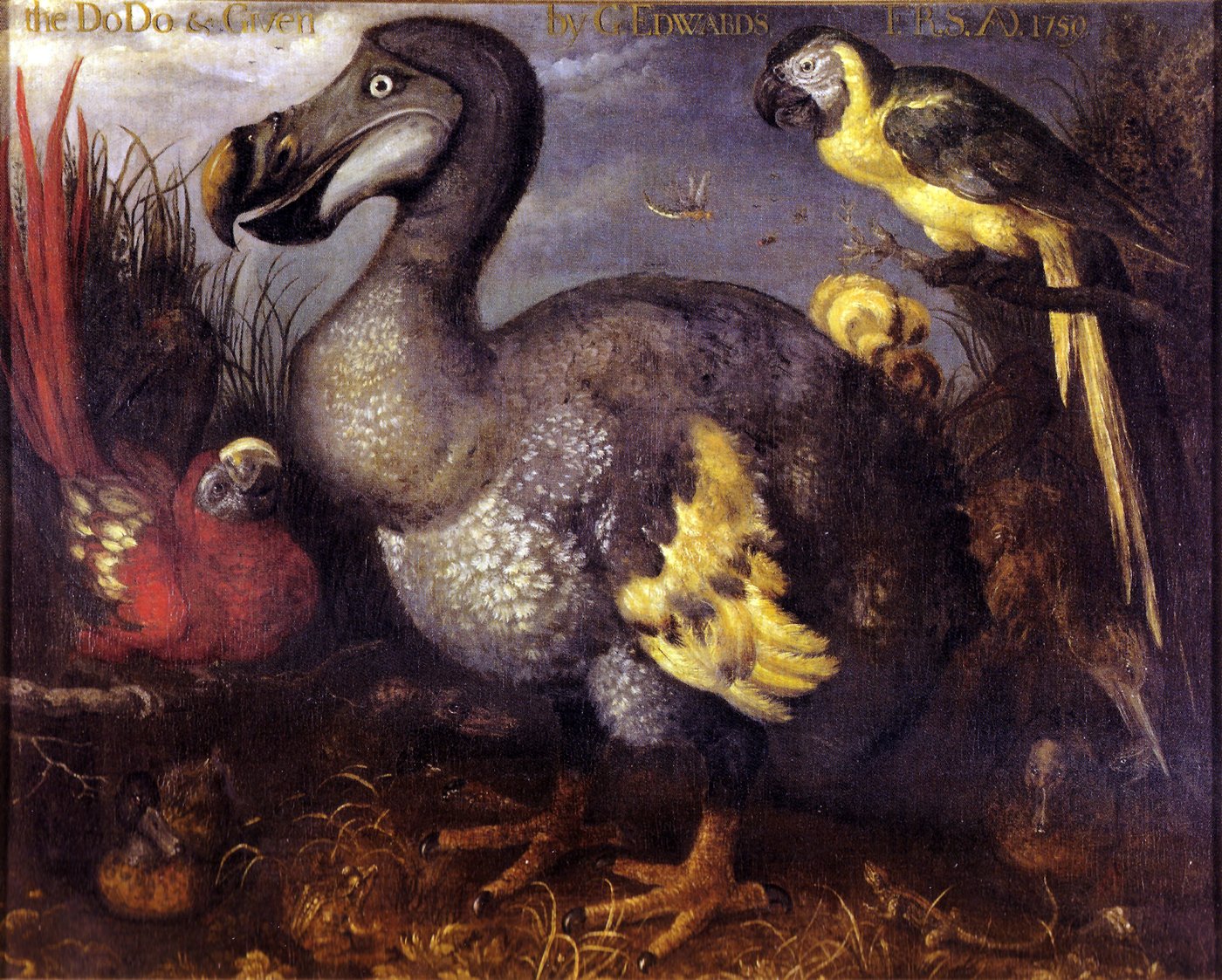
Reputations like the dodo's are why we keep checking the record against the evidence instead of the story everyone already knows. This one has a clean origin: a single painting, a captive bird, and three hundred years of illustrators copying the wrong body.
A species almost nobody ever saw alive
The dodo (Raphus cucullatus) lived on one island, Mauritius, and nowhere else on Earth. The first written record of it comes from Dutch sailors under Vice Admiral Wybrand van Warwijck in 1598, and the species was extinct within decades of that first contact. That is the entire eyewitness record humanity ever got: a few decades, a handful of ships' logs, a small number of captive birds shipped back to Europe, and the paintings made from them. Nearly everything anyone thinks they know about the living dodo was built on that thin, secondhand foundation — which is exactly how the picture went wrong.
The painting that became the template
The image most people picture — round-bellied, waddling, comically overweight — comes from one lineage of 17th-century European paintings, chiefly Roelandt Savery's so-called "Edwards's Dodo," painted around 1626. Savery almost certainly never saw a dodo in the wild; his subject was a captive bird kept in Europe. His painting, or others very like it, became the template that most later illustrators copied without questioning it, and by the time anyone thought to ask whether the picture was accurate, there were no living dodos left to check it against.
The overfed bird versus the wild one
In 1993, zoologist Andrew Kitchener published a reappraisal of the dodo's appearance in Archives of Natural History and made an obvious point that had been overlooked for three centuries: birds shipped to Europe and kept in captivity, fed on whatever sailors had on hand, would fatten up in ways a wild dodo foraging through Mauritius's forests never would. His estimate for a wild dodo's weight came out at roughly 10.6 to 17.5 kilograms. His estimate for the fattened captive birds behind the paintings: 21.7 to 27.8 kilograms — up to nearly triple the low end of the wild figure. In 2011, Delphine Angst, Eric Buffetaut and Anick Abourachid reached a strikingly similar conclusion using a completely unrelated method — scaling bone strength to body mass — and put the wild dodo as low as about 10.2 kilograms. Two independent methods landing in the same range is a real result, not a coincidence.
Not every artist of the period got it wrong, either. Around 1625, the Mughal court painter Ustad Mansur produced a dodo portrait now considered one of the more accurate depictions of a live bird — leaner, longer-legged, closer to what the bones actually show. It just never became the picture that stuck in the culture.
Built for the forest floor, not for falling over
The strongest evidence against "clumsy" doesn't come from art history at all — it comes from the skeleton. A 2016 osteological study of the Thirioux dodo specimens, led by Leon Claessens, Hanneke Meijer, Julian Hume and Kenneth Rijsdijk, examined the leg bones in detail and found them robust and well-muscled, consistent with an animal built for agile, fast movement through dense forest. Their conclusion ran opposite to the popular image: the dodo was, in their words, "perfectly adapted to its island home" — not an oversized bird stumbling through the undergrowth.
Fearless is not the same thing as stupid
The other half of the myth — that dodos were too dumb to run from sailors — mixes up two different traits. Before humans arrived, Mauritius had no native land-mammal predators at all, so dodos evolved with no fear or flight response to large animals walking toward them. Biologists call this island tameness, and it shows up repeatedly in species that evolve without predators. It's a behavioral trait, not a cognitive one: the dodo didn't fail some test of intelligence by standing its ground. It had simply never had a reason to run.
About as smart as a pigeon — literally
That distinction matters more once you look at what the dodo's brain actually says. In 2016, a team led by Eugenia Gold at Stony Brook University and the University of Copenhagen CT-scanned the skulls of eight columbid species — from the extinct Rodrigues solitaire to the living common pigeon — and built virtual brain endocasts to compare them. The dodo's brain-to-body-size ratio landed almost exactly where the pattern predicted for an animal its size, comparable to today's pigeons. That's not a case for the dodo being unusually smart, and it isn't evidence it was unusually dumb either — it's a bird whose brain scaled the way you'd expect. And "compared to a pigeon" isn't a joke here; it's literal. The dodo was a giant, flightless pigeon, a member of the family Columbidae, and its closest living relative is the Nicobar pigeon.
Stories like this one keep the shape of a rumor long after the evidence has moved on — the same way Brontosaurus spent a century erased over a mismatched skull, and a real 1990s science claim outlived the study that made it. The PaleoDex catalogue tries to hold claims like these the way the literature does: sourced, dated, and left blank where the evidence runs out.
Sources
Sourced, not assumed — the papers and their context below.
- Wikipedia — "Dodo" (first record 1598, extinction timeline, depiction history, Ustad Mansur painting, Columbidae relationships)
- Kitchener 1993 — "On the external appearance of the dodo, Raphus cucullatus (L., 1758)" — Archives of Natural History 20(2): 279–301
- Angst, Buffetaut & Abourachid 2011 — "The end of the fat dodo? A new mass estimate for Raphus cucullatus" — Naturwissenschaften 98(3): 233–236
- Claessens, Meijer, Hume & Rijsdijk 2016 — "Anatomy of the Dodo (Raphus cucullatus L., 1758): An Osteological Study of the Thirioux Specimens" — Journal of Vertebrate Paleontology, Society of Vertebrate Paleontology Memoir 15
- Gold et al. 2016 — "The first endocast of the extinct dodo (Raphus cucullatus) and an anatomical comparison amongst close relatives" — Zoological Journal of the Linnean Society
- Stony Brook University — "Study Reveals Dodo Birds Not Stupid As Previously Thought" (2016-02-23)
The real record, in your pocket.
PaleoDex catalogues the real fossil record, and every fact in it is sourced. Get the app.
GET IT ON GOOGLE PLAY →