Amber's DNA Myth, and What It Actually Preserves
PALEODEX · 16 July 2026 · 6 min read
Jurassic Park's whole premise, a mosquito in amber still full of dinosaur DNA, was inspired by a real, published science claim in 1993. Real science says it doesn't hold up. But the reason why, and what amber actually preserves instead, is stranger than the movie.
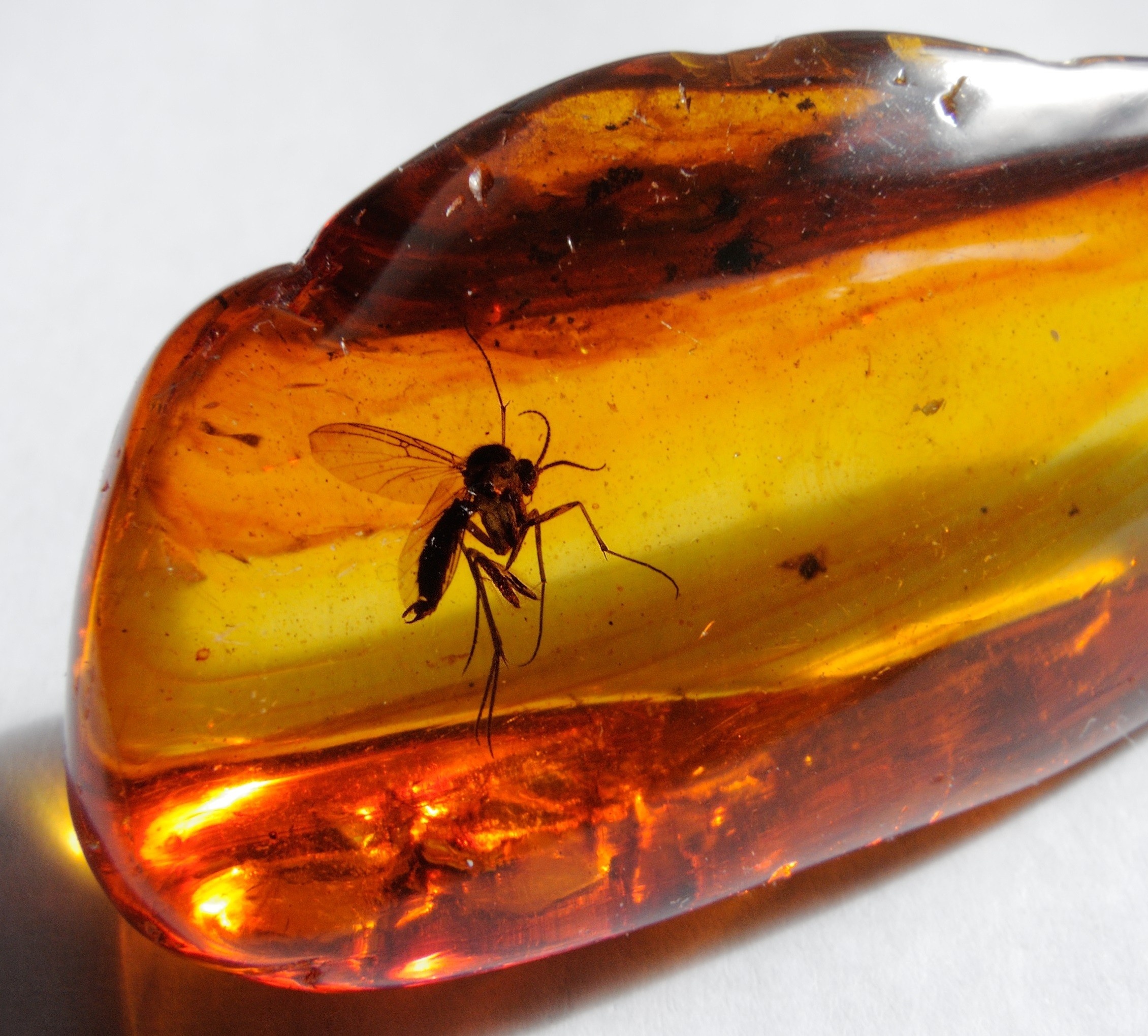
We touched on this briefly in our Jurassic Park myths roundup; this is the deep dive. The amber-DNA premise isn't just a movie invention. It's a real claim that real scientists published, in a real journal, three decades ago. Here's what they found, why it fell apart, and what amber turns out to be extraordinary at instead.
The claim that helped inspire Jurassic Park
In 1993, researchers led by Raul Cano, working with George Poinar Jr., announced in the journal Nature that they had amplified and sequenced DNA fragments from a weevil sealed in Lebanese amber, dated to 120–135 million years old. It wasn't a fringe claim: it was published in one of the most rigorous journals in science.
The connection to Michael Crichton is documented, not folklore. Crichton had read George Poinar's earlier work on amber-preserved insects and, by Poinar's own account, later contacted him directly and flew out to talk before writing Jurassic Park. The novel's central idea, dinosaur DNA extracted from an amber-trapped mosquito, grew directly out of Poinar's real research program.
Why it doesn't hold up
DNA is a chemical, and chemicals break down. In 2012, a team led by Morten Allentoft measured exactly how fast, using 158 radiocarbon-dated leg bones from the extinct New Zealand moa: DNA has a half-life of about 521 years for a given fragment. Half of it gone every five centuries.
That's a bone measurement, not an amber one (the study says nothing directly about insects in amber). But the chemistry of decay doesn't care what the burial medium is. Run the same math out over a few million years, let alone 120 million, and there's nothing left in a readable state. The paper's own theoretical best case puts a hard ceiling on DNA surviving intact at under 7 million years, even in ideal cold storage.
Nobody could replicate it
The 1993 weevil result was never independently reproduced, and it's now treated by the field as contamination: modern DNA that made its way into the sample, not a 120-million-year-old genetic time capsule.
A separate 2013 study, led by David Penney, tested two stingless bees preserved in Colombian copal (young tree resin, not fully fossilized amber), one barely a few decades old and one around 10,600 years old. Using modern sequencing, they found no authentic ancient DNA in either. It's important to be precise about what this shows: copal and 120-million-year-old amber are very different materials on very different timescales, so this wasn't a direct re-test of the 1993 claim. But finding nothing survives even in resin a fraction of that age only deepened the doubt about the older result.
What amber actually preserves
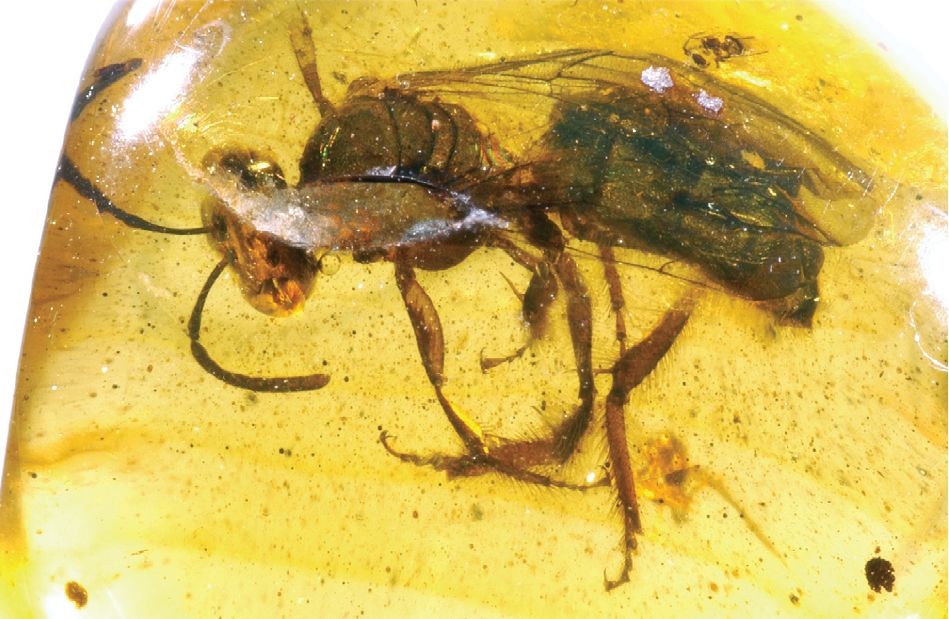
Amber isn't a dead end for the fossil record. It's one of the best preservation systems on Earth, able to trap an organism's full three-dimensional structure, texture, and in some cases even original color, sealed away from decay and scavengers within moments of the resin flowing.
The best proof of that isn't DNA. It's pollen. In 2007, Santiago Ramírez and colleagues described a stingless bee, Proplebeia dominicana, preserved in Dominican amber 15–20 million years old, still gripping a pollen clump from an extinct orchid, Meliorchis caribea, on its back. It remains the oldest unambiguous fossil evidence of the entire orchid family ever found. Before this fossil, molecular-clock estimates for how old the orchid family is had ranged wildly, anywhere from under 30 million years to over 100 million. By anchoring an actual fossil to the family tree, Ramírez's team helped settle that debate, dating the orchids' origin to roughly 76–84 million years ago, deep in the age of dinosaurs.
So, can you clone a dinosaur from amber?
No. Not from a 120-million-year-old insect, not from a mosquito, not with any sequencing technology that exists or is likely to. The math on DNA decay is unambiguous, and the one headline claim that suggested otherwise didn't survive scrutiny. But the honest answer is more interesting than a flat no: amber is a genuine time machine for structure, just not for genetic code, capable of holding a pollen grain in place on an insect's back for twenty million years, waiting for someone to look closely enough to notice.
Why this belongs in PaleoDex
This is exactly the kind of story PaleoDex exists to get right: a real, published, decades-old scientific claim, traced back to its actual paper, checked against what came after, with the parts that held up kept and the parts that didn't clearly marked as such. No invented drama, no live debate where the science has actually settled. Read more myth-vs-record deep dives from the record.
Sources
Every fact above is drawn from the primary literature:
- Cano, R.J., Poinar, H.N., Pieniazek, N.J., Acra, A., & Poinar Jr., G.O. (1993). "Amplification and sequencing of DNA from a 120–135-million-year-old weevil." Nature 363:536–538. (nature.com/articles/363536a0)
- Allentoft, M.E. et al. (2012). "The half-life of DNA in bone: measuring decay kinetics in 158 dated fossils." Proceedings of the Royal Society B. (royalsocietypublishing.org)
- Penney, D., Wadsworth, C., Fox, G., Kennedy, S.L., Preziosi, R.F., & Brown, T.A. (2013). "Absence of Ancient DNA in Sub-Fossil Insect Inclusions Preserved in 'Anthropocene' Colombian Copal." PLOS ONE 8(9):e73150. (journals.plos.org)
- Ramírez, S.R., Gravendeel, B., Singer, R.B., Marshall, C.R., & Pierce, N.E. (2007). "Dating the origin of the Orchidaceae from a fossil orchid with its pollinator." Nature 448:1042–1045. (nature.com/articles/nature06039)
The real record, in your pocket.
PaleoDex catalogues the real fossil record, and every fact in it is sourced. Get the app.
GET IT ON GOOGLE PLAY →