How Long Did It Take the World to Recover?
PALEODEX · 27 August 2026 · 7 min read
The asteroid killed three of every four species on Earth in an afternoon. What came back didn't run on one clock — it ran on thousands of them, and "how long did recovery take" is the wrong question until you specify recovery of what, measured how.
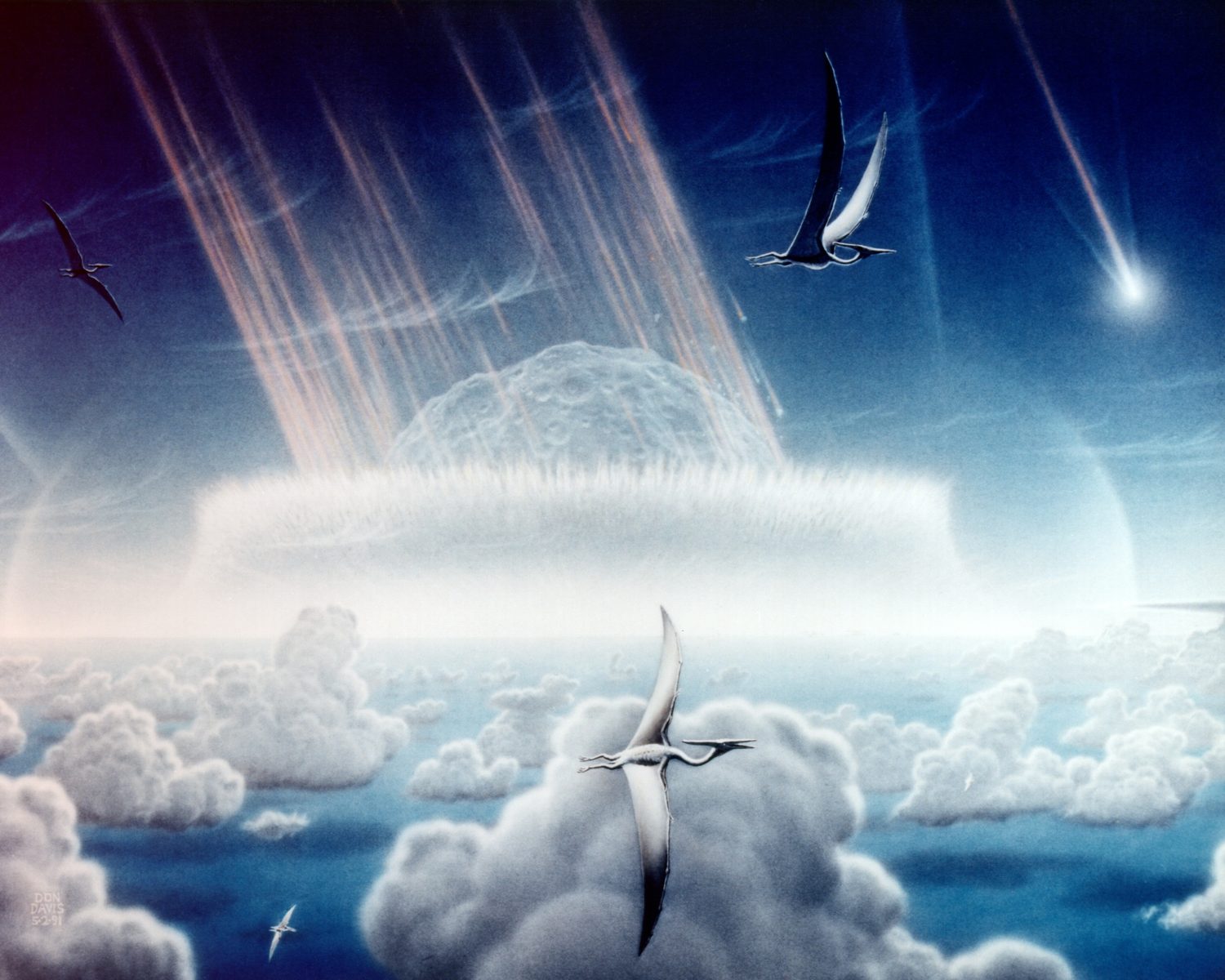
Ask how long the world took to recover from the asteroid that ended the Cretaceous, and the honest answer isn't a number. It's a question back: recovery of what?
Seventy-five percent, gone at once
About 66 million years ago, an asteroid struck what is now Mexico's Yucatán Peninsula, at a site geologists call Chicxulub. What followed is one of the best-documented mass extinctions in the fossil record: roughly 75% of species on Earth were wiped out — three in every four — non-avian dinosaurs included. Some of the physical evidence from that day survives in extraordinary, and disputed, detail; we've written separately about Tanis, the North Dakota fossil bed some researchers argue records the impact's first hours.
Recovery of what, exactly?
Ask a paleontologist how long the world took to recover and you'll get answers that don't agree — not because they're arguing, but because "recovery" was never one event. It was thousands of species and ecosystems, each running its own clock: how fast a new species can evolve, how fast a population can rebuild to a sustainable size, how fast a forest regains its structure, how fast the top of a food chain reappears. Line up four independently measured recovery windows for this one extinction and the range runs from a few thousand years to ten million — a thousand-fold spread, and every figure in it is real, sourced, and about the same asteroid.
About 6,000 years: the fastest clock
The fastest documented recovery belongs to something you'd never see without a microscope: floating single-celled plankton called foraminifera. In a March 2026 study in Geology, Christopher Lowery and colleagues used helium-3 isotope dating — a technique that reads the near-constant trickle of cosmic dust settling into seafloor sediment, like a metronome buried in the rock — to build more precise age models for six K–Pg boundary sites across Europe, North Africa, and the Gulf of Mexico. They found that new planktic foraminifera species, including one named Parvularugoglobigerina eugubina, evolved and spread within roughly 2,000 to 11,000 years of the impact — as many as 10 to 20 new species inside about 6,000 years. On a geological clock, that's close to instantaneous.
700,000 years: from survivor to giant
Land mammals took longer, and one Colorado hillside preserves the whole climb. Corral Bluffs, in the Denver Basin, holds an unusually continuous one-million-year fossil record spanning the K–Pg boundary, described by Tyler Lyson and colleagues in a 2019 Science paper. It shows mammal body size increasing roughly 100-fold over 700,000 years: rat-sized survivors — animals in the mold of the small early mammal Loxolophus — reached raccoon size within about 100,000 years, beaver size by 300,000 years, and by 700,000 years, sizes past 100 lb (roughly 45 kg), including Taeniolabis taoensis, one of the largest land mammals of its moment. A rat to a 100-pound animal, in less time than separates us from the last Ice Age.
Six million years: growing a rainforest back
Forests took even longer — not just to regrow trees, but to become a structurally different kind of forest. In a 2021 Science paper, Mónica Carvalho and colleagues analyzed pollen and spores from more than 1,000 plant taxa across 39 rock sections in Colombia, roughly 1,500 km south of the impact site. Before the extinction, the forests there were open and sunlit, dominated by conifers and ferns. It took about six million years for that to become something recognizably modern: a closed, shaded canopy dominated by flowering plants — the template for today's Neotropical rainforest.
Ten million years: when the top of the food chain came back
The longest number here isn't a K–Pg measurement at all — it's a pattern found across the whole fossil record. In a 2000 Nature paper, James Kirchner and Anne Weil cross-correlated extinction and origination rates through the entire Phanerozoic marine fossil record and found that origination rates — how fast new species appear — consistently lag extinction rates by roughly ten million years, no matter how severe the extinction. It reads like a speed limit on how fast biodiversity can rebuild itself.
So, how long did it take?
None of these numbers is "the" answer, and none of them is wrong. Recovery from a mass extinction isn't a finish line the whole planet crosses together — it's thousands of species finishing their own races at wildly different speeds. "About 6,000 years" and "about ten million years" are both true statements about the same asteroid, measured differently. It's also part of why some lineages barely noticed the extinction at all: we've covered separately why crocodiles came through the K–Pg boundary largely intact — survival and recovery were never governed by the same clock.
Every figure above is tied to a named, dated study, in the spirit of the Fossil Library PaleoDex is building — and where every fact in the app comes from is public, on the data page. If a recovery timeline isn't sourced, we leave it blank.
Sources
- Lowery, C. M. et al. (2026). "Timing of biotic recovery in the earliest Danian based on new Helium-3 age models." Geology 54(3):285. DOI: 10.1130/G53313.1.
- ScienceDaily (2026-03-15). "Life rebounded shockingly fast after the asteroid that killed the dinosaurs" — secondary summary of Lowery et al. 2026, naming authors and figures.
- Lyson, T. R. et al. (2019). "Exceptional continental record of biotic recovery after the Cretaceous–Paleogene mass extinction." Science 366(6468):977–983. DOI: 10.1126/science.aay2268.
- Smithsonian Magazine. "Fossil Site Reveals How Mammals Thrived After the Death of the Dinosaurs" — secondary summary of Lyson et al. 2019, source for the staged body-size figures and the Eocene apex-niche timing.
- Carvalho, M. R. et al. (2021). "Extinction at the end-Cretaceous and the origin of modern Neotropical rainforests." Science 372(6537):63–68. DOI: 10.1126/science.abf1969.
- Kirchner, J. W. & Weil, A. (2000). "Delayed biological recovery from extinctions throughout the fossil record." Nature 404:177–180. DOI: 10.1038/35004564.
The real record, in your pocket.
PaleoDex catalogues the real fossil record, and every fact in it is sourced. Get the app.
GET IT ON GOOGLE PLAY →