How Crocodiles Got Through the Asteroid
PALEODEX · 22 August 2026 · 7 min read
Everyone knows crocodiles made it through. The usual explanations — that they are tough, or that they are living fossils that never needed to change — are both wrong, and the real answer comes in two halves.
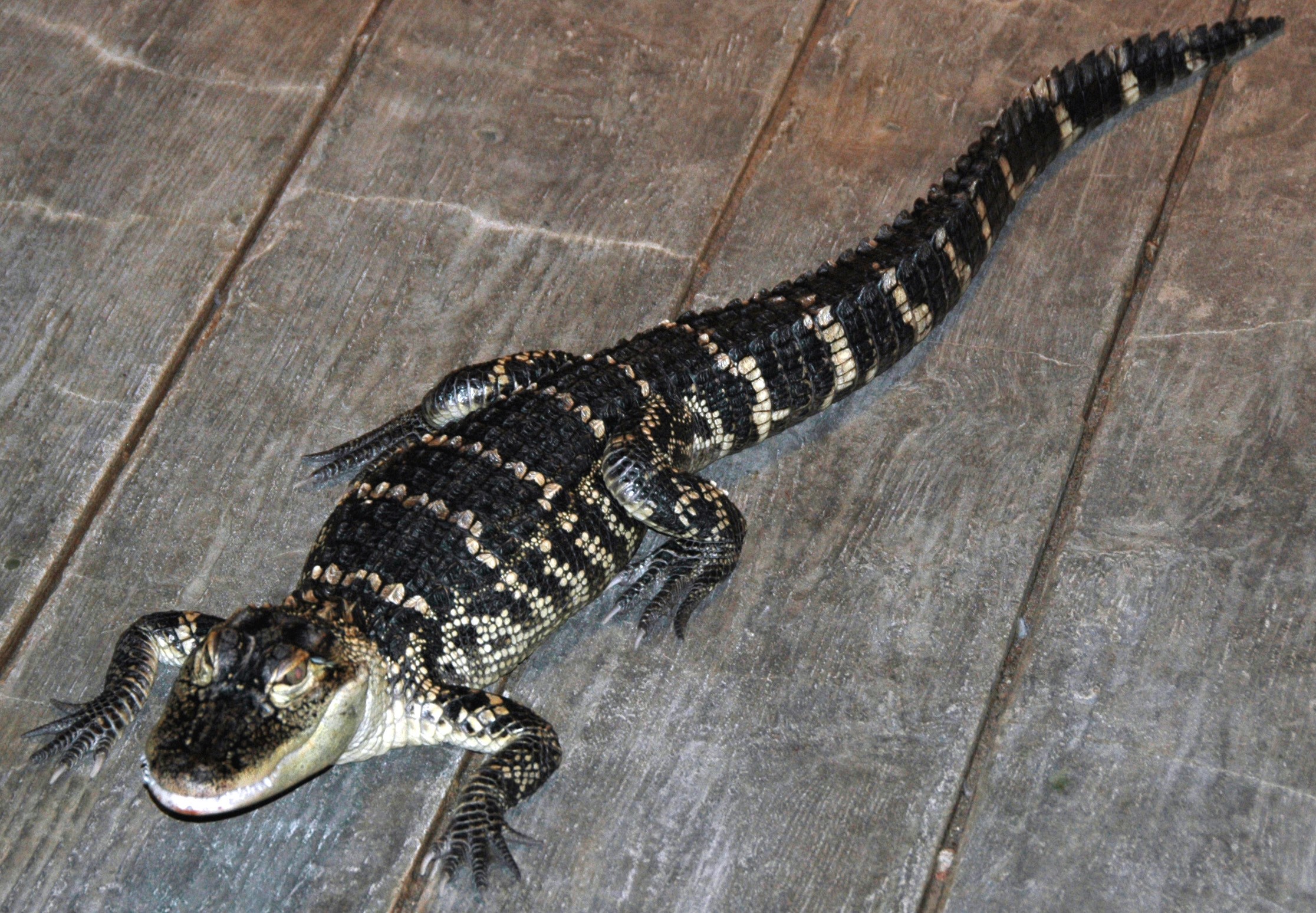
Ask why crocodiles survived the end-Cretaceous extinction and you will usually get one of two answers. They are tough. Or they are living fossils — unchanged for so long that the asteroid was just another bad afternoon. Neither survives contact with the fossil record.
They were never unchanged
“Most people think of crocodylians as living fossils — stubbornly unchanged, prehistoric relics.” That is Keegan Melstrom of the Natural History Museum of Utah, describing the assumption his team set out to test, and it is the first thing their results take apart.
Through most of the age of dinosaurs, this was not a conservative group. There were crocodile relatives that hunted on land on long legs. There were forms that went out into the open ocean, with their limbs remodelled into paddles and a fin on the tail — the only archosaurs known to have gone fully pelagic. There were ones that ate plants, with multicusped leaf-shaped teeth, and herbivory evolved in the group more than once.
Almost none of that is left. What survives is a narrow slice of what the group used to be: the plain ones, in the water. That is the shape of the question. If the strange ones all went, what did the survivors have that they did not?
Half the answer is diet
A 2025 paper in Palaeontology went looking. Melstrom, Kenneth Angielczyk, Kathleen Ritterbush and Randall Irmis measured the skulls of 99 extinct species and 20 living ones — 119 species, spanning 230 million years — and used cranial shape, with other morphological proxies, to reconstruct what each animal ate.
One thing lines up with getting through a mass extinction, and it is not size or armour, neither of which the study tested. It is diet. In their words, “a generalist dietary ecology is associated with mass extinction survivors.”
And it happens twice. Terrestrial generalists survive and diversify after the end-Triassic. Semiaquatic generalists persist through the end-Cretaceous. Both times, the specialists go.
The other half is where you were standing
Diet explains which animals were eligible. It does not explain the first day.
For several hours after the Chicxulub impact, the entire Earth was bathed in intense infrared radiation from ejecta falling back through the atmosphere. Not the blast — the debris, re-entering. Robertson, McKenna, Toon, Hope and Lillegraven set out the consequence in 2004: the heat pulse would have killed unsheltered organisms outright, and sheltering underground, inside natural cavities, or in water would have been “a necessary but not always sufficient condition for survival.”
Read that hedge carefully. Water was not a guarantee. It was a requirement.
90% against 12%
There is one place where the consequence can be counted. In eastern Montana, a database of terrestrial vertebrate species from above and below the boundary — assembled by J. D. Archibald and L. J. Bryant — was split into freshwater and land-dwelling assemblages by Peter Sheehan and David Fastovsky in 1992.
Corrected for the effects of rare taxa, 90% of species in the freshwater assemblage survived into the Tertiary. Of the land-dwelling forms, 12% did.
That figure is about a whole freshwater community in one basin, not about crocodiles specifically — which is exactly what makes it evidence about habitat rather than about any one animal. Why water helped is still argued. Sheehan and Fastovsky pointed at food: a land community runs on primary productivity, and the sunlight went out, while a river derives much of its organic carbon from detritus. That is their hypothesis, hedged twice in their own abstract, and it is one of several on the table alongside thermal shelter and low metabolic demand.
And it was not a triumph
Here the story gets less tidy, and it should. An analysis of diversification across Crocodyliformes by Mario Bronzati, Felipe Montefeltro and Max Langer found only a minor impact of the K/Pg crisis on the group as a whole. There was a post-extinction diversification — but it was confined to the alligatoroids, and to no one else.
So: no great dying, and no great recovery either. One group spread out afterwards and that was all. They did not sail through it, and they did not bounce back.
They just kept going. Which, for a group that once had galloping land hunters and ocean swimmers and animals that ate leaves, is a stranger ending than either of the stories people usually tell.
Sources
- Melstrom, K. M., Angielczyk, K. D., Ritterbush, K. A. & Irmis, R. B. (2025). “For a while, crocodile: crocodylomorph resilience to mass extinctions.” Palaeontology 68:e70005.
- Sheehan, P. M. & Fastovsky, D. E. (1992). “Major extinctions of land-dwelling vertebrates at the Cretaceous-Tertiary boundary, eastern Montana.” Geology 20(6):556–560.
- Robertson, D. S., McKenna, M. C., Toon, O. B., Hope, S. & Lillegraven, J. A. (2004). “Survival in the first hours of the Cenozoic.” GSA Bulletin 116(5–6):760–768.
- Bronzati, M., Montefeltro, F. C. & Langer, M. C. (2015). “Diversification events and the effects of mass extinctions on Crocodyliformes evolutionary history.” Royal Society Open Science 2:140385.
- Melstrom, K. M. & Irmis, R. B. (2019). “Repeated Evolution of Herbivorous Crocodyliforms during the Age of Dinosaurs.” Current Biology.
The real record, in your pocket.
PaleoDex catalogues the real fossil record, and every fact in it is sourced. Get the app.
GET IT ON GOOGLE PLAY →