How Do You Prove a Fossil Was an Animal?
PALEODEX · 10 October 2026 · 8 min read
A 558-million-year-old oval with no shell and no mouth has been called a lichen, a giant single cell and an animal. In 2018 a team stopped arguing about its shape and read its molecules instead.
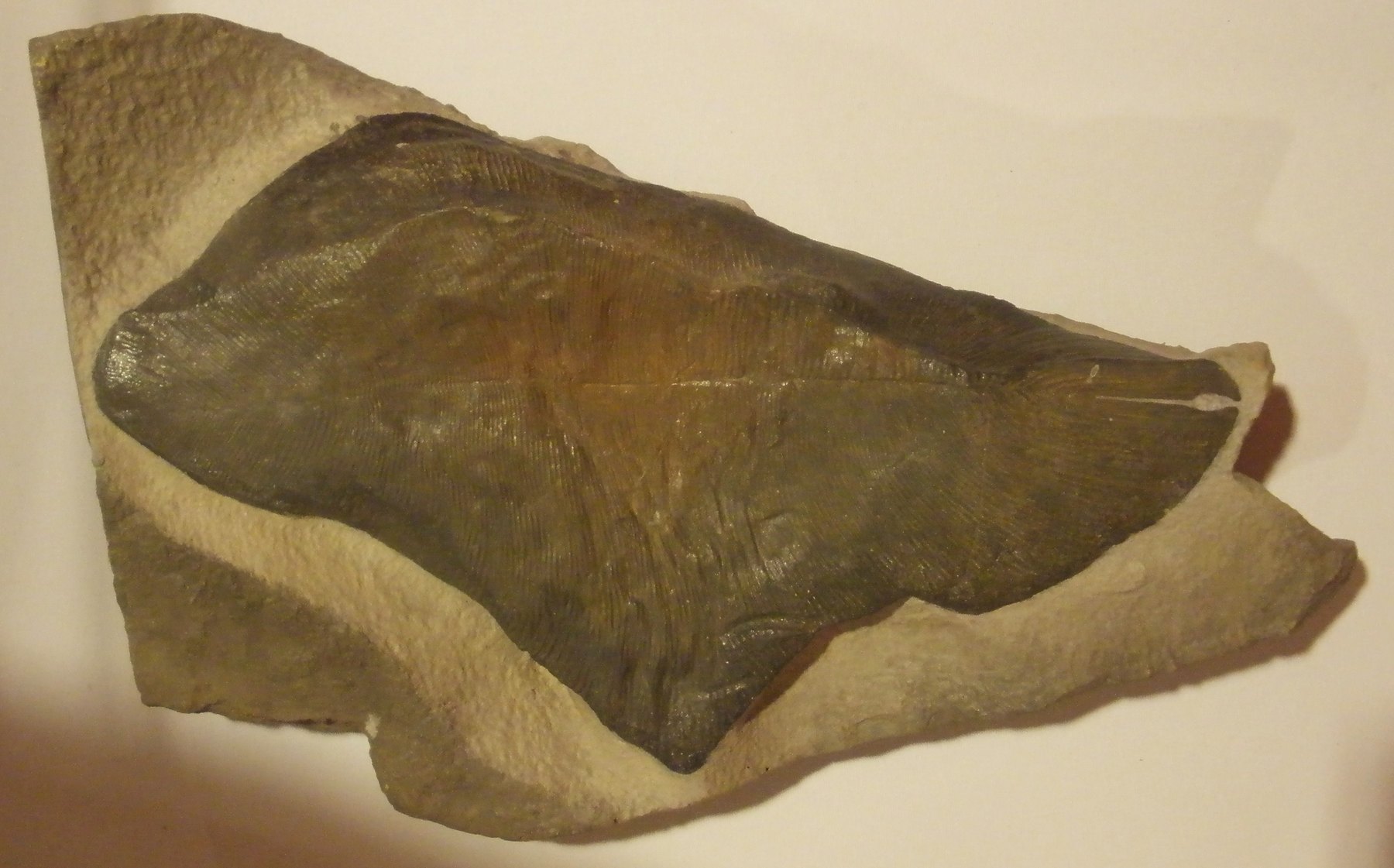
There are fossils that are hard to identify because they are broken, and fossils that are hard to identify because they are small. Dickinsonia is neither. It is a flat, ribbed oval reaching 1.4 m long, preserved well enough that you can count the ribs, and for decades nobody could say what kingdom it belonged to.
It is 558 million years old. It has no shell, no skeleton, and no mouth anyone has found. Interpretations have ranged across the whole tree of life: a marine animal, a giant single-celled organism, a lichen growing on a surface. None of those readings was careless, and that is the point worth sitting with. The shape genuinely could not decide. The 2018 study that changed the question puts it flatly: for many of these fossils it “currently seems impossible to distinguish between giant protist and metazoan origins” from morphology alone.
A second kind of evidence
If the shape cannot settle it, something else has to. On Russia's White Sea coast, at a locality called Lyamtsa, some Dickinsonia specimens are preserved in an unusual way: not as an impression in stone, but as a thin film of organic matter still sitting on the rock surface. That film is the animal's own carbon. It has been cooked by time and pressure, but the molecules in it descend from the molecules the organism built.
In 2018 a team detached that film from the rock and extracted it for molecular biomarkers, under strict exclusion of contamination. The design is what makes the result readable, and it is the part most retellings skip: the sediment immediately above and below each fossil was extracted the same way and run as a control. Without that, a molecule found in a fossil is just a molecule found in a rock. With it, you can ask a sharper question — is this film different from the mud it was buried in?
What a sterol can tell you about a kingdom
Sterols are the molecules that stiffen cell membranes; cholesterol is the one you have heard of. Different branches of life build different ones, and the differences are not subtle enough to be coincidence.
Lichen-forming fungi only produce ergosteroids — and even the ones that host symbiotic algae keep ergosteroids as their major sterols. The giant single-celled groups that were on the table produce a complex mixture, and can make C30 sterols that reach a notable share of their total. Animals, with rare exceptions such as some demosponges and bivalve molluscs, are characterised by exclusive production of C27 sterols. So the sterol type is not a clue about diet or environment. It is a label that points at a branch of the tree.
93 per cent
The sediment behaves exactly as sediment should: it is dominated by the sterols green algae make. The fossil film does not. In the largest Dickinsonia specimen tested, 93% of the monoaromatic steroid molecules were cholesteroids — degraded members of the cholesterol family.
That sentence has to be read with its denominator attached, because this is where popular versions go wrong. It is not that the fossil is 93% cholesterol. It is that of the steroid molecules recovered from the organic matter isolated from that specimen, 93% belong to the C27 family. And it is specifically about the largest specimen: across the ones tested, cholesteroid abundance climbs from 84.8% in the smaller fossils to 93.0% in the biggest. Every careful version of this claim says “the biggest fossil tested” rather than “Dickinsonia”, and that is not hedging for its own sake — it is the difference between the measurement and an extrapolation from it.
A film that is overwhelmingly C27 does not look like a lichen, and does not look like a giant protist. The lichen reading, which had been argued in print, is the one the study set out to test, and the molecules do not support it. What the film looks like is an animal.
The objection that is still in print
This is the part that usually gets dropped, and it is the reason we wrote the video and this post the way we did. In 2022 a geologist published a direct challenge, in a peer-reviewed journal, and it has not gone away. Cholestanes, he writes, “are found in animals, but also in fungi and red algae”, and “Cholesterol (C27) is the main sterol in red algae”. He also holds that “Modern contamination is a concern with the available steroid analyses” of these Russian specimens, and classifies the fossil as a fungus rather than an animal.
One detail is worth checking rather than assuming, so we checked it: red algae are not discussed anywhere in the main text of the 2018 paper. The study rules out lichens and the giant single-celled groups explicitly; it does not take up red algae at all. That does not make the objection correct. It does mean the 2018 paper is not where you will find it answered.
And the caution is not confined to the dissent. A 2025 reassessment that works entirely inside the animal reading — it describes these fossils as animals in its own abstract — still notes that cholesterol “is also produced by many eukaryotes”, and that contamination cannot be ruled out.
Where that leaves it
Most researchers read Dickinsonia as one of the oldest known animals, and the molecular evidence is the reason. One published objection stands against that, and the honest shape of the situation is a weight of opinion rather than a verdict: the molecules point to animal, and not everyone has signed off.
What actually changed in 2018 is not that the argument ended. It is that it stopped being an argument about what a shape looks like and became an argument about evidence you can measure, with a control, and disagree about in public. That is a better argument to be having, and it is the kind of open question we would rather leave open than close for you. If you want to see what else is in the record, the catalogue is in Fossil Dex, and you can watch the continents move underneath all of it in Continental Drift. We have written before about the rock that was supposed to be empty, and about how we handle uncertainty like this in About the Data.
Sources
- Bobrovskiy, I., Hope, J.M., Ivantsov, A., Nettersheim, B.J., Hallmann, C. & Brocks, J.J. 2018. Ancient steroids establish the Ediacaran fossil Dickinsonia as one of the earliest animals. Science 361(6408): 1246–1249. The source of the 93% figure, the 84.8–93.0% range across specimens, the control design and the sterol-by-kingdom comparison.
- Retallack, G.J. 2022. Damaged Dickinsonia specimens provide clues to Ediacaran vendobiont biology. PLOS ONE 17(6): e0269638. The published objection quoted above: red algae, fungi, and modern contamination.
- Mulligan, C.R. & Gold, D.A. 2025. A reassessment of the coprostane biomarker in the Ediacaran with implications for Dickinsonia. Geobiology 23(4): e70029. Works inside the animal reading and still records the “many eukaryotes” caveat.