Oxygen Was a Poison Before It Was an Atmosphere
PALEODEX · 1 August 2026 · 7 min read
The gas keeping you alive right now was once a reactive waste product almost nothing on the planet had a defense against. It took 200 million years of failing to stick before it finally did.
For roughly the first two billion years of Earth's history, the atmosphere had essentially no free oxygen. Every living thing on the planet ran on chemistry that oxygen actively destroys. Then something started making it anyway — as waste — and the fallout took 200 million years to settle.
The world before oxygen
We don't have to guess that early Earth's air was oxygen-free — it's measured, not assumed. A specific kind of sulfur isotope signature, called mass-independent fractionation, only survives when there's essentially no free oxygen (and therefore no ozone layer) up in the sky. That signature shows up in Precambrian rocks and then simply stops appearing in anything younger than about 2.45 billion years old. Before that line, gas-phase atmospheric chemistry — not biology — was running the sulfur cycle. Every organism alive at the time was built for a world that free oxygen would have destroyed.
A waste product that changed everything
Then a new kind of photosynthesis evolved — the oxygen-releasing kind — and it started dumping a reactive gas into a world that had never had to handle it. To nearly everything alive at the time, that gas was toxic. The physical evidence for the organisms doing this is still around today: stromatolites, the layered mounds built by photosynthetic microbial mats, are still forming in a handful of places on Earth, most famously Shark Bay in Western Australia. Atmospheric oxygen starts climbing around 2.46 to 2.43 billion years ago — the onset of what's called the Great Oxidation Event.
Not a moment — a 200-million-year stutter
"Event" undersells what actually happened. Oxygen didn't arrive and stay. For roughly the next 200 million years, it repeatedly crosses the threshold and vanishes again, in step with some of the most severe ice ages in Earth's history — a sequence of Paleoproterozoic glaciations that shows up in the rock record alongside the oxygen swings. It doesn't become a permanent feature of the atmosphere until around 2.2 billion years ago, tied to a shift in the carbon cycle called the Lomagundi excursion. That's a genuine 200-million-year delay between the first appearance of oxygen and its permanence — about 100 million years longer than scientists thought as recently as a few years ago.
The rock everyone points to — and why it's contested
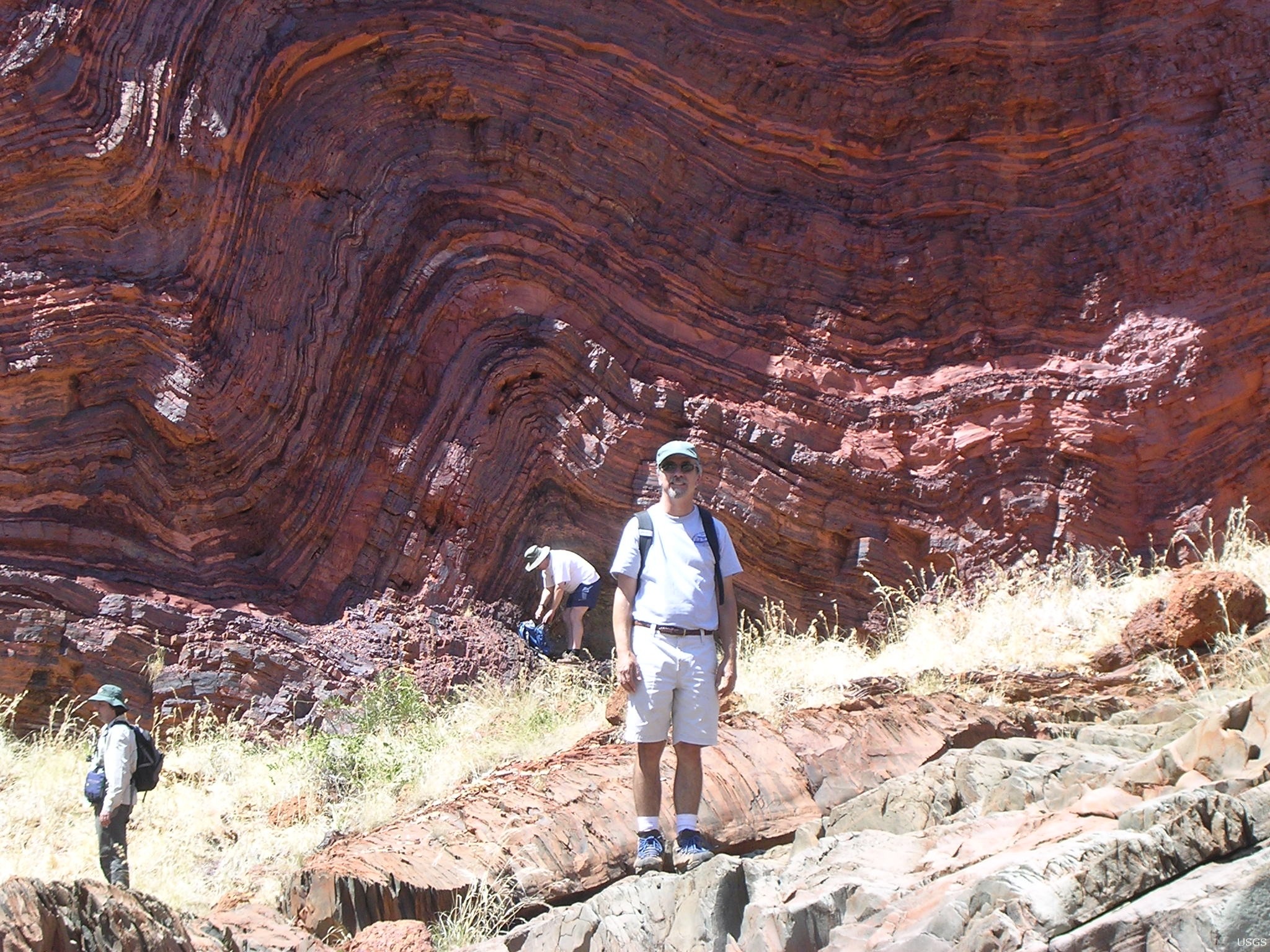
The classic image for all of this is banded iron formation: a striped red-and-grey rock made of layers of iron that dropped out of the ancient ocean in pulses. The popular story says the ocean rusted the moment oxygen showed up. That's not settled science. A substantial body of research argues that a lot of that iron may have been oxidized by anoxygenic bacteria — organisms that need no oxygen at all, just light and dissolved iron, to do the same chemical job. Even the rock everyone points to as proof of the Great Oxidation Event isn't clean proof of the thing it's supposed to prove.
The payoff — and the honest gaps
Here's the part worth sitting with: the gas that was lethal to nearly everything alive on Earth at that point in time is the same gas you just breathed in. A waste product that should have been catastrophic is the reason this planet works the way it does now.
What actually drove the 200-million-year oscillation, and how much of that oxygen-free world was lost in the transition, is still genuinely unresolved. There's no fossil record of a die-off to count, and no honest number anyone can put on it — which is a more interesting answer than a fake one would be.
Why this matters for the fossil record
Every animal in the Fossil Library — every giant, every predator, everything with a skeleton to fossilize in the first place — is downstream of this chemistry. Oxygen didn't just make the air breathable; it's part of what makes large, active, skeleton-building life possible at all. The plants that later pumped out even more of it get their own credit, but the first, harder shift happened here, in rock that predates anything with a face. As always, every date and figure above traces to a named source — see where every fact comes from.
Sources
Every claim above traces to one of these — sources below.
- Farquhar, Bao & Thiemens (2000), "Atmospheric influence of Earth's earliest sulfur cycle," Science 289:756–759
- Gumsley et al. (2017), "Timing and tempo of the Great Oxidation Event," PNAS 114(8):1811–1816
- Poulton et al. (2021), "A 200-million-year delay in permanent atmospheric oxygenation," Nature 592:232–236
- Kappler, Pasquero, Konhauser & Newman (2005), "Deposition of banded iron formations by anoxygenic phototrophic Fe(II)-oxidizing bacteria," Geology 33(11):865–868
The real record, in your pocket.
PaleoDex catalogues the real fossil record, and every fact in it is sourced. Get the app.
GET IT ON GOOGLE PLAY →