The Quagga: The First Extinct Animal to Give Up Its DNA
PALEODEX · 30 September 2026 · 5 min read
In 1984 a scrap of dried muscle from a museum quagga gave up 229 letters of DNA. Two later studies changed what those letters seemed to say.
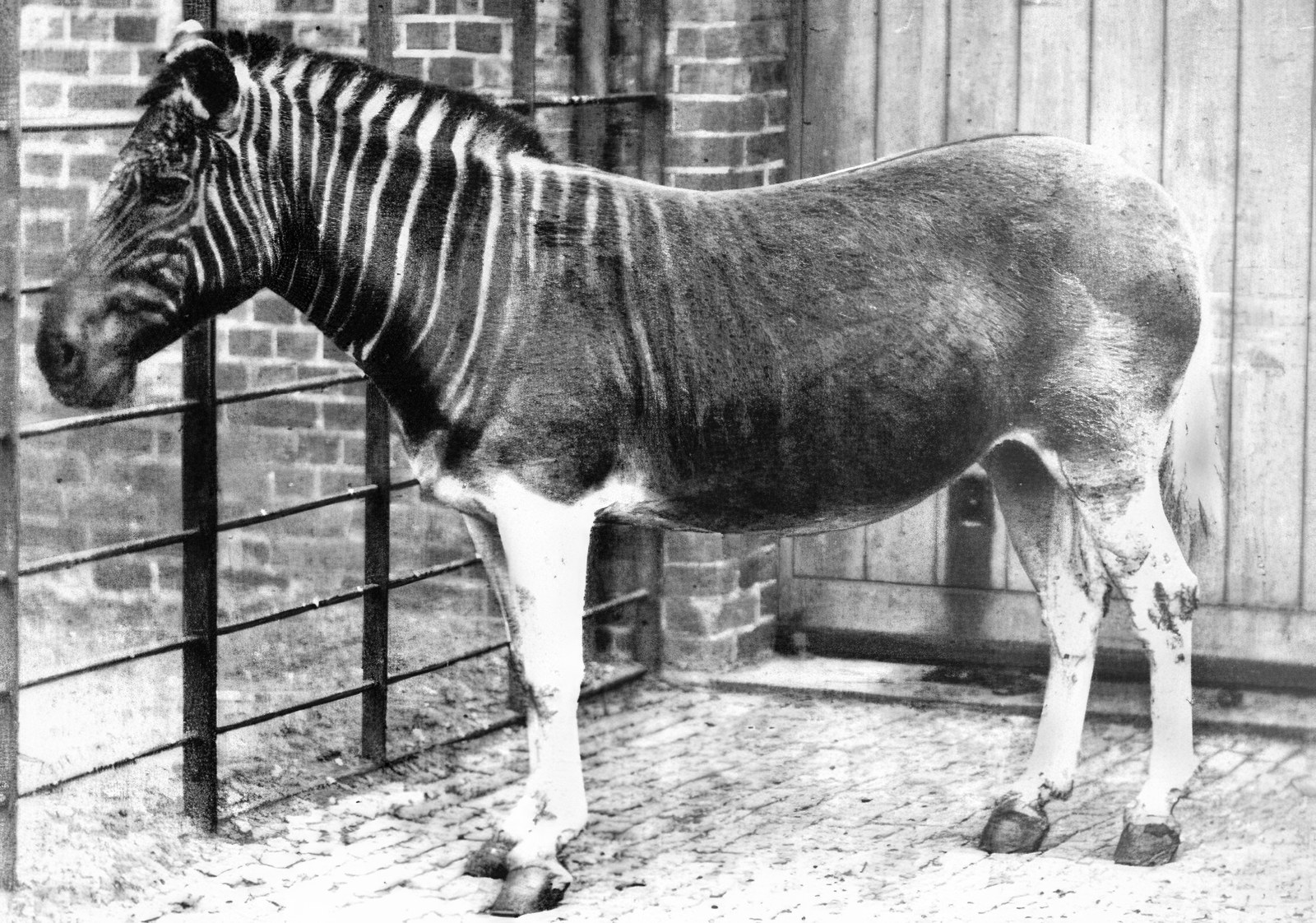
The quagga was a zebra-like animal from South Africa. Only its head and neck were boldly striped, and the rest of the body was plain. It was extinct by 1883. What is left of it sits in museums: by the count of the natural history museum in Mainz, Germany, 23 mounted quaggas survive worldwide, and Mainz is the only museum that holds more than one.
1984: 229 letters
In 1984, Russell Higuchi and four colleagues reported in Nature that they had examined dried muscle from a museum quagga, to find out, in their words, "whether DNA survives and can be recovered from the remains of extinct creatures". It did. They extracted DNA in amounts approaching 1% of what fresh muscle would be expected to give, and it was broken into short pieces.
From the many clones they made of that DNA, two contained pieces of mitochondrial DNA, and those were sequenced. Together they came to 229 nucleotide pairs, the letters of the genetic code. The Mainz museum records that the tissue came from its own quaggas, a group the museum acquired before 1850, and it calls the result an absolute first. A later paper states it plainly: this was the first extinct species from which genetic information was retrieved.
What those letters were compared with
The 1984 team lined the 229 letters up against the matching stretch of DNA from a mountain zebra, a living member of the horse family. The two differed at 12 positions, which made the quagga look like a relative of the mountain zebra.
That was the only comparison the paper's summary reports. It contains no horse and no plains zebra. One comparison can show that two animals are related. It cannot show which living animal is the closest relative.
1987: a horse and a plains zebra
Three years later, Higuchi, Wilson and four new co-authors published the missing comparisons. They sequenced the same stretches of DNA from a domestic horse and a plains zebra, and set them beside the published quagga and mountain zebra sequences.
The quagga and the plains zebra were identical at every silent site, the positions where a change in the DNA makes no difference to the protein. The horse differed from both of them at 11 of those sites. The idea that the quagga's closest relative was the domestic horse, the authors wrote, "receives no support from these data".
2005: eight quaggas
In 2005, Jennifer Leonard and colleagues went back to the museums. They took small samples from 13 quagga specimens, 11 skins, a tooth and a piece of bone, and recovered DNA from eight of them. The quaggas turned out to have little genetic diversity, and the team estimated that the quagga derived from the plains zebra only around 120,000 to 290,000 years ago. Their paper is titled "A rapid loss of stripes", because a split that recent means the quagga's coat must have changed quickly.
On whether the quagga was its own species, the paper is careful. It notes that the animal has been described both as a species and as a subspecies of the plains zebra. It found no DNA variant shared between the quaggas and the plains zebras it compared, but one living kind of plains zebra had none in common with the others either. Its conclusion is that the results "could be consistent with the quagga and the plains zebra being synonymized", that is, treated as one species. The Mainz museum now lists its quaggas as an extinct subspecies of the plains zebra.
Where that leaves it
The 1984 result still stands: those 229 letters were the first DNA read from an extinct species. What changed is what they are taken to mean. With one comparison, the quagga looked like a relative of the mountain zebra. With three, its nearest match was the plains zebra. With eight quaggas, it may never have been a separate species at all. For more on how old DNA lasts, read our post on where ancient DNA survives. Browse the real fossil record in the Fossil-DEX, and see where every fact comes from.
Sources
- Higuchi, R., Bowman, B., Freiberger, M., Ryder, O.A. & Wilson, A.C. (1984). DNA sequences from the quagga, an extinct member of the horse family. Nature 312: 282–284. doi:10.1038/312282a0
- Higuchi, R.G., Wrischnik, L.A., Oakes, E., George, M., Tong, B. & Wilson, A.C. (1987). Mitochondrial DNA of the extinct quagga: relatedness and extent of postmortem change. Journal of Molecular Evolution 25: 283–287. doi:10.1007/BF02603111
- Leonard, J.A., Rohland, N., Glaberman, S., Fleischer, R.C., Caccone, A. & Hofreiter, M. (2005). A rapid loss of stripes: the evolutionary history of the extinct quagga. Biology Letters 1: 291–295. doi:10.1098/rsbl.2005.0323
- Naturhistorisches Museum Mainz / Landessammlung für Naturkunde Rheinland-Pfalz. Die Mainzer Quaggas vor 1945. museum-digital, object 1040
Every fact has a source.
PaleoDex catalogues the real fossil record, and every fact in it is sourced. Get the app.
GET IT ON GOOGLE PLAY →