Quaternary Period
Ice ages, giant mammals, and the rise of humans.
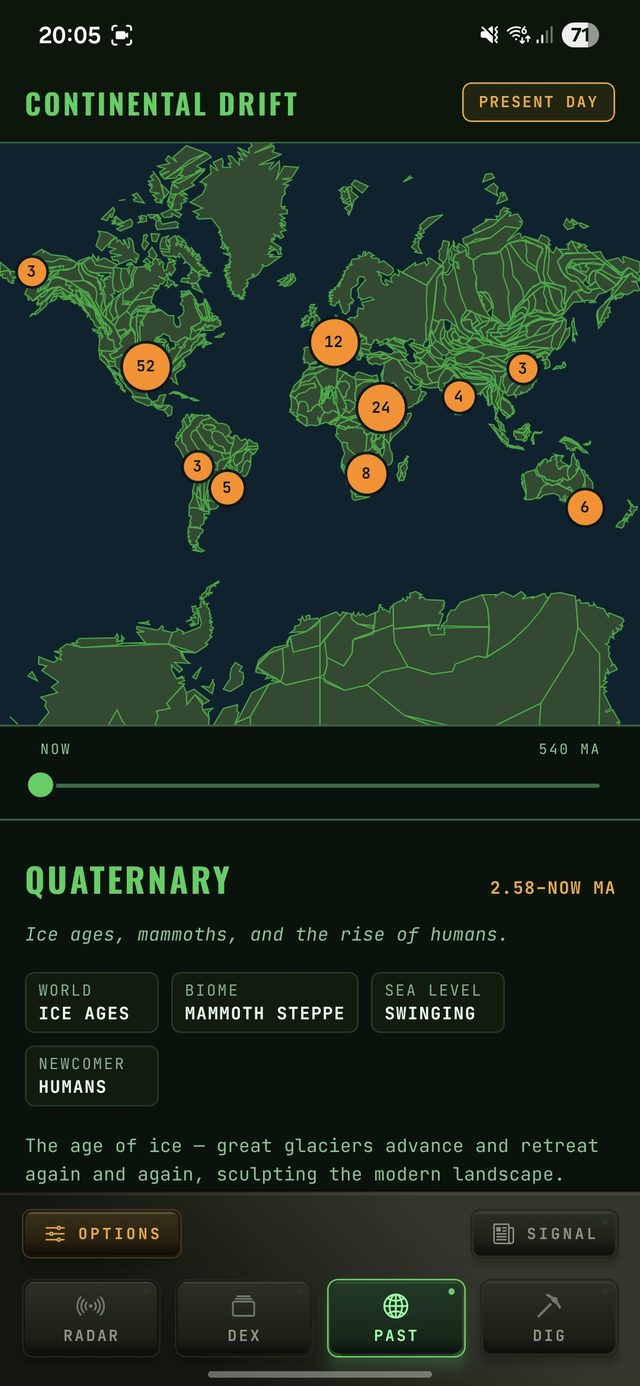
The Quaternary is the most recent geological period, beginning about 2.58 million years ago and continuing today. It spans two epochs — the Pleistocene (the great Ice Age) and the Holocene (our current warm interval) — and is defined by dramatic climate swings and the rise of humans.
GEOLOGIC POSITION
| Eon | Phanerozoic |
| Era | Cenozoic Era |
| Span | 2.58 Ma – present |
| Duration | ongoing (~2.58 My so far) |
| Preceded by | Neogene |
| Followed by | — (current period) |
AT A GLANCE
| Climate | Marked by repeated ice ages — cycles of glacial advance and retreat — continuing into the present interglacial. |
| Geography | Continents sat in essentially their modern positions; growing ice sheets locked up water, lowering sea levels and opening land bridges between continents. |
| Key life | The age of Ice Age megafauna — Smilodon, mammoths, and giant ground sloths — and of the genus Homo, which evolved and spread worldwide. |
The world then
The continents were where we find them now, but the climate was not. Vast ice sheets repeatedly advanced and retreated across the northern hemisphere; each glacial phase locked up so much water that sea levels dropped, exposing land bridges that animals — and people — crossed.
Life
This is the world of Ice Age giants: Smilodon the saber-toothed cat, woolly mammoths, and giant ground sloths roamed alongside early humans. Many of these megafauna vanished in a wave of extinctions near the end of the Pleistocene, around 10,000 years ago.
Up to today
The Quaternary is still running — we live in the Holocene, the most recent slice of it. It's the period closest to us in time, and the one where prehistory meets recorded human history.
Sources
Compiled by PaleoDex from open scientific data. Boundary ages follow the International Commission on Stratigraphy (ICS); descriptions draw on Wikipedia/Wikimedia. Where a fact isn't sourced, we leave it out rather than guess.
· Wikipedia · ICS International Chronostratigraphic Chart
Travel the whole timeline.
PaleoDex maps all 12 geological periods — 540 million years of real life. Join the waitlist and explore it for yourself.
JOIN THE WAITLIST →