The Tadpole Came Later
PALEODEX · 14 August 2026 · 7 min read
Every amphibian you can name begins life as a larva. New fossils say the first four-legged animals did not — and the argument about how much that overturns is worth as much as the finding.
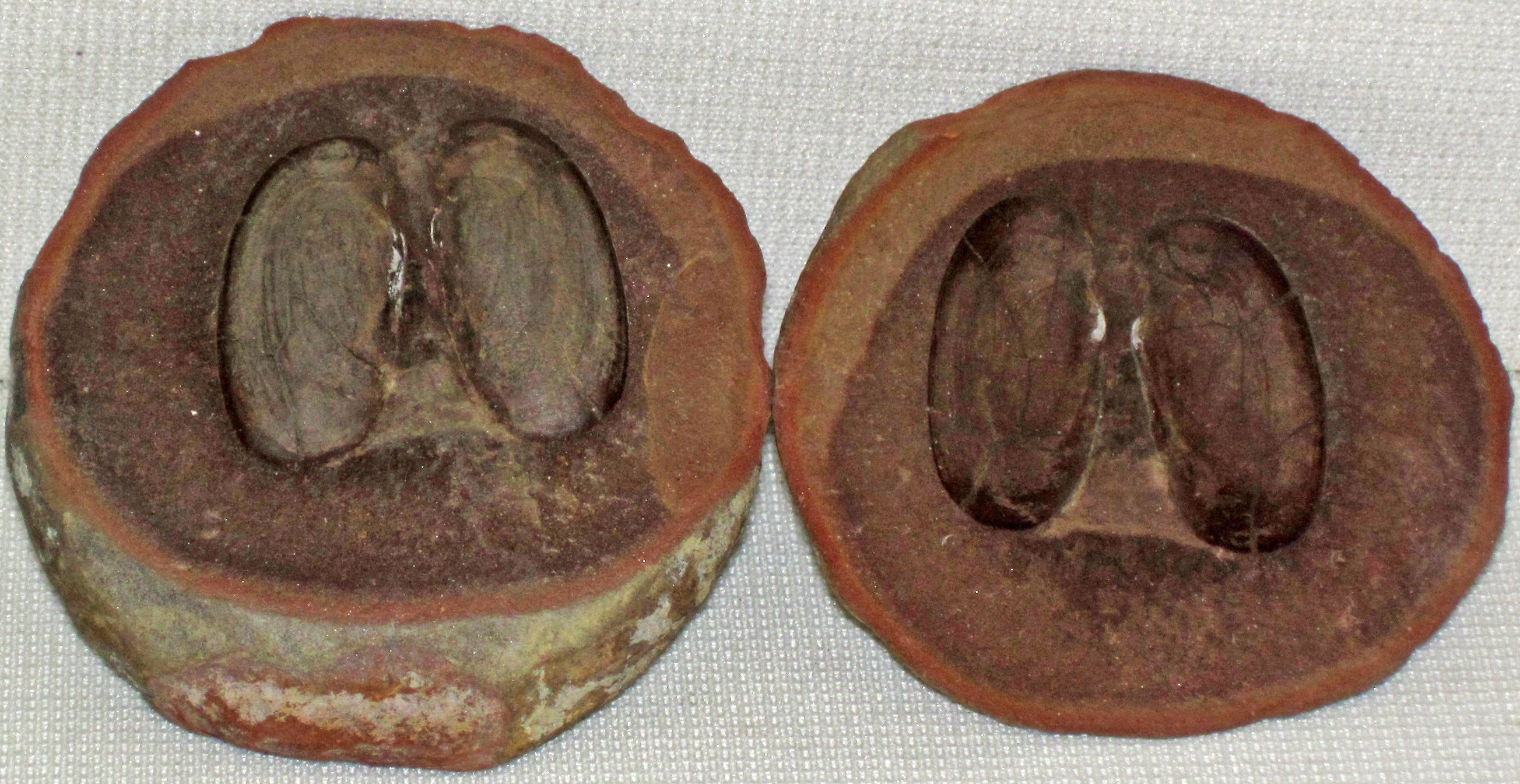
Frogs, toads, newts and salamanders all run the same two-stage life. They hatch into water as larvae, spend a while as something that does not look much like the adult, then remodel the whole body and climb out. It is so universal among living amphibians that it stopped looking like a strategy and started looking like an inheritance — the way vertebrates got out of the water in the first place.
A 2026 paper in Science went looking for that larval stage in the animals that actually made the crossing. It is not there.
Mud that caught soft tissue
An hour southwest of Chicago is a fossil site called Mazon Creek. About 309 million years ago it was a river delta, and its mud closed around dead animals inside ironstone nodules fast enough to preserve things that almost never survive — skin, gills, the outlines of soft bodies. The nodules come out of the ground closed. You split them, and something is lying inside.
That preservation is the whole reason this question could be asked at all. Baby animals are small, thin-boned and fragile, and they are close to absent from most of the fossil record. Mazon Creek is one of the few places that routinely catches them.
Babies that looked like adults
Jason Pardo and Arjan Mann examined hatchlings and juveniles from those nodules. Some of the specimens were only days to a couple of weeks old.
The animal they belonged to was an embolomere — a crocodile-shaped river and swamp predator that grew past three metres as an adult. Its hatchlings were a few centimetres long. And they were built like the adults: no external gills, nothing fringed, nothing tadpole-shaped. A small version of what it would become.
Either side of the crossing
One animal is an anecdote. So the authors looked either side of the move from fins to legs: a megalichthyid fish from before it, and limbless, snake-like aistopods from during it. All showed the same pattern — direct development, hatching as miniature adults.
Their conclusion is narrow and worth quoting the shape of: a transient larval stage ending in metamorphosis originated near or within the tetrapod crown group. Later, in other words. Closer to the animals alive now than to the ones that made the crossing. On that reading the two-stage amphibian life cycle is an invention rather than a starting point, and it is not what carried anything onto land.
The part that is contested
This is where it gets more interesting, not less.
The Field Museum's statement described the study as upending scientists' understanding of how animals conquered the land. The outside specialists Live Science approached disagreed with that framing — and it is worth being precise about what they disagreed with, because it was not the fossils.
Per Ahlberg of Uppsala University, who has worked on early tetrapod evolution for four decades, called the Mazon Creek material wonderful and the interpretation of the fossils sound, but did not find the results terribly surprising: nobody, he said, has been arguing in recent years that all early tetrapods had such a larval stage. Tim Smithson of the University of Cambridge called it an important contribution, and read it as showing that the earliest tetrapods were able to rely on the reproductive strategies of their forebears. Pardo's reply is on the record too: specialists knew the data did not support amphibian-like development across the board, but assumptions were still being made anyway.
What is not in dispute is the material. Hatchlings days old, from a stretch of the tetrapod family tree nobody had seen this young, across three separate lineages, with no tadpole in any of them. That is new regardless of how much of the textbook you think it moves.
You can browse the extinct record in the Fossil Library, watch the continents move underneath it on the Continental Drift map, and see where every fact comes from.
Sources
Every claim above traces to the paper, to its abstract, or to a statement on the record.
- Pardo, J.D. & Mann, A. 2026 — “Direct development of stem tetrapods across the fin-to-limb transition”, Science 392(6804):1292–1296 — a two-author paper, not “Pardo et al.”
- Pester, P. 2026 — Live Science, 19 June — the source of the Ahlberg and Smithson comments, the hatchling ages, and the note that the “upends” framing came from the museum statement
- Clements, T. et al. 2019 — “The Mazon Creek Lagerstätte: a diverse late Paleozoic ecosystem entombed within siderite concretions”, Journal of the Geological Society 176(1):1–11 — the age, setting and preservation mechanism
- Bardack, D. 1974 — “A larval fish from the Pennsylvanian of Illinois”, Journal of Paleontology 48:988–993 — the original description of Esconichthys apopyris as a larval lungfish
- Earth Science Club of Northern Illinois — “Mazon Monday #327”, June 2026 — the taxa examined and the Esconichthys reinterpretation
The real record, in your pocket.
PaleoDex catalogues the real fossil record, and every fact in it is sourced. Get the app.
GET IT ON GOOGLE PLAY →