What Did Parasaurolophus Sound Like? The Model and Its Limits
PALEODEX · 2 October 2026 · 7 min read
One dinosaur has had its voice computed. The instrument is real and measured to the millimetre — the player is not.
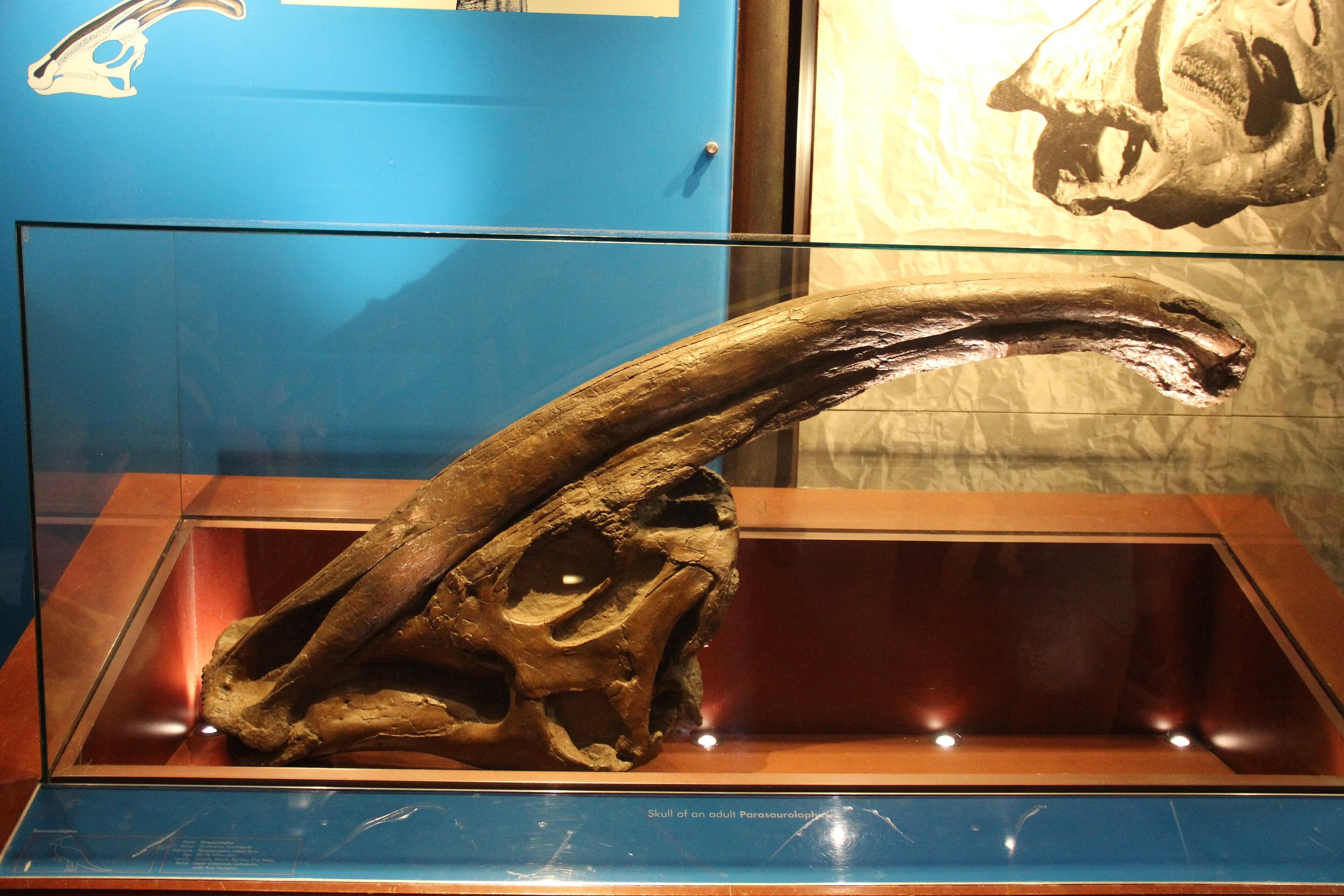
Parasaurolophus carries the most recognisable crest in palaeontology, and that crest is hollow. It is the one dinosaur whose sound people have seriously tried to compute — which makes it a good place to ask what a reconstruction of this kind can honestly claim.
The crest is a folded tube
The crest is not a solid blade of bone. The airway runs from the nostrils up through what anatomists call the dorsal ascending tract, continues to the apex of the crest, turns at a sharp U-bend, and drops back down through a shorter tract into the main body of the skull. In the holotype of Parasaurolophus walkeri, named by William Parks in 1922, that tube measures 3.46 metres.
This part is not inference. It is anatomy, read off the fossil and off CT data, and it is the reason the question is askable at all.
1981: the acoustic reading
David Weishampel published an acoustic analysis of lambeosaurine nasal cavities and judged the crests “conducive to resonation”. The size and shape of the cavity suggested low vocal frequencies in adults, supported by what could be inferred about their hearing; he also concluded that juveniles would have vocalised at higher frequencies than adults.
Treated as a simple open tube, a 3.46-metre airway has a fundamental near 48 hertz. That figure is arithmetic on a measured length, not a recording.
1997: air through a model
Carl Diegert, a computer scientist at Sandia National Laboratories, and Tom Williamson, a palaeontologist at the New Mexico Museum of Natural History and Science, worked from a crested skull unearthed near Farmington, in northwest New Mexico, in August 1995. A series of about 350 CT cross-sections were taken through the skull and crest at 3 mm intervals, a model of the air passages was built, and air was driven through it computationally.
The result was described as a resonating, low-frequency rumbling sound that can change in pitch. The team were careful about what they had made: they called it an approximation of the possible tones the crest was capable of producing.
What the model had to assume
This is the part that decides how much weight the result carries, and it is usually left out.
The beak, the nostrils and the soft tissues of the head and throat are not preserved. The team stated plainly that they had to use common sense and some imagination to reconstruct them. Whether the animal had vocal cords at all was itself uncertain, so a variation of sounds was simulated both with and without them.
So the model is not a recording, and it is not a reconstruction of a known anatomy. It is an estimate built on a real tube and an assumed sound source.
The organ nobody has found
Birds sing with a syrinx, a vocal organ unique to them, and it has never been reported in a non-avian dinosaur. A fossil larynx has now been described — in the ankylosaur Pinacosaurus grangeri — and it is a real and significant find. But a larynx is a different structure, and that study reads the Pinacosaurus specimen as a possible vocal modifier rather than as the vocal source itself.
Which leaves an odd asymmetry: the apparatus that would have shaped the sound is known in extraordinary detail, and the apparatus that would have produced it is not known at all.
The comparison that holds
A juvenile Parasaurolophus from the Kaiparowits Formation of southern Utah, roughly 75.5 million years old and about 2.5 m long, preserves a crest whose airway is only 0.195 metres. Run through the same tube formula as the adults, it returns about 872 hertz — approximately 11 to 18 times higher than the figures for two adult specimens.
That comparison survives where the simulated timbre does not, because it is arithmetic on measured lengths rather than a guess about soft tissue. Whatever these animals did, young and old did not do it at the same pitch.
Where that leaves it
Every sound claim here is conditional, and the researchers say so themselves: the juvenile frequency is given “assuming that the structure was indeed used in sound production”. Vocalisation and visual display are together the most broadly accepted explanations for the crest, and they are not competing camps.
We know the shape of the instrument to the millimetre. Nobody has ever heard the player.
Sources
- Parks, W.A. 1922. Parasaurolophus walkeri, a new genus and species of trachodont dinosaur. University of Toronto Studies, Geological Series 13.
- Weishampel, D.B. 1981. Acoustic analyses of potential vocalization in lambeosaurine dinosaurs (Reptilia: Ornithischia). Paleobiology 7(2): 252–261.
- Sandia National Laboratories, 5 December 1997. Scientists use digital paleontology to produce voice of Parasaurolophus dinosaur. News release; with Sandia Lab News, 19 December 1997.
- Farke, A.A., Chok, D.J., Herrero, A., Scolieri, B. & Werning, S. 2013. Ontogeny in the tube-crested dinosaur Parasaurolophus (Hadrosauridae) and heterochrony in hadrosaurids. PeerJ 1:e182.
- Yoshida, J., Kobayashi, Y. & Norell, M.A. 2023. An ankylosaur larynx provides insights for bird-like vocalization in non-avian dinosaurs. Communications Biology 6:152.
Every fact has a source.
PaleoDex catalogues the real fossil record, and every fact in it is sourced. Get the app.
GET IT ON GOOGLE PLAY →