Trilobite Eyes Were Made of Stone. That Should Not Work.
PALEODEX · 17 August 2026 · 8 min read
Almost every lens in nature is made of protein. Trilobites are the one group of arthropods that built theirs out of a mineral instead — and the mineral they chose should have made seeing impossible.
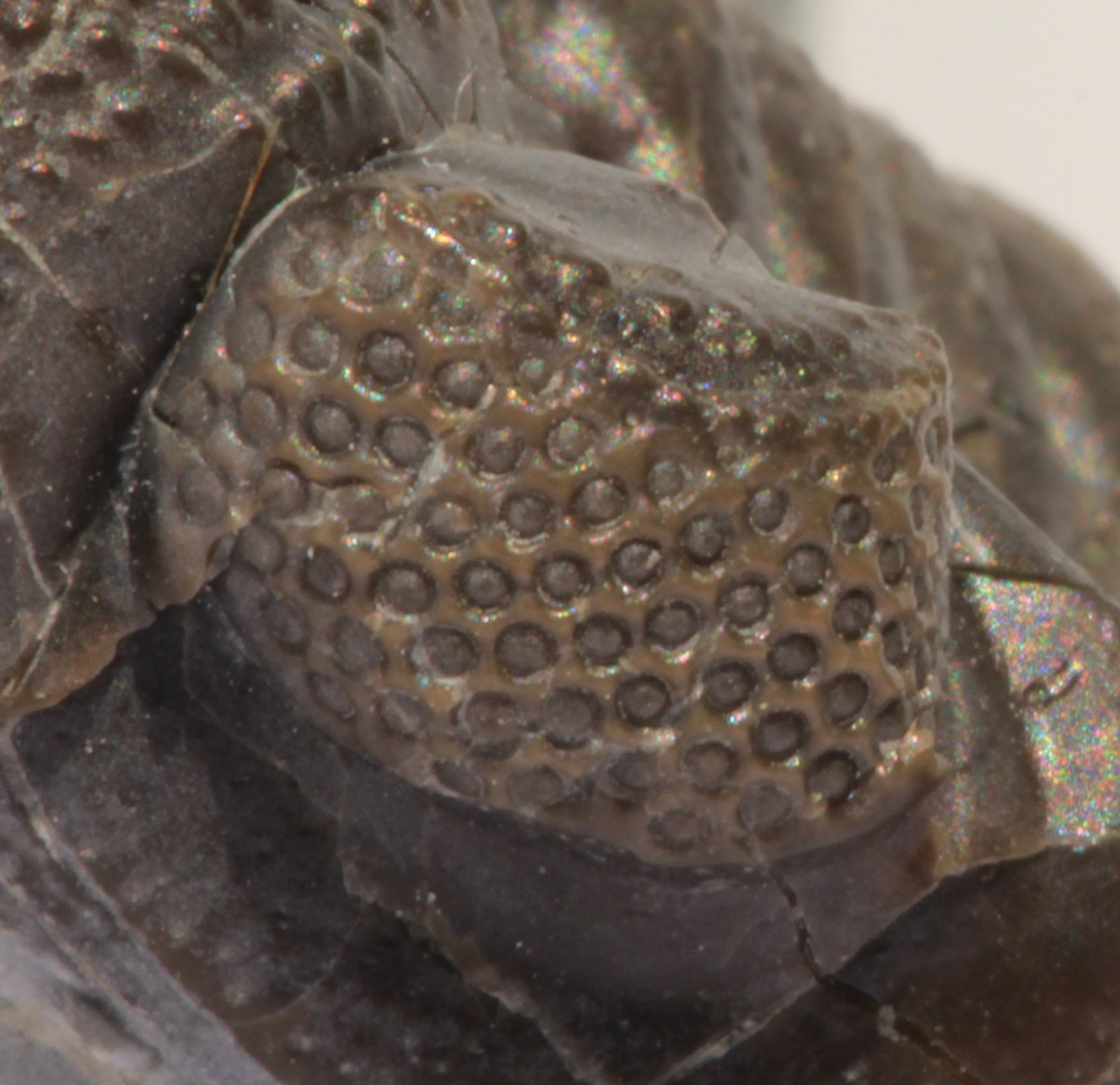
Almost every lens in nature is protein. Yours is. So is the lens in the eye of very nearly every animal that has ever had one.
Trilobites are the exception, and as far as anyone can show they are the only arthropods that ever were. Their lenses were calcite — the mineral limestone is made of. Because the lens was already rock while the animal was alive, it is still sitting there in the fossil hundreds of millions of years later. You can put your face close to a specimen in a museum case and count the individual lenses with your own protein ones.
Calcite sees double
Which sounds like a gift until you try to look through it.
Calcite is birefringent. A ray entering the crystal splits into two that travel at different speeds and emerge in different places, so anything viewed through it appears twice. This is not a flaw in a particular crystal; it is what calcite does, and it is easy to check for yourself. Rest a clear block of it on a printed page and every line underneath doubles.
The Handbook of Mineralogy lists calcite as optically uniaxial with two refractive indices, 1.658 and 1.486. That gap is the double image, and as minerals go it is a wide one.
So how does an animal see through a lens that shows it the world twice?
The one direction that doesn't
A uniaxial crystal has exactly one direction along which light passes without splitting: its optic axis, which in calcite is the crystallographic c axis. Orient the crystal any other way and you get two images. Aim that axis straight out at the world and you get one.
Every lens in a trilobite's eye is grown that way. Kenneth Towe reported it in Science in 1973, and his abstract is still the cleanest summary anyone has managed: the corneal lenses are “constructed of calcite that is crystallographically oriented to behave like glass.” In 2014 Clare Torney, Martin Lee and Alan Owen documented the geometry in detail — in the lenses they examined, the c axis lies parallel to the lens axis.
The blur nobody mentions
Fixing the double image does not fix everything. Any single curved lens bends light more steeply at its rim than at its centre, so rays entering near the edge come to a focus closer to the lens than rays entering near the middle. The image goes soft. Opticians call it spherical aberration and they are still designing around it today.
Each lens is two pieces
One group of trilobites, the phacopids, had eyes built from large lenses set well apart from one another — and each of those lenses is not one piece of calcite. It is two: an upper unit sitting on a lower one, meeting along a curved interface.
Give the two halves slightly different refractive power and that curved boundary cancels the aberration. Euan Clarkson and Riccardo Levi-Setti described the arrangement in Nature in 1975 as “double structures designed to eliminate spherical aberration.”
Thirty years of doubt, and then magnesium
That interpretation very nearly did not survive. For three decades nobody could show the two halves were made of anything different — and if they were not, then the “doublet” was only a boundary in the rock, an artefact of fossilisation rather than a feature of the animal. That objection was published, and it stood.
In 2007 Martin Lee, Clare Torney and Alan Owen went back to the original Dalmanites material and mapped its chemistry at high resolution. The lower unit had been richer in magnesium. Their abstract is careful about what that means: the lenses have undergone diagenetic alteration, but its products “reflect original differences in mineral chemistry” between the upper lens unit and the lower intralensar bowl — the first direct evidence of such a contrast, “thus confirming the doublet hypothesis.”
What is still open
One question genuinely is not settled, and it goes to the heart of everything above.
In 2019 a team led by Johan Lindgren published a study in Nature of the eyes of 54-million-year-old crane flies, and showed that lens cuticle which had originally been chitin — organic, not mineral — became calcified during fossilisation. They stated the implication directly: the calcitic corneas of trilobites, they wrote, “we posit are artefacts of preservation rather than a product of in vivo biomineralization.”
Brigitte Schoenemann and Euan Clarkson disagree, in print. Their 2020 paper on a 429-million-year-old trilobite eye cites the Lindgren study and states plainly that “there is no question, in our view that trilobite lenses consisted to a high degree of calcite.” No formal published rebuttal of the 2019 paper has appeared, and the argument is live.
It is worth being exact about what the disagreement covers. Nobody disputes that the lenses are there, that they are shaped like lenses, or that they are crystallographically aligned — Lindgren's own paper concedes the optics while arguing about the material, and even suggests an organic lens would have worked better. What is in question is what those lenses were made of while the animal was alive.
The trilobite that wore a cap
That argument cannot reach the shape of the animal, which is where the best detail in this story sits.
Erbenochile erbeni, a Devonian trilobite from Morocco, carries a rim that stands proud over the top of each eye like the brim of a cap. Brian Chatterton, who described it with Richard Fortey in Science in 2003, said the structure “would have acted like a lens shade on a camera or a baseball hat brim on humans” and that it “prevented unwanted light from entering the lenses.” His reading is that the animal may have operated during daylight hours, more than 395 million years ago.
Whatever those lenses turn out to have been made of, something up there was bright enough to need shading.
Trilobite eyes are one of the reasons the fossil record is worth cataloguing in detail rather than in highlights. You can browse the animals themselves in the Fossil Dex, and read about where our specimen data comes from on the data page.
Sources
Every quotation below is verbatim from the cited paper's own abstract, checked against the source rather than a summary of it.
- Towe, K.M. (1973) “Trilobite Eyes: Calcified Lenses in vivo”, Science 179(4077):1007–1009 — calcite lenses crystallographically oriented to behave like glass, and present in the living animal
- Clarkson, E.N.K. & Levi-Setti, R. (1975) “Trilobite eyes and the optics of Des Cartes and Huygens”, Nature 254(5502):663–667 — the doublet described as designed to eliminate spherical aberration
- Gál, J., Horváth, G., Clarkson, E.N.K. & Haiman, O. (2000) “Image formation by bifocal lenses in a trilobite eye?”, Vision Research 40:843–853 — the Descartes resemblance called misleading and accidental, by one of the 1975 authors
- Lee, M.R., Torney, C. & Owen, A.W. (2007) “Magnesium-rich intralensar structures in schizochroal trilobite eyes”, Palaeontology 50(5):1031–1037 — the magnesium contrast, and the diagenetic-artefact objection it answers
- Torney, C., Lee, M.R. & Owen, A.W. (2014) “Microstructure and growth of the lenses of schizochroal trilobite eyes”, Palaeontology 57(4):783–799 — the c axis parallel to the lens axis
- Fortey, R.A. & Chatterton, B.D.E. (2003) “A Devonian Trilobite with an Eyeshade”, Science 301(5640):1689 — Erbenochile's eyeshade. Chatterton's quoted wording is from the University of Alberta's release of 22 September 2003, as the paper itself is paywalled
- Lindgren, J. et al. (2019) “Fossil insect eyes shed light on trilobite optics and the arthropod pigment screen”, Nature 573(7772):122–125 — the preservation-artefact argument
- Schoenemann, B. & Clarkson, E.N.K. (2020) “Insights into a 429-million-year-old compound eye”, Scientific Reports 10:12029 — the counter-position, in a paper that cites Lindgren et al.
- Handbook of Mineralogy — Calcite (Mineral Data Publishing) — uniaxial, ω 1.658 / ε 1.486
The real record, in your pocket.
PaleoDex catalogues the real fossil record, and every fact in it is sourced. Get the app.
GET IT ON GOOGLE PLAY →