They Chose the Rock Before They Found the Fossil
PALEODEX · 9 August 2026 · 7 min read
Is palaeontology a science that predicts, or one that just finds things? Here is the cleanest test available.
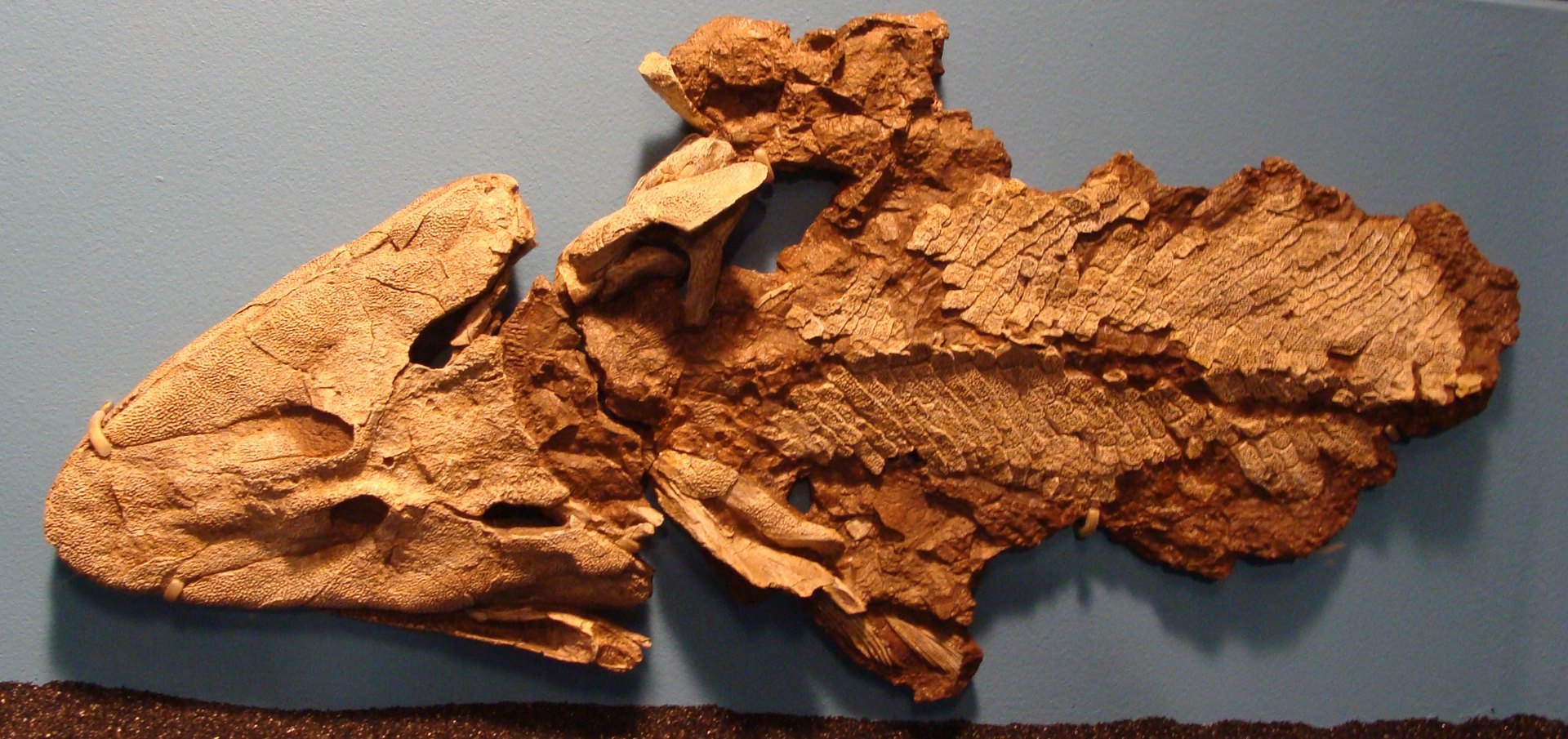
Most famous fossils are found the way you would expect: erosion exposes something, and somebody walks past at the right moment. Tiktaalik roseae is interesting for the opposite reason. The rock was chosen first.
A gap with a shape
The relationship between lobe-finned fish and four-legged animals was, by the 1990s, well established. What was missing were the fossils documenting the sequence in which the changes happened — which end of the body moved first, and in what order. Without those, nobody could say what an intermediate ought to look like until one turned up.
So in 1999 Neil Shubin, Ted Daeschler and Farish Jenkins stopped looking for an animal and started specifying a rock.
Three conditions
Not a hunch about the creature — a specification for the ground it had to be lying in.
- The right age. Late Devonian, the interval the transition had to fall inside.
- The right kind. Freshwater stream deposits, not marine ones.
- Reachable. Exposed at the surface, somewhere a field team could physically stand.
Very few places on Earth satisfy all three at once. The team found one on a geological map: Ellesmere Island, in the Canadian Arctic, six hundred miles from the North Pole.
Five years of nothing
Field work began in 1999. Nothing turned up until 2004.
That gap is the part of the story worth sitting with, because it is where a prediction is actually at risk. You can dig the rock you chose, season after season, and find nothing — and then the idea that put you there is in trouble.
What came out
In 2004, in the predicted rock, they found it. The description published in Nature in 2006 is a mosaic, and the authors were careful about which half was which.
The body scales, the fin rays, the lower jaw and the palate are all comparable to more primitive lobe-finned fish. That part is a fish. But the same animal also has a shortened skull roof, a modified ear region, a mobile neck, and a functional wrist joint.
The neck is the one that does the work. A head that could move independently of the shoulder girdle — something no fish can do, because in a fish the skull is effectively bolted to the shoulder. That single character is why this animal is not simply another Devonian fish with interesting fins.
And then it got complicated
In 2010 a team working in a quarry in Poland published tetrapod trackways from the early Middle Devonian — approximately 18 million years older than the earliest tetrapod body fossils, and about 10 million years older than the oldest elpistostegids, the group Tiktaalik belongs to.
So animals with feet were already walking somewhere while Tiktaalik was still in the water. Tiktaalik is not your ancestor, the branching order has kept moving since, and anyone who tells you the fish-to-land story is a tidy ladder is selling you something.
None of which touches the prediction. It was never a claim about ancestry. It was a claim about where an animal built like this would be lying — and the rock was picked in advance, dug on purpose, and the animal was in it.
You can browse the extinct record, Tiktaalik included, in the Fossil Library, watch the continents move under it on the Continental Drift map, and see where every fact comes from.
Sources
Every claim above traces to a primary source or to a statement on the record from one of the authors.
- Daeschler, Shubin & Jenkins 2006 — “A Devonian tetrapod-like fish and the evolution of the tetrapod body plan”, Nature 440:757–763
- Shubin, Daeschler & Jenkins 2006 — “The pectoral fin of Tiktaalik roseae and the origin of the tetrapod limb”, Nature 440:764–771
- Niedźwiedzki, Szrek, Narkiewicz, Narkiewicz & Ahlberg 2010 — “Tetrapod trackways from the early Middle Devonian period of Poland”, Nature 463:43–48
- Shubin, N. 2008 — Your Inner Fish (Pantheon Books), the author’s own account of how the search area was chosen
- University of Chicago Medical Center, 6 April 2006 — release quoting Ted Daeschler, and the source of the six-hundred-mile figure
The real record, in your pocket.
PaleoDex catalogues the real fossil record, and every fact in it is sourced. Get the app.
GET IT ON GOOGLE PLAY →