What Did a Mosasaur’s Tail Really Look Like?
PALEODEX · 3 October 2026 · 7 min read
One mosasaur fin has ever been seen. Everything else about mosasaur tails is reconstruction — and the difference is the whole story.
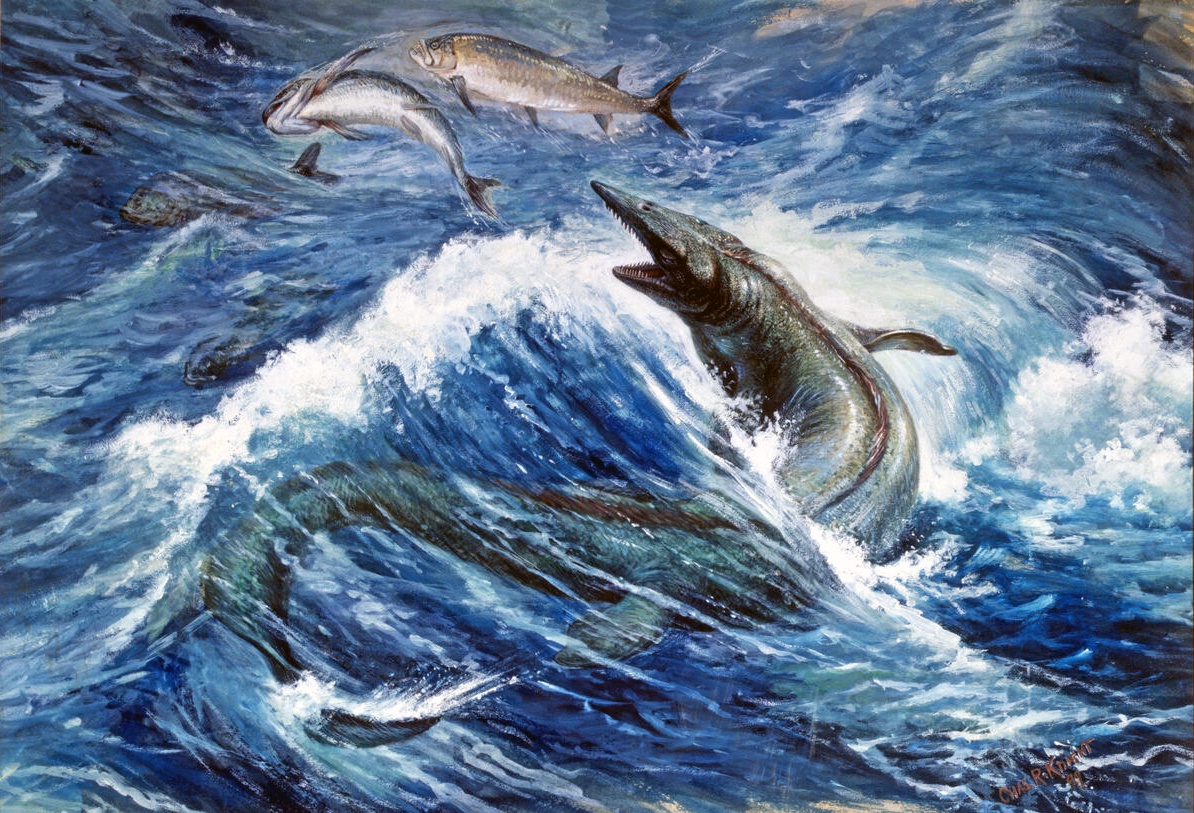
If you learned what a mosasaur looked like from a book, a museum mural or a film, you probably learned a long, lizard-shaped sea reptile with a long, straight tail, swimming by rippling its whole body like an eel. That picture was consistent, it was everywhere, and about the back end of the animal it was wrong.
The picture everyone grew up with
For most of the time mosasaurs have been studied, they were treated as simple anguilliform swimmers — the 2010 description of one puts it as “unremarkable, dorsoventrally narrow tails and long, lizard-like bodies”. A 2011 paper on a different mosasaur opens the same way: mosasaurs “have traditionally been considered as anguilliform locomotors capable only of generating short bursts of speed during brief ambush pursuits”. Even the derived forms, the most thoroughly aquatic ones, were portrayed as long, sleek animals with broadened but ultimately tapering tails.
That is not a story about one bad artist. It is what the field thought, and the artwork followed it.
The bones were saying something else
Partway along a mosasaur’s tail, the vertebral column turns sharply downward, and the rear section of the tail becomes much deeper from top to bottom. That downturn is visible in mounted skeletons, and it has been for a very long time.
What it meant was the argument. A bend in the bones is consistent with a fin, but it is not a fin. As the 2013 paper that finally settled it put it, the idea that derived mosasaurs swam with a downturned tail fin had until then been “based on comparative skeletal anatomy alone”.
2010: skin, an outline, and a downturned tail
Then an exceptionally complete Platecarpus came out of the Smoky Hill Chalk Member of the Niobrara Formation, in Kansas. Catalogued as LACM 128319 and 5.67 metres of preserved animal, it kept “large portions of integument, a partial body outline … a downturned tail, branching bronchial tubes, and probable visceral traces”.
Its describers concluded that a streamlined body plan and a crescent-shaped tail fin were already well established in Platecarpus — an animal that preceded the most specialised mosasaurs by twenty million years.
It is worth being precise about what that sentence is. The skin is observed. The partial body outline is observed. The downturned tail is observed. The crescent-shaped fin is the authors’ inference drawn from those things. The fin itself was still missing.
2013: the fin itself
It turned up in Jordan. A fossil from Harrana, in the centre of the country, preserved soft tissues including what the paper calls “high fidelity outlines of a caudal fluke and flippers”.
The fluke has two lobes. The vertebral column runs down into the lower one. The paper states that this specimen “provides the first indisputable evidence that derived mosasaurs were propelled by hypocercal tail fins” — hypocercal meaning exactly that downward bend. The animal is a young Prognathodon, only about a metre and a half long, against adults that could reach fifteen.
One specimen. One preserved fin. It is still, today, the only one.
A shark’s tail, turned over
The shape it reveals is uncannily familiar, and inverted. Sharks have an epicercal caudal fluke, in which — in the words of a 2011 study of mosasaur swimming — “the tail bends dorsocaudally”: upward, into the larger upper lobe. Derived mosasaurs, that same paper says, “develop a hypocercal tail with a ventrocaudal bend”: downward, into the lower one.
Same two-lobed propulsive surface. Same job. The skeleton inside it points the opposite way. Two groups separated by hundreds of millions of years, starting from completely different anatomies, arrived at the same solution to the same problem.
What is still a prediction
Soft tissue is rare, so the overwhelming majority of mosasaur species preserve no fin at all. A recent study takes the problem sideways: it measures how tail-fin shape and the underlying caudal skeleton vary together in living sharks and in the handful of mosasaurs that do preserve soft tissue, finds the covariation pattern is remarkably similar in both, and builds a predictive model that reconstructs the fin in species where nothing soft survives.
The model indicates that all hydropedal forms — the ones whose limbs had become flippers — had a bilobed, downturned fluke, while plesiopedal species, which kept more land-like limbs and pelvis, “lacked a well-developed fleshy dorsal lobe”. It also finds that the fin varies enough between the four derived mosasaur lineages to suggest the bilobed tail evolved independently more than once.
Where the line falls
This is the part that usually gets flattened in the retelling. The honest version is not “mosasaurs had shark tails upside down”. It is narrower and more interesting than that:
One mosasaur demonstrably had a two-lobed, downturned fin, because its outline is preserved in rock in Jordan. A second specimen, in Kansas, preserves a downturned tail inside a streamlined body and lets a fin be inferred. The skeletons of many more carry the same downturn. And for the rest, a quantitative model — good, published, and explicitly predictive — says what shape to expect.
That last sentence is a prediction, and it is worth keeping it labelled as one. Reconstructions become “what the animal looked like” very quickly, which is exactly how the long straight tail lasted as long as it did.
Sources
- Lindgren, J., Caldwell, M.W., Konishi, T. & Chiappe, L.M. 2010. Convergent evolution in aquatic tetrapods: insights from an exceptional fossil mosasaur. PLoS ONE 5(8): e11998.
- Lindgren, J., Kaddumi, H.F. & Polcyn, M.J. 2013. Soft tissue preservation in a fossil marine lizard with a bilobed tail fin. Nature Communications 4: 2423.
- Lindgren, J., Polcyn, M.J. & Young, B.A. 2011. Landlubbers to leviathans: evolution of swimming in mosasaurine mosasaurs. Paleobiology 37(3): 445–469.
- Lindgren, J., Everhart, M.J. & Caldwell, M.W. 2011. Three-dimensionally preserved integument reveals hydrodynamic adaptations in the extinct marine lizard Ectenosaurus. PLoS ONE 6(11): e27343.
- Song, Y. & Lindgren, J. Convergence in aquatic locomotion: reconstructing mosasaurian (Squamata: Mosasauria) tail fins from osteological correlates and covariation with extant sharks. Paleobiology 52(1): 121–130.
- Lund University, 10 September 2013. Unique fossil of marine lizard discovered. Press release.
Every fact has a source.
PaleoDex catalogues the real fossil record, and every fact in it is sourced. Get the app.
GET IT ON GOOGLE PLAY →