The Last Aurochs Died in 1627, and a Clerk Wrote It Down
PALEODEX · 3 September 2026 · 6 min read
Almost every extinction is a gap in the record. This one has a year, and it survives for a reason that has nothing to do with anyone studying the animal.
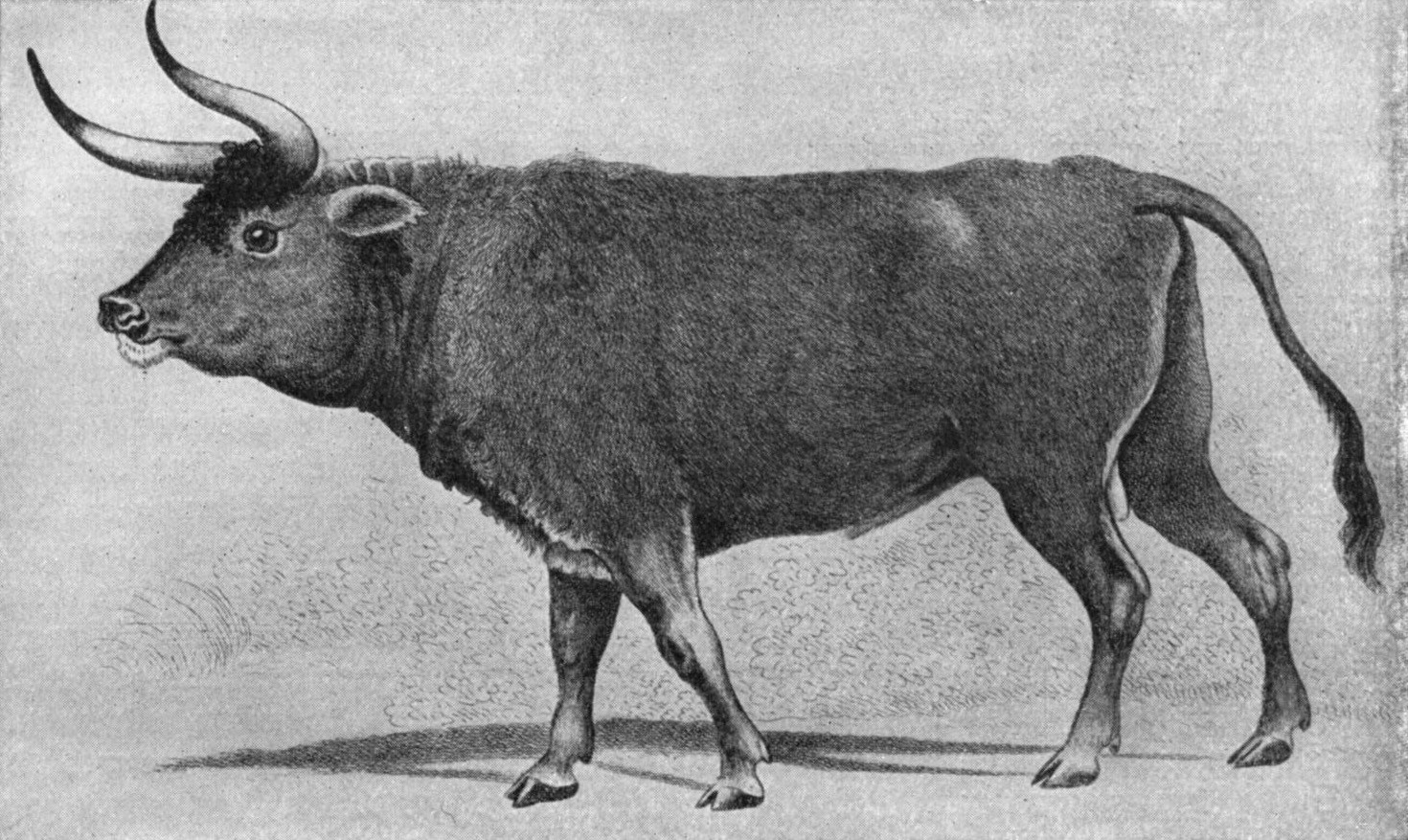
Ask when a species went extinct and you will almost always get a range, or a last confirmed sighting followed by decades of silence. The aurochs is one of the very few exceptions. It has a year: 1627.
The reason that year exists is not that a naturalist was watching. It is that the last herd on earth belonged to a king, and property gets counted.
What the aurochs actually was
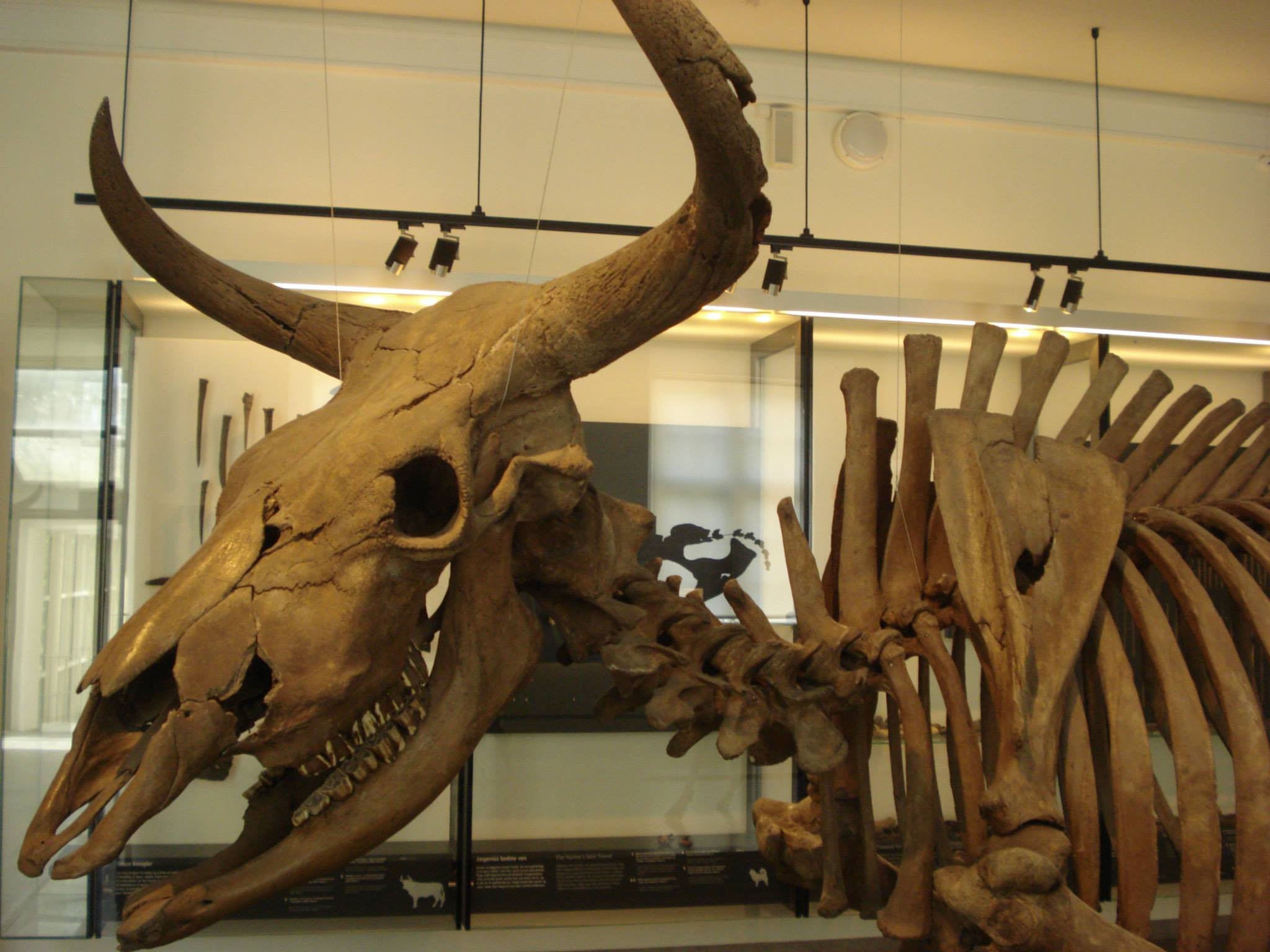
The aurochs (Bos primigenius) was the wild ox that domestic cattle were bred from: a large, long-horned bovine that ranged across Europe, Asia and North Africa. Humans had been painting it on cave walls for millennia; the bulls in the Hall of the Bulls at Lascaux, painted roughly 17,000 years ago, are aurochs.
One herd, in one forest, owned by the crown
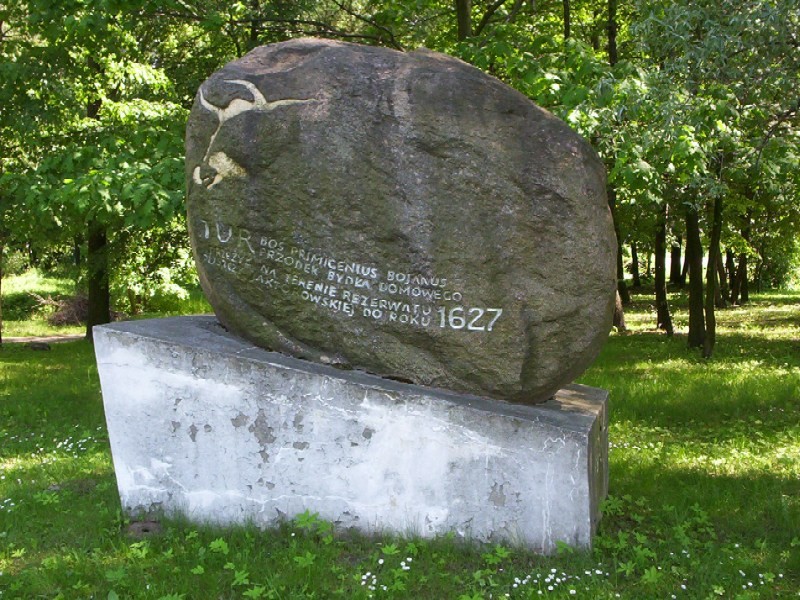
By the sixteenth century the species had contracted to a single surviving herd anywhere in the world: in marshy woodland in the Jaktorów Forest, in Mazovia, roughly 55 kilometres south-west of Warsaw.
It survived as long as it did because it was protected, and it was protected because it was owned. The animals came under the care of the Dukes of Masovia and then, after Mazovia's incorporation in 1526, the Polish crown. Gamekeepers put out hay at winter feeding places. A royal decree in 1604 restated their protected status. By that point, as the numbers below show, the population was already almost gone.
Being the king's property carried a second consequence, and it is the one that matters here. When the crown sent an inspector, the herd was counted.
The counts, and what they are not
This is the part usually got wrong, including in otherwise careful retellings: the Jaktorów records are not an annual census. They are periodic royal inspections, and five of their figures survive across sixty-three years. That distinction is not pedantry — it is what gives the ending its shape.
- 1564: thirty-eight animals, itemised as eleven bulls, twenty-two cows and five calves.
- 1599: twenty-four.
- 1602: four, three bulls and one cow.
- 1620: the last bull dead. One cow remaining.
- 1627: the last aurochs dies.
Read them in order and you are watching a species run out in an accounting document. The 1602 line is the one that settles it: three bulls and a single cow is not a herd that recovers, and eighteen years later even that arithmetic had collapsed to one animal.
The death notice, filed three years late
The last aurochs was a female, and she died in 1627. We know the year because the royal inspection carried out in 1630 recorded it, the next time anyone official came to count.
That is the whole mechanism, and it is worth sitting with. The extinction of a species entered the written record three years after it happened, in a file compiled by someone auditing a monarch's assets. Not an obituary. An inventory line that had gone to zero.
What the record does not say
Three things are worth flagging, because the popular version of this story either fills them in or leaves them out.
How she died. The widespread claim that the last aurochs was poached or shot is contradicted by the literature, which holds she died of natural causes, but the specific cause is not known. "Perhaps old age" is a guess, and it is usually presented as a fact.
What happened to her remains. You will often read that her skull was looted by the Swedish army during the invasion of 1655–60 and now sits in the Royal Armoury in Stockholm. Cis van Vuure, who wrote the standard modern monograph on the species, states directly that this is not her skull. It is contested, so we are not going to assert it.
Whether 1627 was truly the end. In 2021 the Bulgarian palaeozoologist Zlatozar Boev published an aurochs horn-core excavated in central Sofia from a layer dated to the late 17th or early 18th century, and argued that the animal "survived in the Central Balkans a century later" than the Polish date. It deserves to be known about, and it deserves to be weighed honestly. It is a single fragment; it was never radiocarbon-dated, the date coming from the layer it sat in rather than from the bone; it carries axe cutmarks showing it was worked, which is precisely how an older horn ends up in a later deposit; and it was identified as aurochs rather than cattle on size alone. Boev's own text is more careful than his title: some of the last aurochs, he writes, "might have survived a century longer." The IUCN Red List and van Vuure's monograph still give 1627, and so does this article. But it is not a closed question, and the honest version of the date carries that.
Why this belongs in PaleoDex
Because the interesting thing here is not the animal, it is the evidence. Most of what we know about extinct species is inferred from bone, sediment and dating. Once in a while the record is documentary instead — a bureaucracy that happened to be counting, for reasons entirely unrelated to science, and left behind a number that runs down to zero. That is a different kind of fact, with different failure modes, and it deserves to be labelled as what it is. Read more of the record here, or see how the catalogue handles it in the Fossil Dex.
Sources
Every figure above is drawn from the standard literature on the Jaktorów herd and on aurochs genomics:
- Rokosz, M. (1995). "History of the aurochs (Bos taurus primigenius) in Poland." Animal Genetic Resources Information 16: 5–12. The standard citable account of the Jaktorów herd, the royal inspection series and the 1627 death reported in the inspection of 1630.
- van Vuure, C. (2005). Retracing the Aurochs: History, Morphology and Ecology of an Extinct Wild Ox. The standard modern monograph; source for the natural-causes reading and for the correction on the Stockholm skull.
- Rossi, C., Sinding, MH.S., Mullin, V.E., et al. (2024). "The genomic natural history of the aurochs." Nature 635: 136–141. 38 ancient genomes, four population ancestries, domestication from a small number of Southwest Asian animals.
- Chen, S., et al. (2010). Molecular Biology and Evolution 27: 1–6. The two separate cattle domestications (taurine from Near Eastern aurochs; zebu from Indian aurochs) behind the precision note above.
- Historical inspection figures cross-checked against Otto Antonius' evaluation of the Jaktorów records, which reports the 1564 count with the same itemisation (eleven bulls, twenty-two cows, five calves).
The real record, in your pocket.
PaleoDex catalogues the real fossil record, and every fact in it is sourced. Get the app.
GET IT ON GOOGLE PLAY →