Steller's Sea Cow: What Did It Look Like, and How Do We Know?
PALEODEX · 17 September 2026 · 5 min read
Museums hold its bones. Nearly everything about the living animal comes from the notes of one naturalist, written on the island where his ship was wrecked.
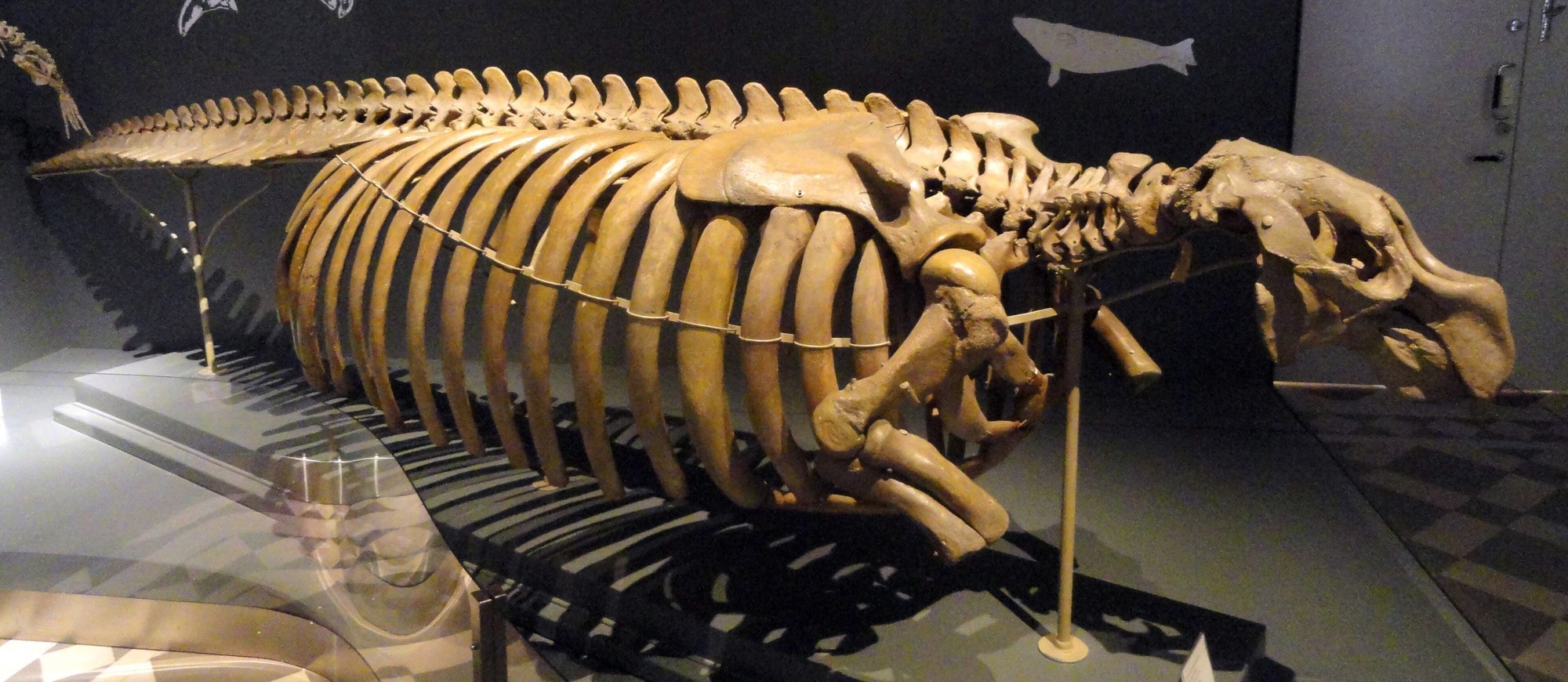
Steller's sea cow was a giant relative of the manatee that fed on kelp in the cold coastal waters of the Bering Sea. No one ever photographed or filmed one. So when a book describes what it looked like, where does that description come from? There are two kinds of evidence, and they do very different jobs.
The bones: plenty of them, from many animals
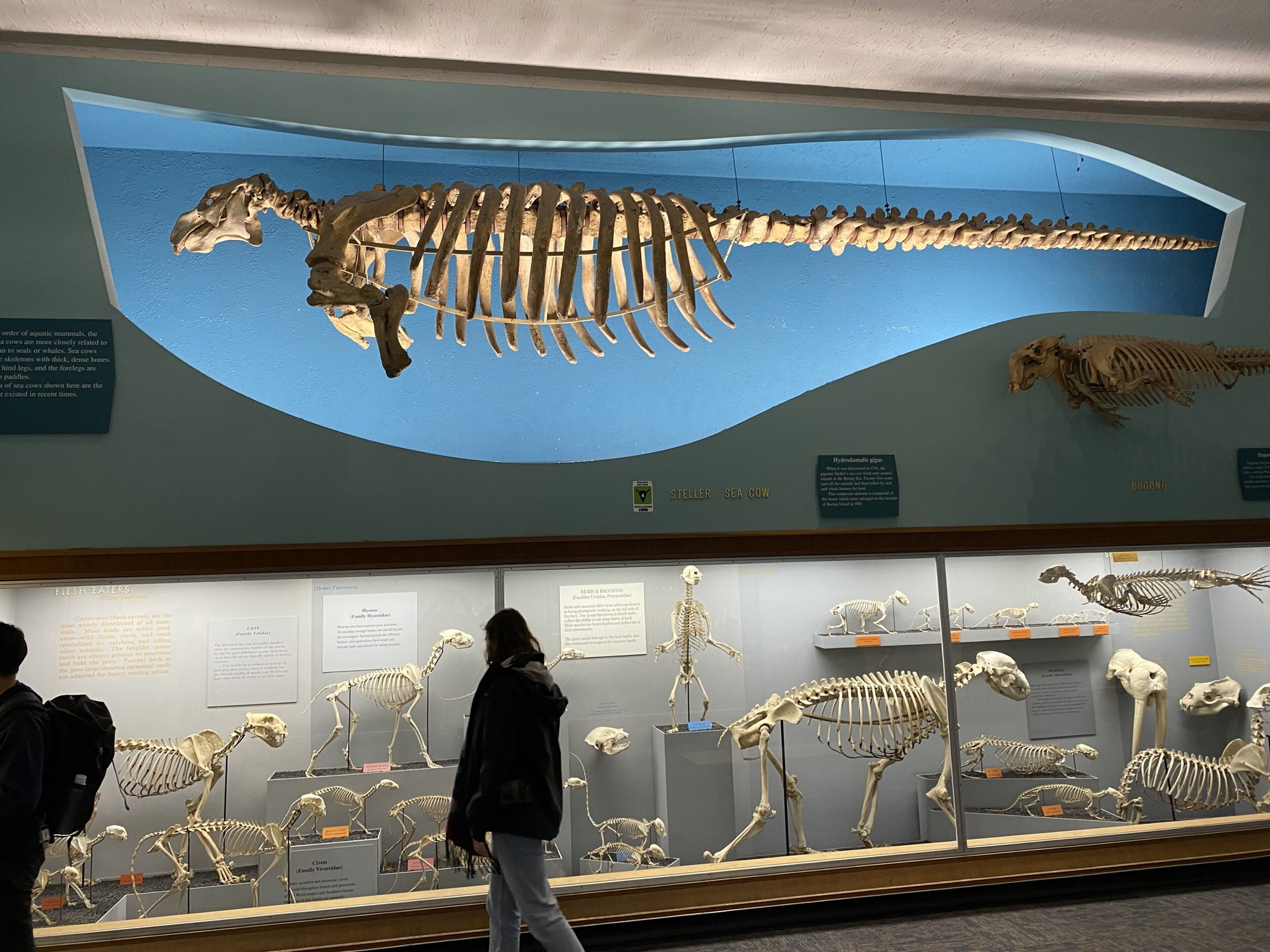
A 2006 survey by Stefano Mattioli and Daryl Domning counted at least 27 skeletons, 62 more skulls and more than 550 further bones of the species, held in 51 museums. Most of those skeletons are composites. Perhaps only two to four of them come from a single animal, and the rest were assembled from the bones of two to 16 individuals. The first bones were probably collected shortly before 1840, the first partial skull in 1844 and the first skeleton in 1855.
Bones say a lot about an animal's shape and build. What they cannot show is its skin, or how it behaved.
One naturalist on a wrecked ship
Georg Wilhelm Steller was the naturalist, a volunteer, on Vitus Bering's second voyage, a Russian expedition sent to explore the northwest coast of North America. The crew was shipwrecked on Bering Island and stayed there from November 1741 to August 1742. There were so many sea cows around the island, Steller wrote, that they would suffice "to support all the inhabitants of Kamchatka". The crew hunted and ate them, and Steller studied them. In his own words, he could watch them "daily for ten months from the door of my hut".
His account, De bestiis marinis ("On the beasts of the sea"), was published in Latin in 1751, after his death. It is the only scientific description of the animal made from life.
What he wrote down
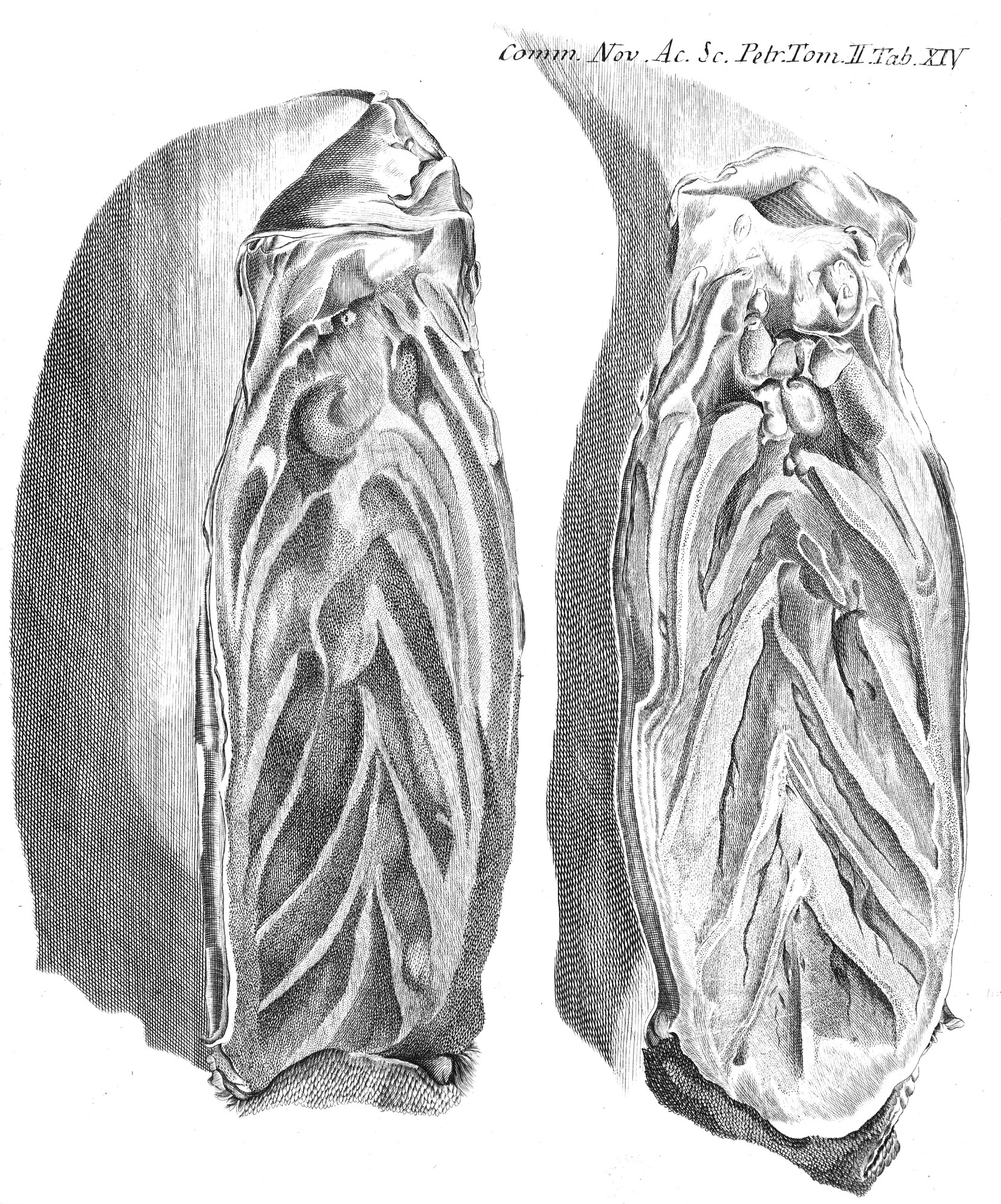
Steller described the hide as "more like unto the bark of an ancient oak than unto the skin of an animal": black, wrinkled, rough, hard and an inch thick. He wrote that they had no teeth at all. They chewed "not with teeth, which they lack altogether, but with two strong white bones", one set in the palate and one in the lower jaw, and he had those bones drawn.
He described how they fed. Because they were so greedy, he wrote, they kept "their heads always under water", tearing seaweed off the rocks with their forelimbs, and raised their noses above the water "every four or five minutes" to breathe out with a snort like a horse's. He described their families, a male with one grown female and their young, and one scene that no skeleton could ever record. When a female was caught, the male tried with all his strength to free her and followed her all the way to the shore, even as the crew struck him. Then, "when we came the next day, early in the morning, to cut up the flesh and take it home, we found the male still waiting near his mate; and I saw this again on the third day".
The one he measured
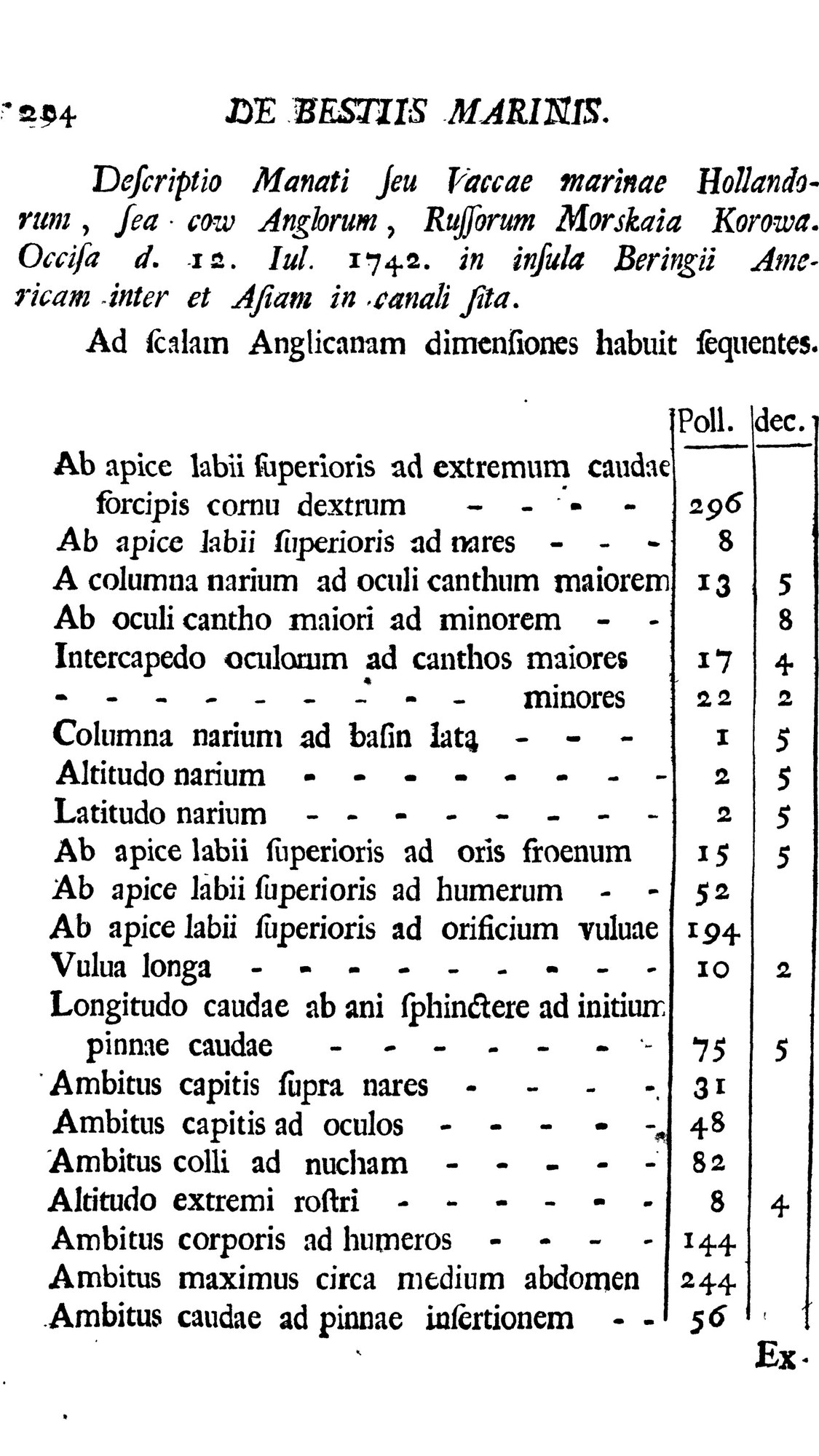
The measurements in his description come from one female, killed on 12 July 1742, and he took them "according to the English scale of measurement". From the tip of her upper lip to the tip of her tail fork she was 296 inches long, about 7.5 metres. The table is still there on page 294 of the 1751 volume.
He tried to bring physical evidence home as well. "I had prepared a skeleton of a manatee calf", he wrote, along with its skin stuffed with grass, "but when I saw that on account of the small size of our craft this was impossible I wanted to bring with me at least the spoils (skin), but even this wish was vain."
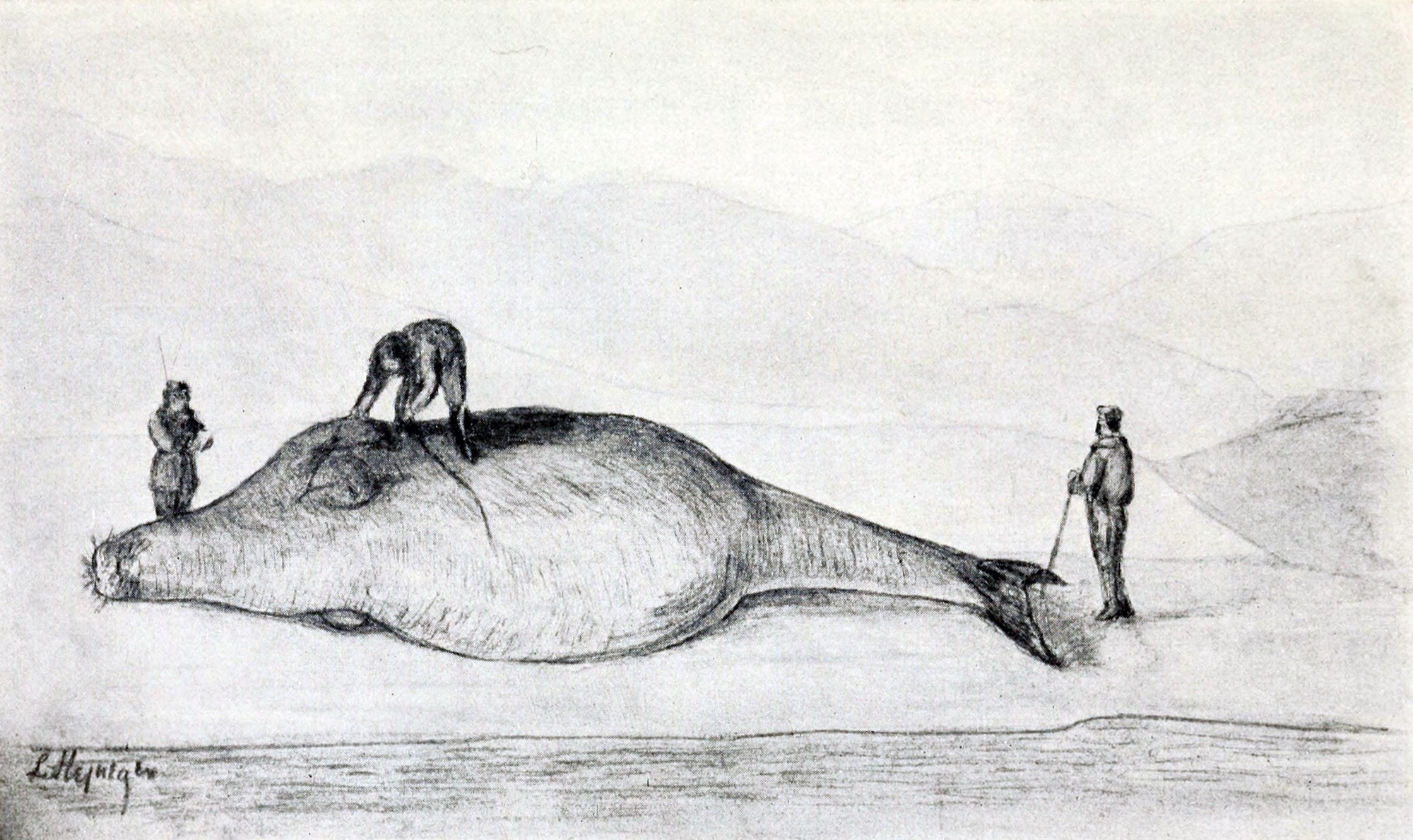
Not the only people who saw one
A whole crew saw these animals alive, and others on the voyage recorded them too: a 1744 map by Sven Waxell and Sofron Khitrov, both of the same expedition, shows a sea cow beside a fur seal and a sea lion. What sets Steller apart is that he was a trained naturalist. He measured the animal, examined its insides and wrote it all up.
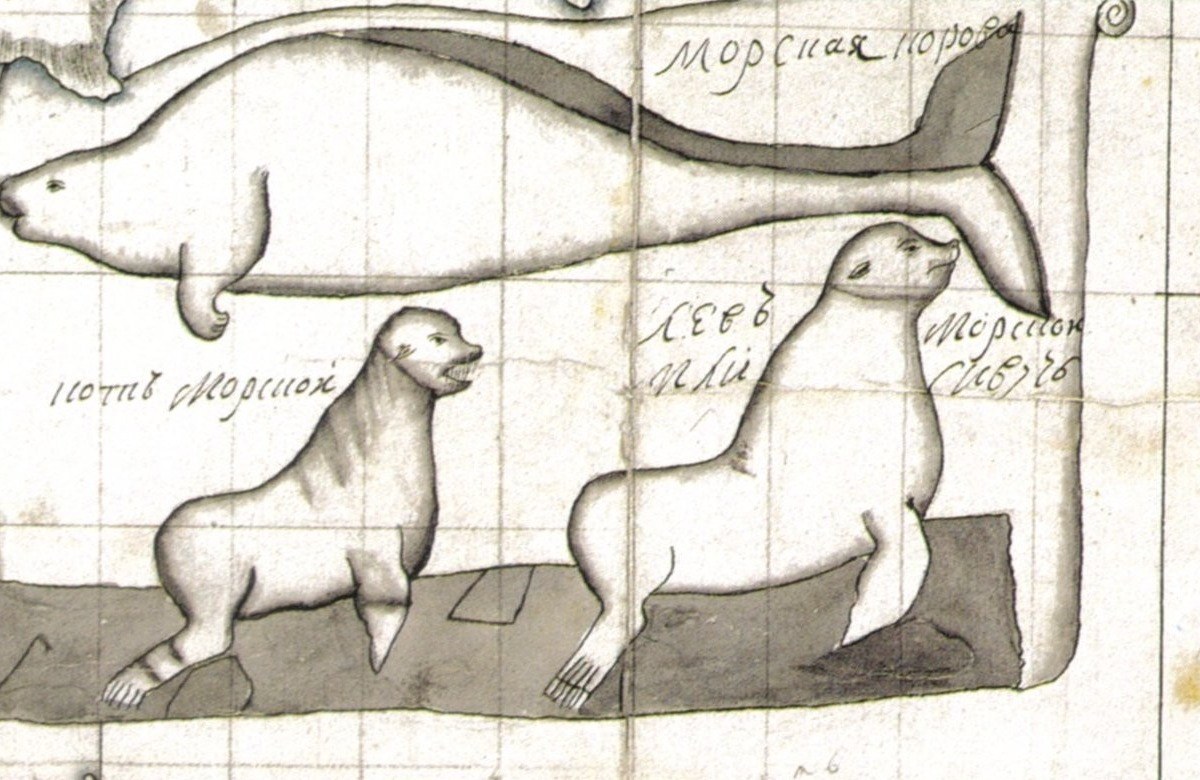
Why this belongs in PaleoDex
Because it shows what the evidence for an animal no one alive has seen can really look like. The skeletons are real, but most are assembled from several animals. What it looked like alive and how it behaved come almost entirely from one naturalist's notes, written on the island where his ship was wrecked. When you read a description of the living animal, you are usually reading Steller. The wider catalogue is in the Fossil Dex, and how we handle sourcing is in about the data.
Sources
Every claim above traces to the sources below. Where we relied on someone else's reading of a source, we say so.
- Steller, G.W. (1751). "De bestiis marinis." Novi Commentarii Academiae Scientiarum Imperialis Petropolitanae 2: 289–398. Scan (SUB Göttingen). The Latin original: pages 289, 294, 296 and 302, and plate XIV.
- Steller, G.W. (1899). "The Beasts of the Sea." Translated by W. Miller & J.E. Miller. In D.S. Jordan (ed.), The Fur Seals and Fur-Seal Islands of the North Pacific Ocean, Part 3: 179–218. Washington: Government Printing Office. Reprinted as De bestiis marinis, or, The Beasts of the Sea, ed. P. Royster, Zea Books, University of Nebraska–Lincoln, 2011: open access. Source for every quotation from Steller, for the voyage and the dates of the shipwreck, and for the translators' note that nearly all knowledge of the animal comes from his account.
- Mattioli, S. & Domning, D.P. (2006). "An Annotated List of Extant Skeletal Material of Steller's Sea Cow (Hydrodamalis gigas) (Sirenia: Dugongidae) from the Commander Islands." Aquatic Mammals 32(3): 273–288. DOI. Source for the skeletons, skulls and bones in museums, the composite skeletons and the dates of the first finds. Read at abstract level.
- Animal Diversity Web. "Hydrodamalis gigas (Steller's sea cow)." University of Michigan Museum of Zoology. Account. Source for its kelp diet and its cold coastal habitat in the Bering Sea.
- Golder, F.A. (ed.) (1925). Bering's Voyages, vol. II. American Geographical Society. Source of Stejneger's reconstruction drawing.
The real record, in your pocket.
PaleoDex catalogues the real fossil record, and every fact in it is sourced. Get the app.
GET IT ON GOOGLE PLAY →