Megalodon Is Not Hiding in the Deep, and the Proof Is a Missing Tooth
PALEODEX · 4 September 2026 · 7 min read
The case for megalodon's extinction is not that nobody has found one alive. It is that nobody has found a tooth — and this is an animal that produced them by the thousand.
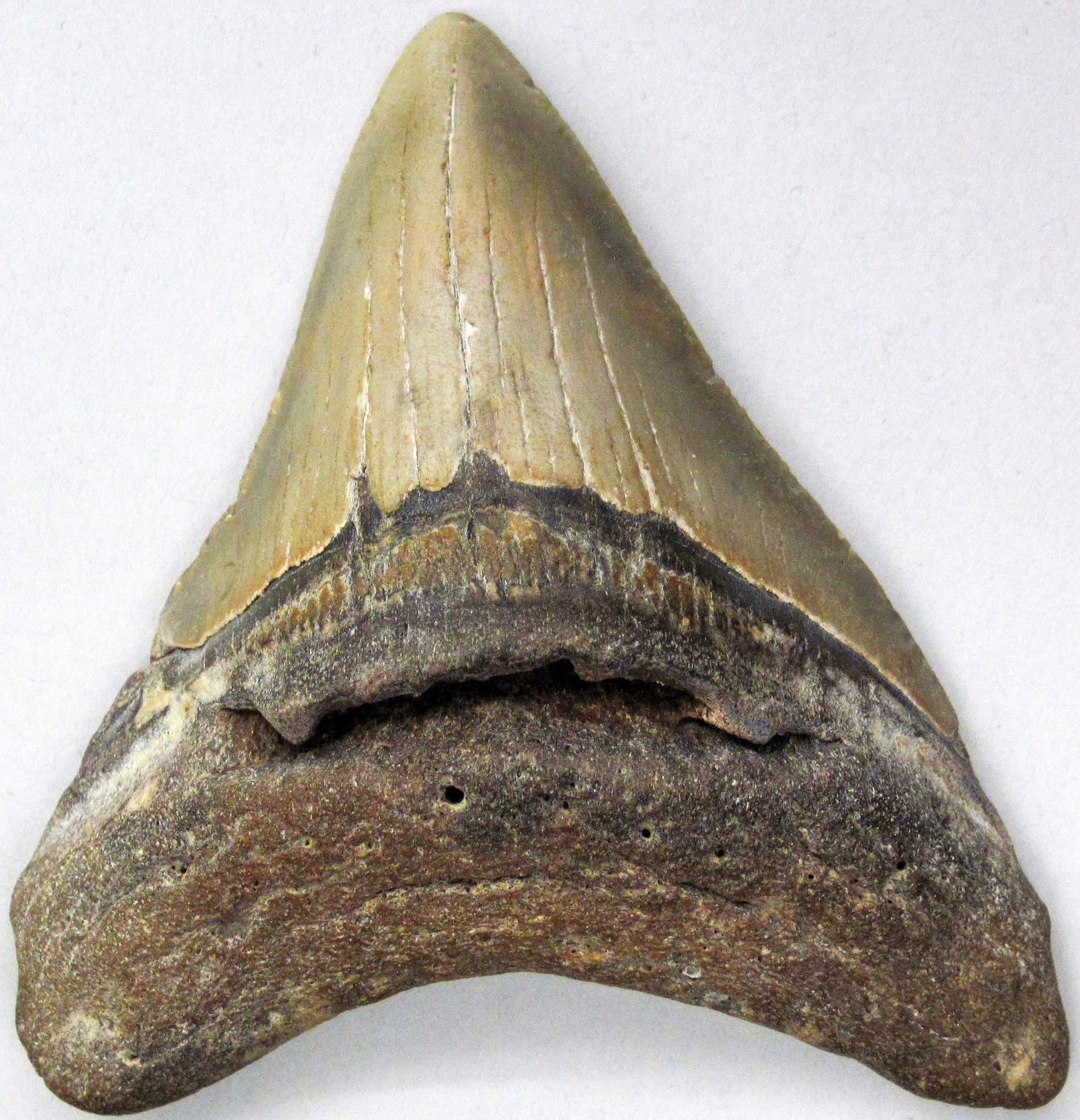
"Most of the ocean is unexplored" is a true sentence, and it is the reason the question keeps coming back. If we have mapped so little of the deep sea, how can anyone say for certain that a large shark is not down there?
The answer is that megalodon's extinction does not rest on anyone having looked. It rests on something the animal did continuously, everywhere it lived, for as long as it existed — and then stopped doing.
A shark cannot disappear quietly
Sharks are polyphyodont. They do not get one set of teeth and keep it. New teeth form continuously in a groove inside the jaw and move forward on a band of skin, so a shark is shedding and replacing teeth for its entire life. A single animal discards many thousands of them before it dies.
That matters for the fossil record because of what a shark is made of. The skeleton is cartilage, which breaks down quickly and rarely mineralises the way bone does. With very few exceptions, teeth are the only part of a shark that survives — which is why shark teeth are among the most commonly found fossils anywhere on earth.
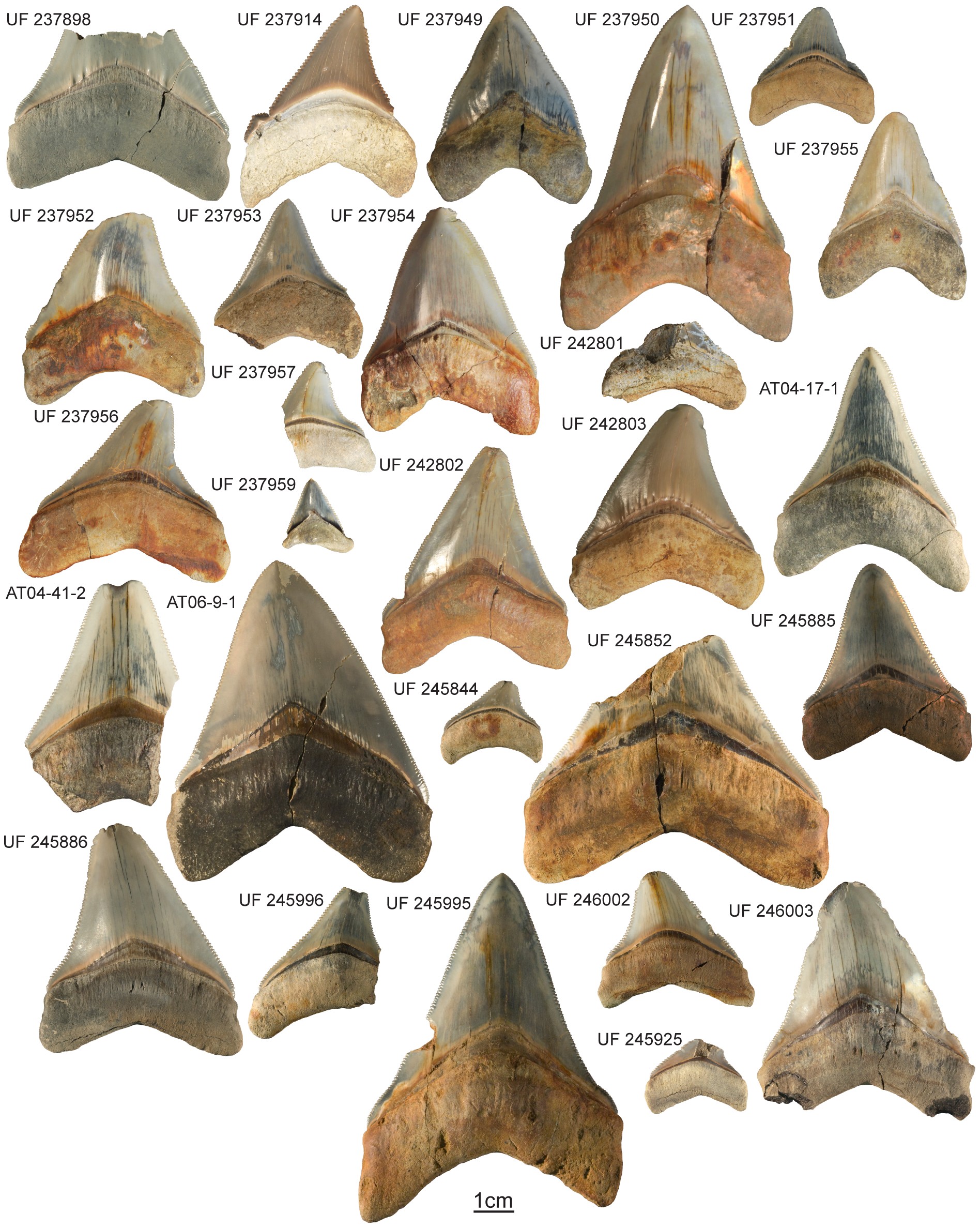
Put those two facts together and you get an unusual property: a shark species does not leave a scattering of specimens. It leaves a continuous trail, dropped a few teeth at a time, across every seafloor it ever swam over.
And then the trail stops
Megalodon's trail is one of the richest in the fossil record. Its teeth turn up on beaches, in quarries and in deep-sea dredges across nearly every continent. And then, at a particular point in the early Pliocene, they stop.
The current best estimate comes from Boessenecker and colleagues (2019), who did something more useful than adding another date to the pile: they went back through every reported occurrence and threw out the ones that would not stand up — fossils reworked out of older rock into younger deposits, misidentifications, and old dates since revised by better geology. Then they ran an optimal linear estimation on what survived.
Their result puts the extinction at a modal date of 3.6 million years ago, with the full range of estimates falling between 4.1 and 3.2 Ma, and a median of 3.51 Ma on the reanalysed dataset. That supersedes the older figure of 2.6 Ma.
So where did "still out there" come from?
Not from television, and this is the part most retellings get backwards. The survival claim is more than a century older than any documentary, and it came from fossils.
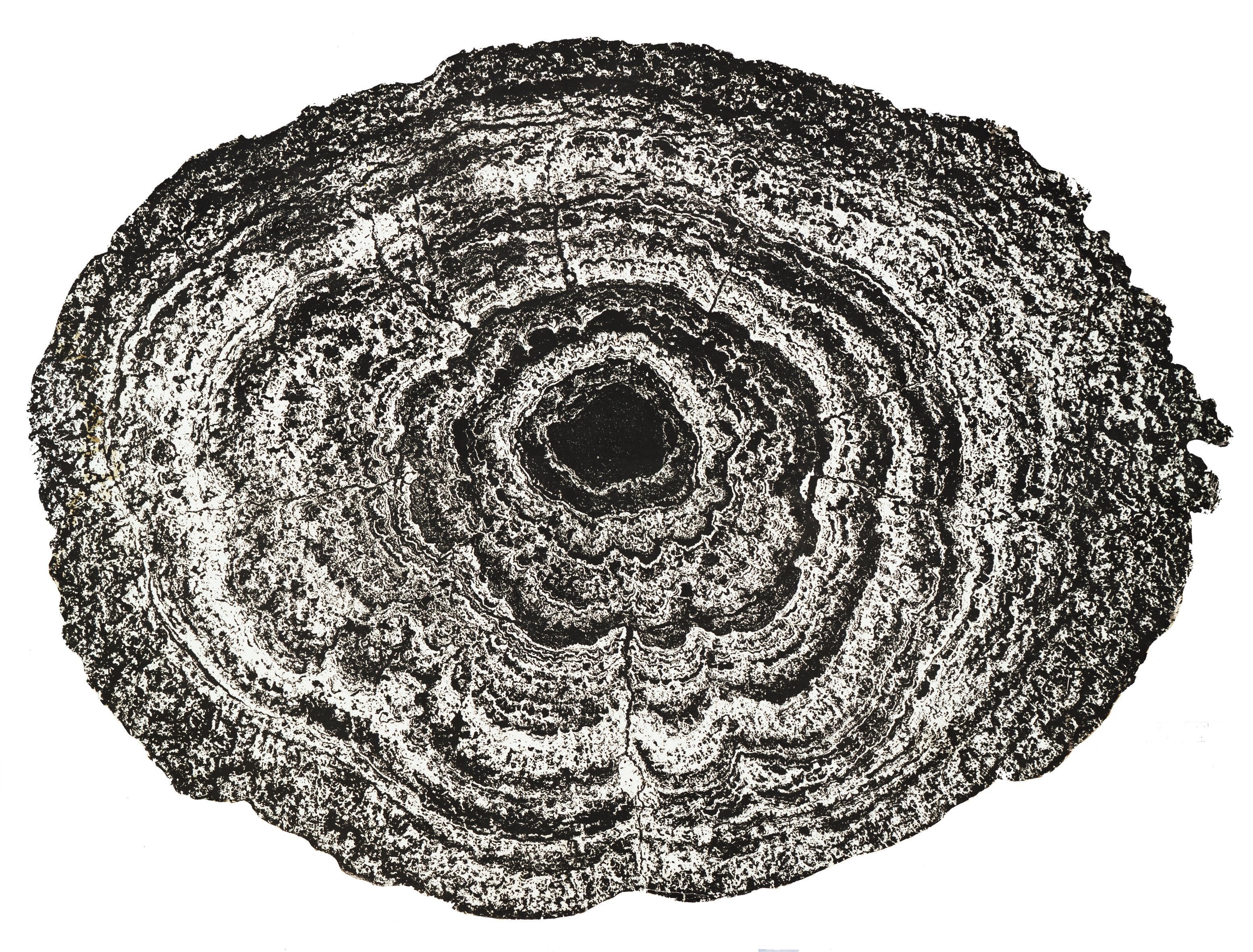
In 1875 HMS Challenger, on the great oceanographic voyage of 1872–76, dredged two megalodon teeth from Station 281 in the South Pacific near Tahiti, from 2,385 fathoms. Both were encrusted with manganese dioxide, one lightly and one heavily.
In 1959 the zoologist Wladimir Tschernezky, writing in Nature, tried to date them from those crusts. He measured 1.7 mm of manganese on one tooth and 3.64 mm on the other, assumed a minimum growth rate of 0.15 mm per thousand years, and derived ages of roughly 24,406 and 11,333 years. On that basis he argued megalodon had survived into the Holocene — geologically, into the present day.
What was actually being measured
It does not hold, and it was taken apart by Belyaev and Glikman in 1970 for two independent reasons, either of which is enough on its own.
The growth rate was wrong. Tschernezky's figure came from radium dating of manganese deposits, a method that yields accumulation rates 20 to 30 times faster than the more accurate ionium–thorium method. Ages derived from it come out 20 to 30 times too young.
The clock started late. The dentine roots and cores of both Challenger teeth had entirely decayed before any manganese was laid down, leaving only the hard enameloid crowns. Whatever the crust records, it began recording it long after the teeth reached the seafloor. Belyaev and Glikman also noted the teeth co-occurred in the sediment with Carcharodon hastalis and Parotodus benedenii — a Mio-Pliocene fauna, which is where megalodon belongs.
The general principle is worth keeping, because it applies well beyond this case. A crust does not date the object underneath it. It records how long that object lay exposed. Boessenecker et al. put it precisely: such dates "can only indicate when these teeth were exposed to seawater and do not reflect geochronologic age."
Everything after 1959 is amplification
The idea did not die with its evidence. David Stead published a second-hand account of a giant white shark seen by fishermen at Port Stephens, New South Wales, which appeared posthumously in 1963. The cryptozoologist Karl Shuker endorsed the survival idea in 1991. Steve Alten's novel Meg took it into mass fiction in 1997. And in August 2013 Discovery aired Megalodon: The Monster Shark Lives, which presented faked footage and hired actors as scientists.
That programme is the reason most people have heard of the claim. It is not the reason the claim exists. Reviewed treatments of megalodon as a cryptid — Guimont (2021) and Greenfield (2023) — make the same point: this animal was turned into a cryptid inside Western science, by a misread fossil, and television arrived a century late.
But the coelacanth came back
This is the honest objection, and we have made it ourselves: the coelacanth was known only from fossils, the youngest around 66 million years old, until a living one was landed off South Africa in 1938. Why should megalodon be different?
Because the difference is in the record, not in the animals. A coelacanth is a rare fish of steep, deep volcanic slopes, with a skeleton that fossilises poorly and a habitat that almost nothing samples. Its record is thin enough that an absence in it is genuinely a gap — the fish was somewhere nobody was looking, and the rock was not preserving it either.
Megalodon's record is the opposite kind of object. It is dense, global, and self-replenishing: an animal shedding teeth continuously into every sea it occupied, into sediments that have been collected and catalogued for two centuries. A gap in a thin record means very little. A stop in the richest one we have means something.
Why this belongs in PaleoDex
Because the interesting thing here is the shape of the argument. Extinction is usually inferred from the last thing found. This is one of the few cases where it is inferred from the sheer volume of things not found, in a record so thick that its edge is measurable. That is a stronger kind of evidence than a last sighting, and it is worth being able to tell the two apart. Read more of the record here, or see how the catalogue handles it in the Fossil Dex.
Sources
Every figure above traces to the primary literature:
- Boessenecker, R.W., Ehret, D.J., Long, D.J., Churchill, M., Martin, E. & Boessenecker, S.J. (2019). "The Early Pliocene extinction of the mega-toothed shark Otodus megalodon: a view from the eastern North Pacific." PeerJ 7: e6088. Open access. Source for the vetted occurrence dataset, the optimal linear estimation, the 3.6 Ma modal and 3.51 Ma median dates, and the assessment of manganese-crust dating.
- Tschernezky, W. (1959). "Age of Carcharodon megalodon?" Nature 184 (4695): 1331–1332. The original manganese-crust argument and the 24,406 / 11,333-year figures.
- Belyaev, G.M. & Glikman, L.S. (1970). Trudy Instituta Okeanologii (Institute of Oceanology, USSR Academy of Sciences). The rebuttal: the radium-derived growth rate, the decayed dentine, and the associated Mio-Pliocene shark fauna.
- Guimont, A. (2021). "The Megalodon: A Monster of the New Mythology." M/C Journal 24 (5). On megalodon as a cryptid produced inside scientific practice rather than by popular media.
- Greenfield, T. (2023). Journal of Scientific Exploration 37 (3): 330–347. Reassessment of the "modern survival" claim.
The real record, in your pocket.
PaleoDex catalogues the real fossil record, and every fact in it is sourced. Get the app.
GET IT ON GOOGLE PLAY →