Mary Anning: The Fossil Hunter History Nearly Forgot
PALEODEX · 20 July 2026 · 7 min read
From the age of 12, a working-class girl pulled sea dragons out of the cliffs of southern England: cliffs that could kill her, and once did kill her dog. She went on to make four discoveries that reshaped how science understands life on Earth. For most of her life, she got almost none of the credit.
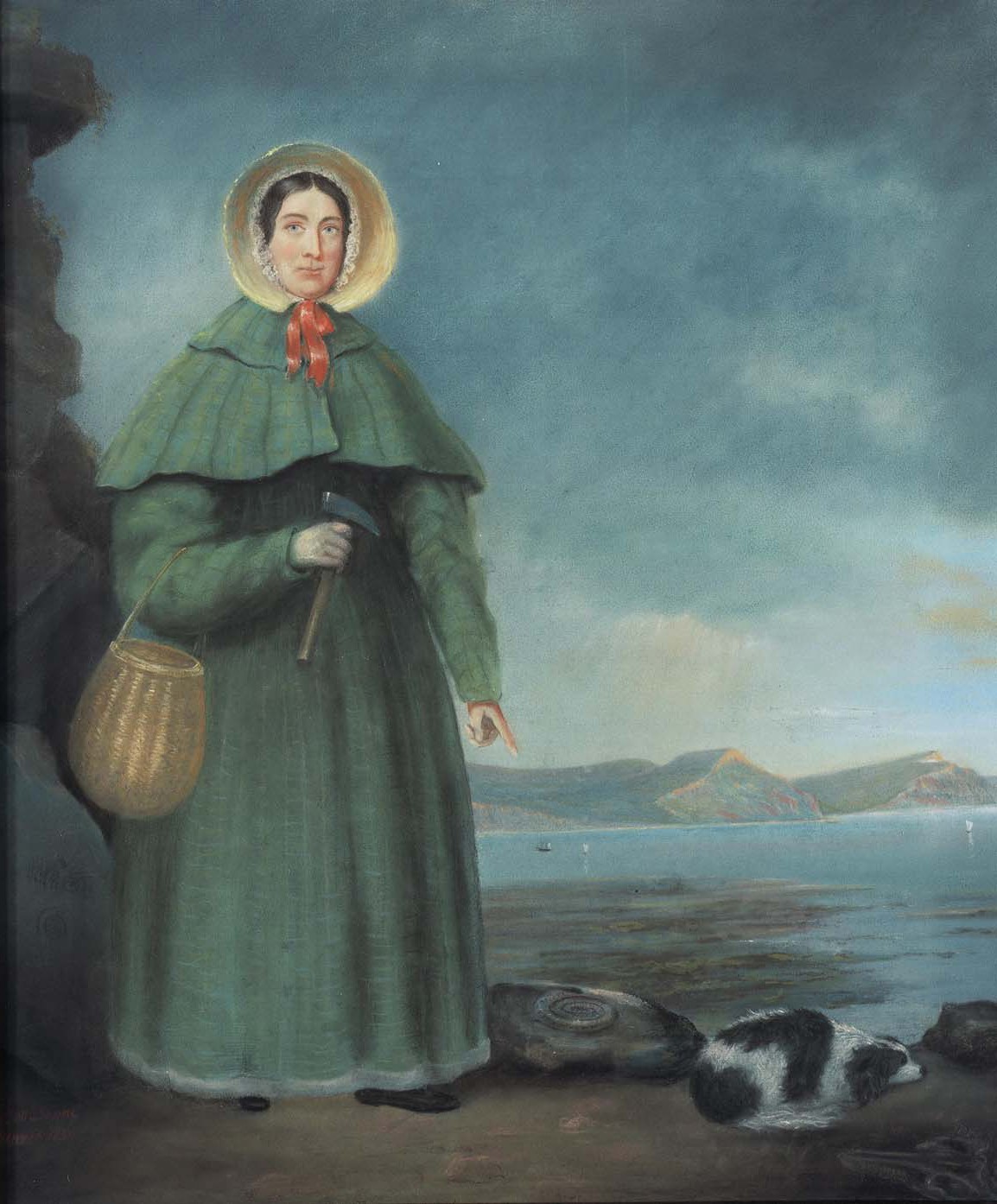
Mary Anning was born in 1799 in Lyme Regis, on England's Jurassic Coast, to a poor family. Her father was a cabinetmaker who hunted fossils on the side to make ends meet, and after he died in 1810, fossil-hunting was how the family survived. Mary searched the crumbling Blue Lias cliffs at low tide, dangerous work. A landslide once killed her dog, Tray, and nearly killed her too. She kept going, and over the next three and a half decades she made a string of discoveries that any single paleontologist would be proud of in a whole career.
The first ichthyosaur ever studied by science
In the autumn of 1811, when Mary was twelve, her brother Joseph spotted a strange skull poking out of the cliff face. Mary spent the following months digging out the rest: a skeleton almost five meters long, with a dolphin-like body and long, tooth-lined jaws. It became the first ichthyosaur skeleton ever studied by science, found by a child with no formal training at all. The specimen was sold to Sir Everard Home of the Royal Society, who published the first formal scientific description of an ichthyosaur.
A skeleton so strange, the world's top scientist called it a fake
On 10 December 1823, Mary made an even bigger find: the first complete Plesiosaurus skeleton ever recovered, a long-necked marine reptile unlike anything described before. The specimen's neck alone had an unprecedented 35 vertebrae. It was so strange that Georges Cuvier, the most famous anatomist in the world, wrote to a colleague suggesting the find might be a fraud stitched together from different animals. A special meeting of the Geological Society examined the evidence in early 1824 and concluded the skeleton was legitimate. Cuvier later admitted he had acted in haste and was mistaken. In 1848 the specimen was bought by the British Museum and is now held at the Natural History Museum, London, catalogued as NHMUK OR 22656.
Britain's first pterosaur, and a rare named credit
In December 1828, Mary found something Britain had never recorded: the fossil remains of a pterosaur, the first ever found outside Germany. William Buckland described it in 1829 as Pterodactylus macronyx. Richard Owen later renamed it Dimorphodon macronyx in 1859. Unlike most of Mary's finds, Buckland's paper explicitly credited Anning by name for the discovery.
She even named what came out the other end
Mary also noticed something odd: strange stony lumps, sometimes called "bezoar stones," turned up inside ichthyosaur skeletons, and when broken open, they were often packed with fossilized fish bones and scales. She proposed to Buckland, around 1824, that these were fossilized droppings. Buckland agreed, and in a paper read before the Geological Society in 1829 (published in the Society's Transactions in 1835), he gave them a new name: coprolite. Once again, he credited Mary Anning by name for the insight.
The paradox: named twice, barred all the same
Here is the part of Mary Anning's story that's easiest to oversimplify in either direction. Buckland named her, in print, twice: for the pterosaur and for the coprolite. That's real, and it matters. But the Geological Society of London wouldn't let her join. No woman was admitted as a Fellow until 21 May 1919 (Margaret Crosfield, first by alphabetical primacy among the first eight women elected that day), 72 years after Mary Anning died. A commonly repeated date, 1904, is not the same milestone: that year, Maud Healey merely became the first woman permitted to be present at the reading of her own paper. She was never made a Fellow. Most of the scientists who bought Mary's fossils, including the famous 1823 Plesiosaurus, published them under their own names, with her collecting work barely mentioned. She found the specimens that were remaking science, and for most of her career, she was almost never allowed to be formally part of it.
Remembered, eventually
Mary Anning died in 1847, still working the Lyme Regis cliffs. Today, the ichthyosaurs, plesiosaurs and pterosaurs she pulled out of that stretch of English coast anchor museum halls worldwide, and she's remembered as one of the founders of paleontology, a recognition that, for most of her life, the institutions of her own time would not give her.
Sources
Every fact above is drawn from primary and institutional sources:
- Natural History Museum, London, "Mary Anning: the unsung hero of fossil discovery." (nhm.ac.uk)
- The Geological Society of London, "Mary Anning and the Geological Society" online exhibition (ichthyosaur, Plesiosaurus, Dimorphodon and coprolite pages). (geolsoc.org.uk)
- The Geological Society of London, "Margaret Crosfield: the first female Fellow" and "100 years of female Fellowship" (2019). (geolsoc.org.uk)
- Burek, C. & Malpas, J. (2020). "Margaret Chorley Crosfield, FGS: the very first female Fellow of the Geological Society." Geological Society, London, Special Publications 506. (lyellcollection.org)
- Lyme Regis Museum, "Dimorphodon and the Reverend George Howman — Mary Anning, William Buckland and 'Pterodactylus' macronyx." (lymeregismuseum.co.uk)
- Biodiversity Heritage Library, "Uncovering the Truth about Fossil Feces: Buckland, Anning, and Coprolites." (biodiversitylibrary.org)
- Wikipedia, "Mary Anning." (en.wikipedia.org)
The real record, in your pocket.
PaleoDex catalogues the real fossil record: sourced, and honest about who actually found it. Get the app.
GET IT ON GOOGLE PLAY →