What Was the Largest Land Mammal That Ever Lived?
PALEODEX · 24 September 2026 · 6 min read
Not a mammoth. The usual answer is a hornless rhino relative from Asia, and a 2016 study says an extinct elephant may have beaten it. Neither case is as solid as the headlines make it look.
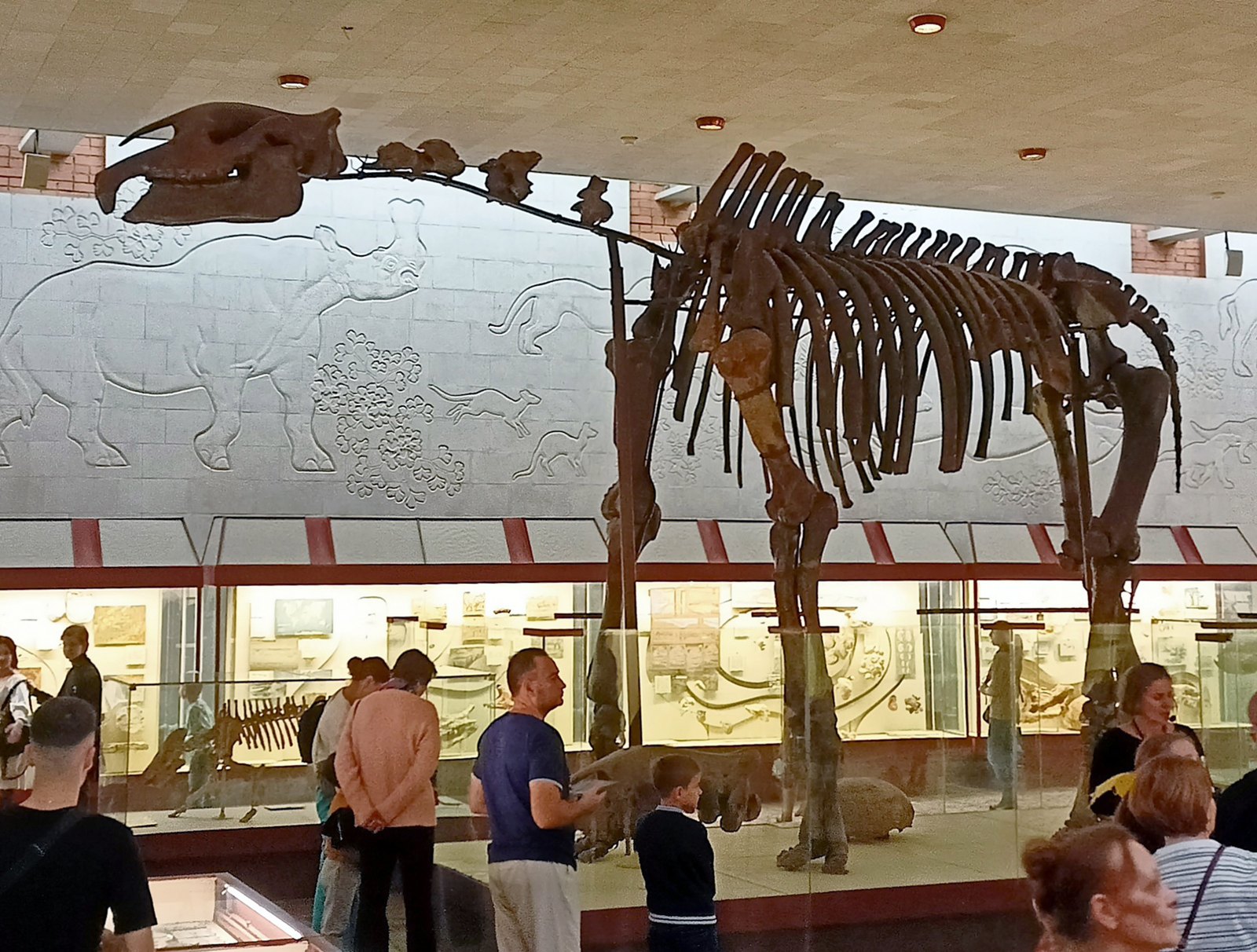
Ask what the largest land mammal was and a mammoth is the obvious guess. It is a reasonable one. Mammoths were enormous, and the heaviest in the most thorough recent survey, a steppe mammoth known from a giant arm bone and pelvis found at Mosbach in Germany, comes out at about 14.3 tonnes.
But it is not the answer you will usually be given.
The usual answer: a rhino relative with no horn
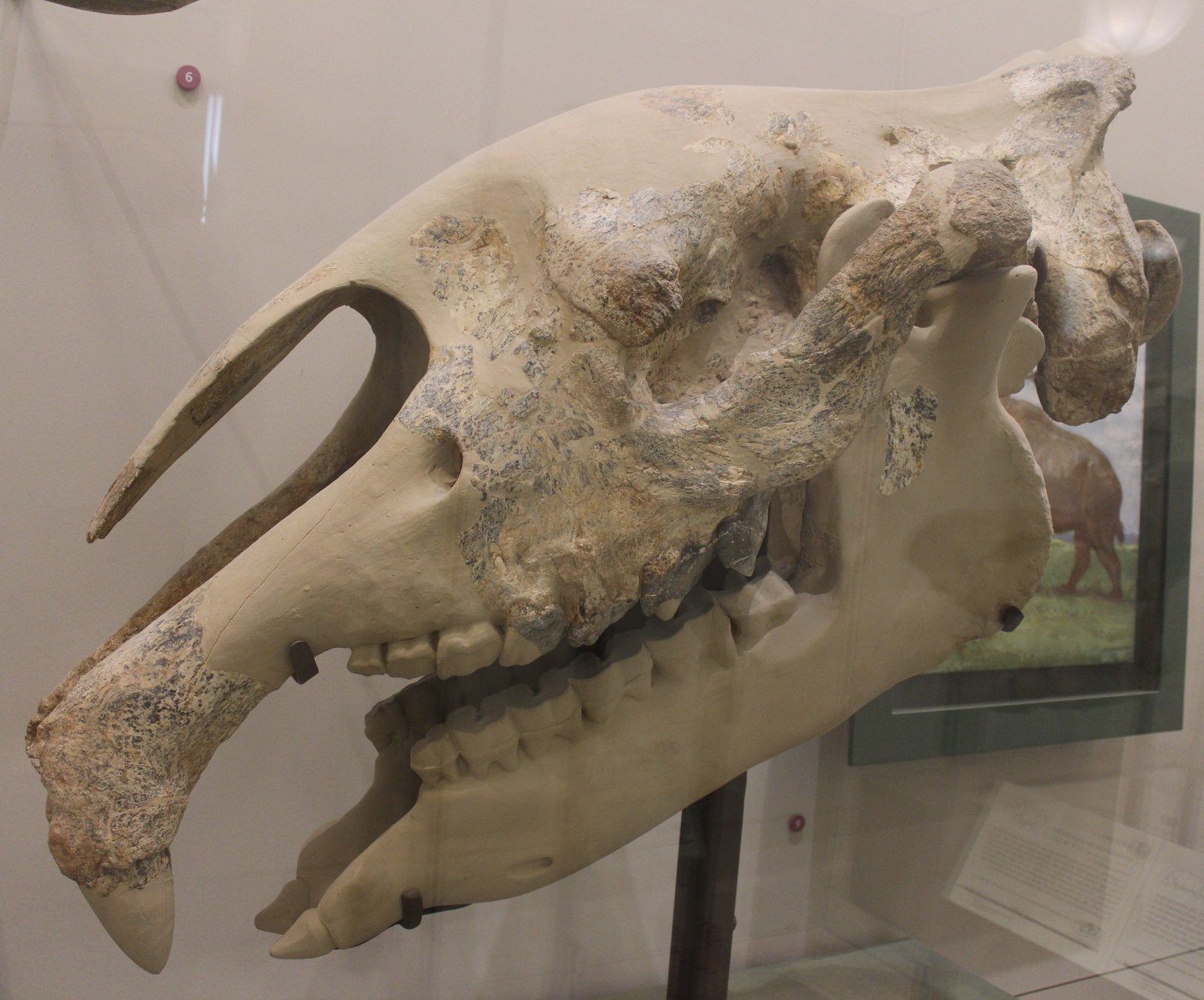
That answer is Paraceratherium, a giant member of the rhino superfamily that lived across Asia in the Oligocene, around 30 million years ago. Its fossils run from Mongolia and China to Kazakhstan and Pakistan, with remains as far west as Eastern Europe and Anatolia. It had a long neck and no horn at all. When a skull came out of Mongolia in 1922, the paper describing it called the animal, simply, a giant hornless rhinoceros.
How big? The largest bulls are reconstructed at about 4.8 metres at the shoulder and around 17 tonnes. That comfortably clears the heaviest mammoth, and it is why Paraceratherium is the name you usually hear.
The challenger: an extinct elephant from India
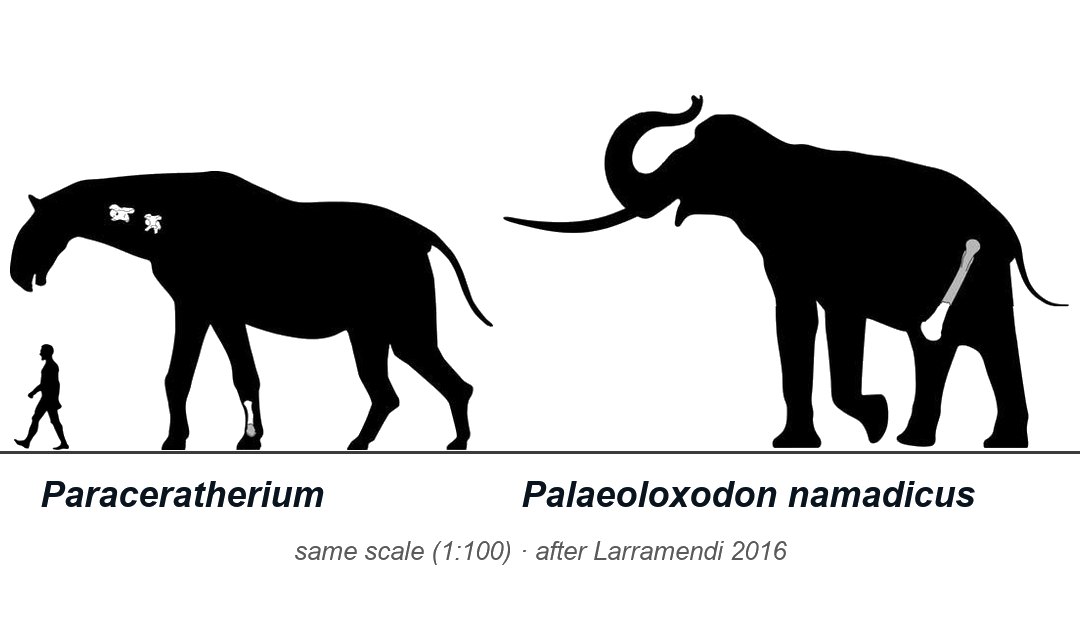
In 2016 Asier Larramendi published a survey of the body size of dozens of extinct elephants and their relatives in Acta Palaeontologica Polonica, and it reached a different conclusion about the record. In the author's words, a few of the largest proboscideans "were found out to have reached and surpassed the body size of the largest indricotheres", which is the group Paraceratherium belongs to.
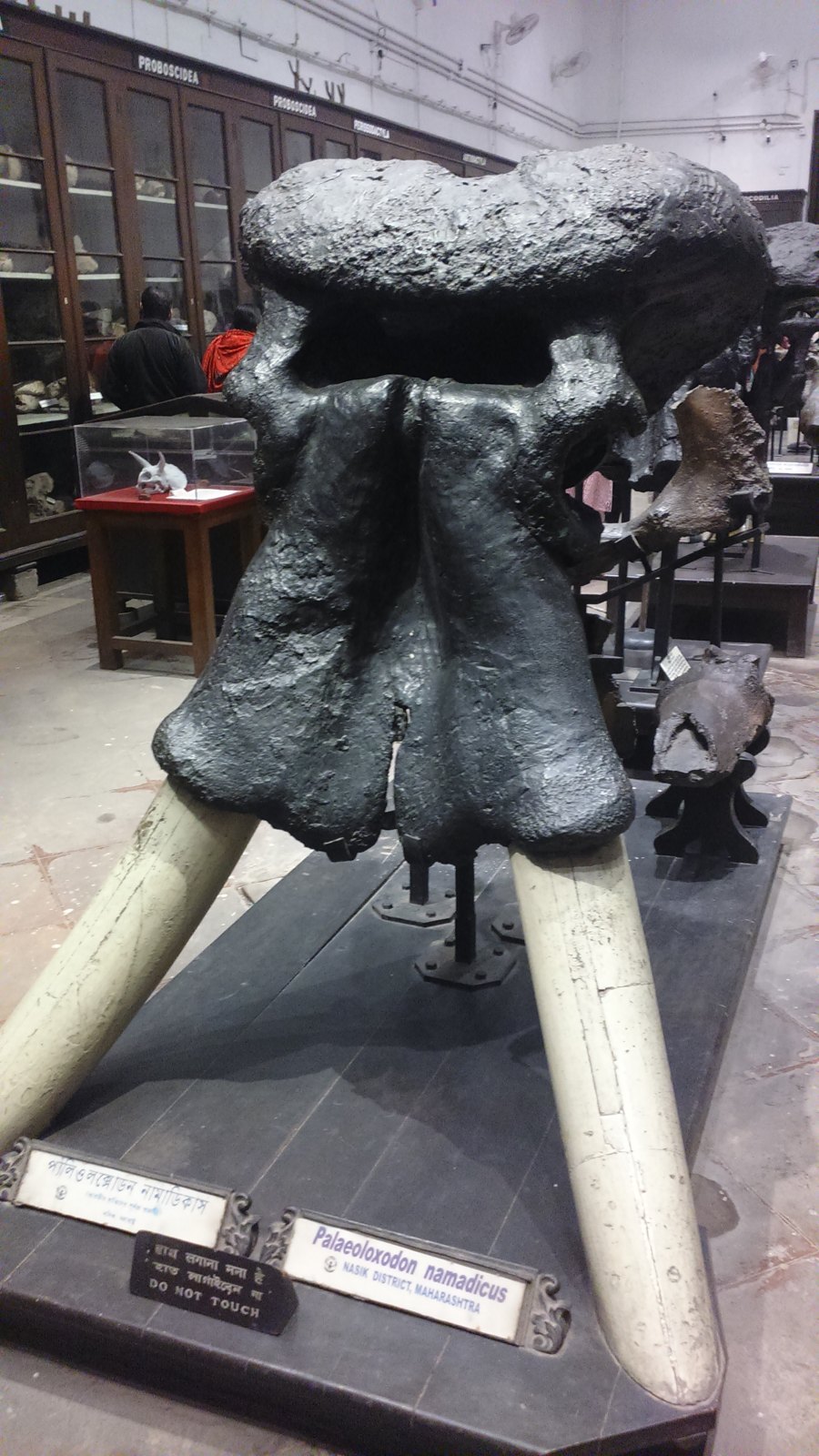
The strongest candidate is Palaeoloxodon namadicus, an extinct elephant from the Indian subcontinent. The study puts its biggest bull at about 5.2 metres at the shoulder and over 22 tonnes. It also argues that big bulls of Mammut borsoni, a European mastodon, may have matched or passed Paraceratherium: one young male from Greece already weighed around 14 tonnes, and might have gone past 18 had he lived to old age. The study's own conclusion is blunt: "Paraceratherium appears not to be the largest land mammal ever."
Why it is not settled
Look at the grey bone inside the elephant. That is where the 22 tonnes comes from.
The estimate rests on the lower end of a single thigh bone, reported in 1834 from Sagauni in central India. It is candid about how much that carries: the fossils, it says, are likely stored in the Indian Museum in Kolkata, the piece "must be restudied", and "until such a collection can be revised, this size estimate will remain speculative". A note on the same plate asks readers to take both headline figures, the elephant's and Paraceratherium's, "with a grain of salt".
And neither animal is known from a complete skeleton. The fullest Palaeoloxodon namadicus find the study describes is a partial skeleton whose thigh bones were found broken. Paraceratherium is known from skulls, limb bones and partial skeletons, and the standard picture of the whole animal is a composite.
So which is it?
We are not going to pick one, and the evidence does not let us. What is solid is the shortlist. On the figures in the most detailed survey we could read in full, the largest land mammal was not a mammoth: it was either a hornless rhino from Asia or a giant elephant from India, with a European mastodon close behind. Which of them wore the crown depends on a femur fragment that has not been re-examined, and on reconstructions of animals nobody has found whole.
That is an unsatisfying answer and an honest one. It is also a question that could move the moment someone re-examines that 1834 bone.
Why this belongs in PaleoDex
Because "the biggest" is the kind of fact that gets repeated until it sounds like a measurement, and it rarely is. Here the headline number for each contender traces back to a handful of bones and a drawing, and the author who drew them said so. That is exactly the distance between a claim and its evidence that the app is built to show. The rest of the catalogue, sourced the same way, is in the Fossil Dex, and how we decide what counts as sourced is in About the data.
Sources
Every claim above traces to the sources below. Where we did not read a source in full, we say so.
- Larramendi, A. (2016). "Shoulder height, body mass, and shape of proboscideans." Acta Palaeontologica Polonica 61(3): 537–574. DOI. Open access, CC BY 4.0, which is why its plate appears above. Read in full. Source for the ~17 t and ~4.8 m figures for the largest Paraceratherium, the ~14.3 t Mosbach mammoth, the P. namadicus and M. borsoni estimates, the 1834 Sagauni femur and its likely location, "speculative", "with a grain of salt", and the state of both skeletal records.
- Deng, T., Lu, X., Wang, S., Flynn, L.J., Sun, D., He, W. & Chen, S. (2021). "An Oligocene giant rhino provides insights into Paraceratherium evolution." Communications Biology 4: 639. DOI. Open access, CC BY 4.0. Read in full. Source for the rhino-superfamily placement, the long neck, the Oligocene ages and the geographic range.
- Osborn, H.F. (1923). "Baluchitherium grangeri, a giant hornless rhinoceros from Mongolia." American Museum Novitates 78: 1–15. Not read: cited for its title.
The real record, in your pocket.
PaleoDex catalogues the real fossil record, and every fact in it is sourced. Get the app.
GET IT ON GOOGLE PLAY →