Is Bigfoot a Surviving Gigantopithecus?
PALEODEX · 22 September 2026 · 8 min read
The giant ape is real. Almost everything you have read about it was worked out from its teeth.
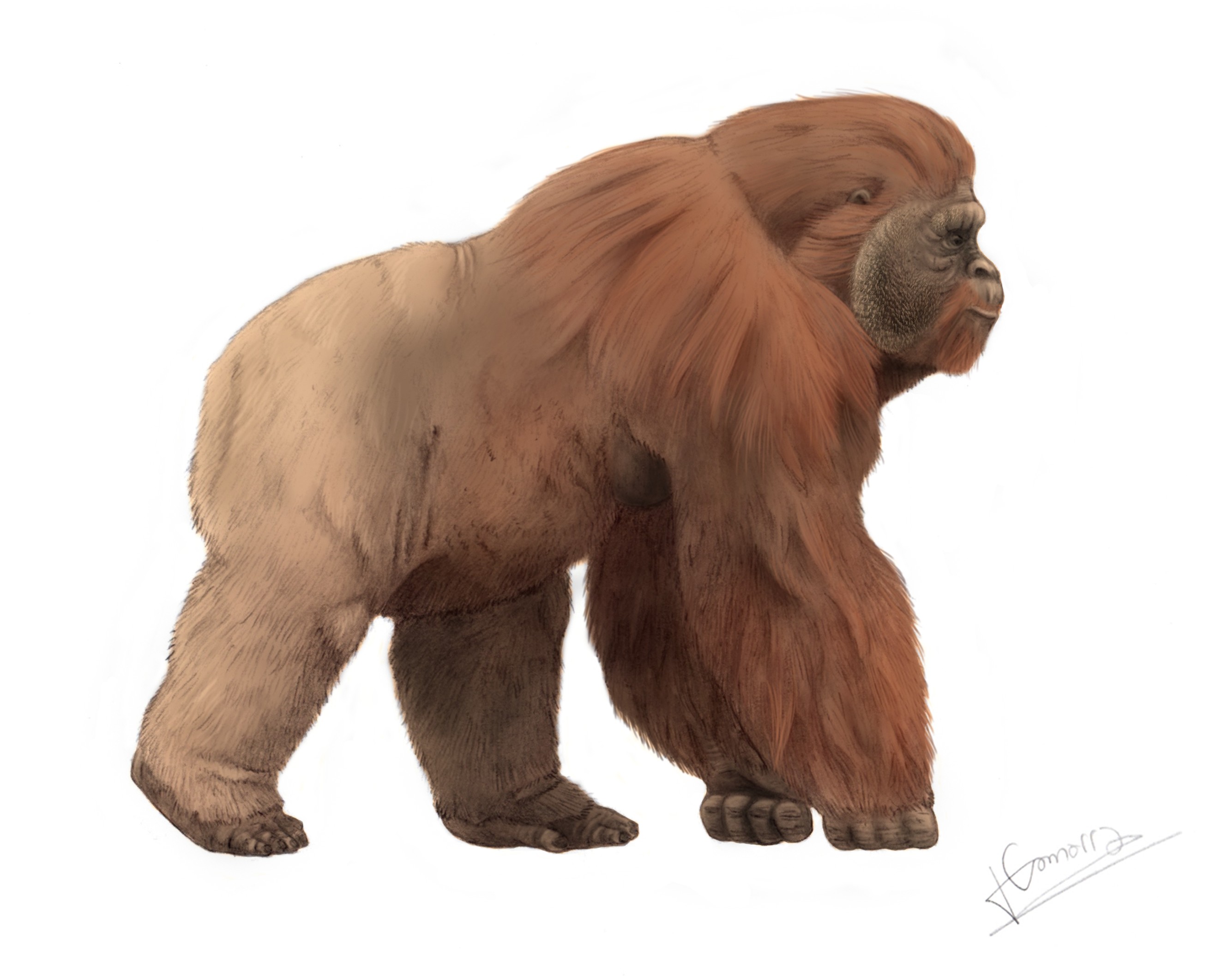
Whenever someone argues that Bigfoot is a real animal rather than a story, the same fossil ape gets called as a witness. Gigantopithecus blacki is a genuine, described species — the largest ape that has ever lived — and the argument writes itself: a giant ape existed in Asia, Asia and North America were joined at the Bering Strait, therefore a population could have crossed and could still be out there. The anthropologist Grover Krantz spent much of his career making exactly that case.
The interesting part is not whether that argument is right. It is how little of this animal exists to argue about, and how much was squeezed out of what does.
The picture everyone has seen
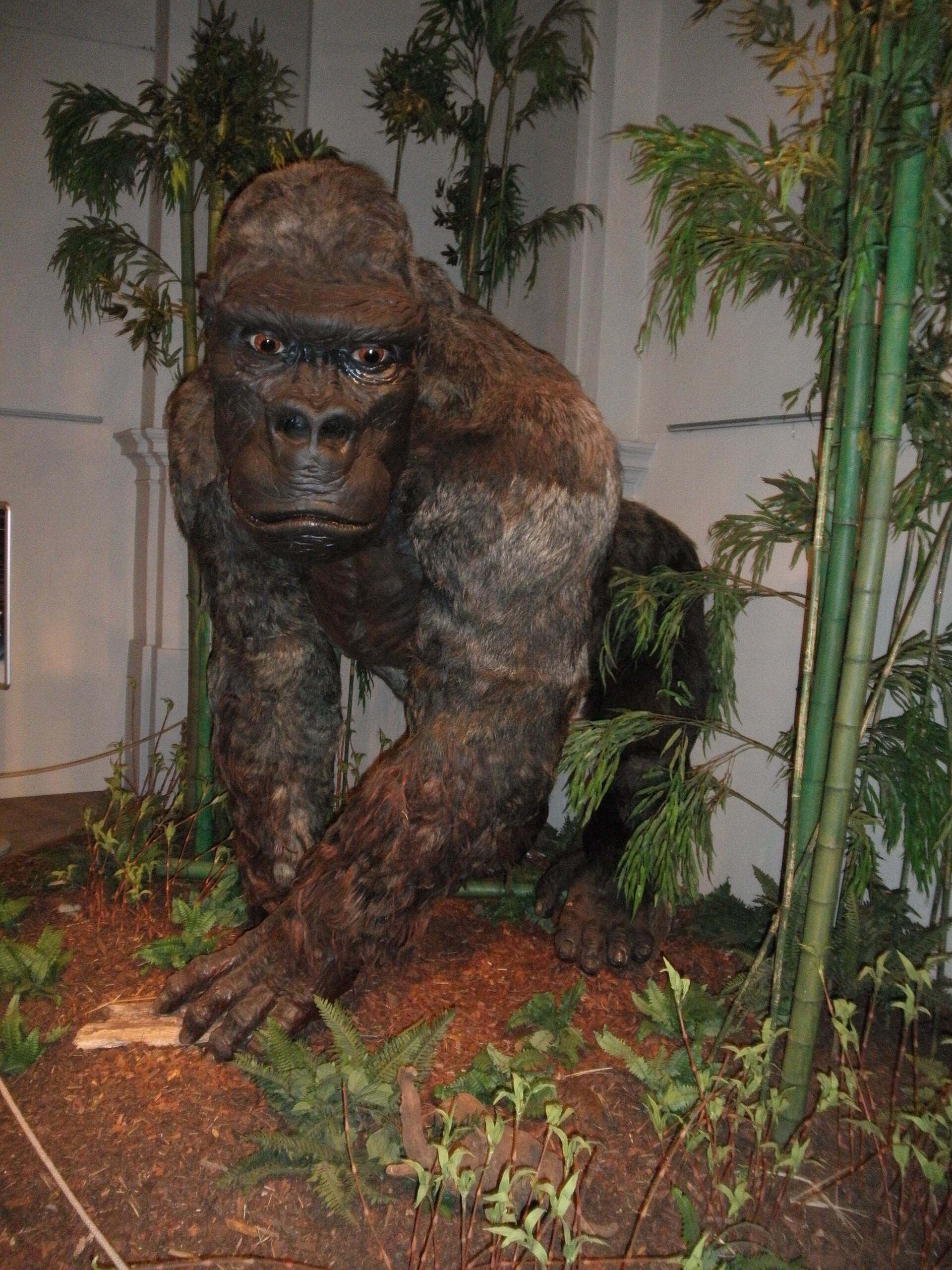
Search for this animal and you will get a barrel-chested ape reared up on two legs, somewhere between a gorilla and a very large man. Museum models often go the same way. That posture is a choice made by an artist or a model-maker, not a reading of a fossil — and the reason is the next section.
The entire fossil record fits in one sentence
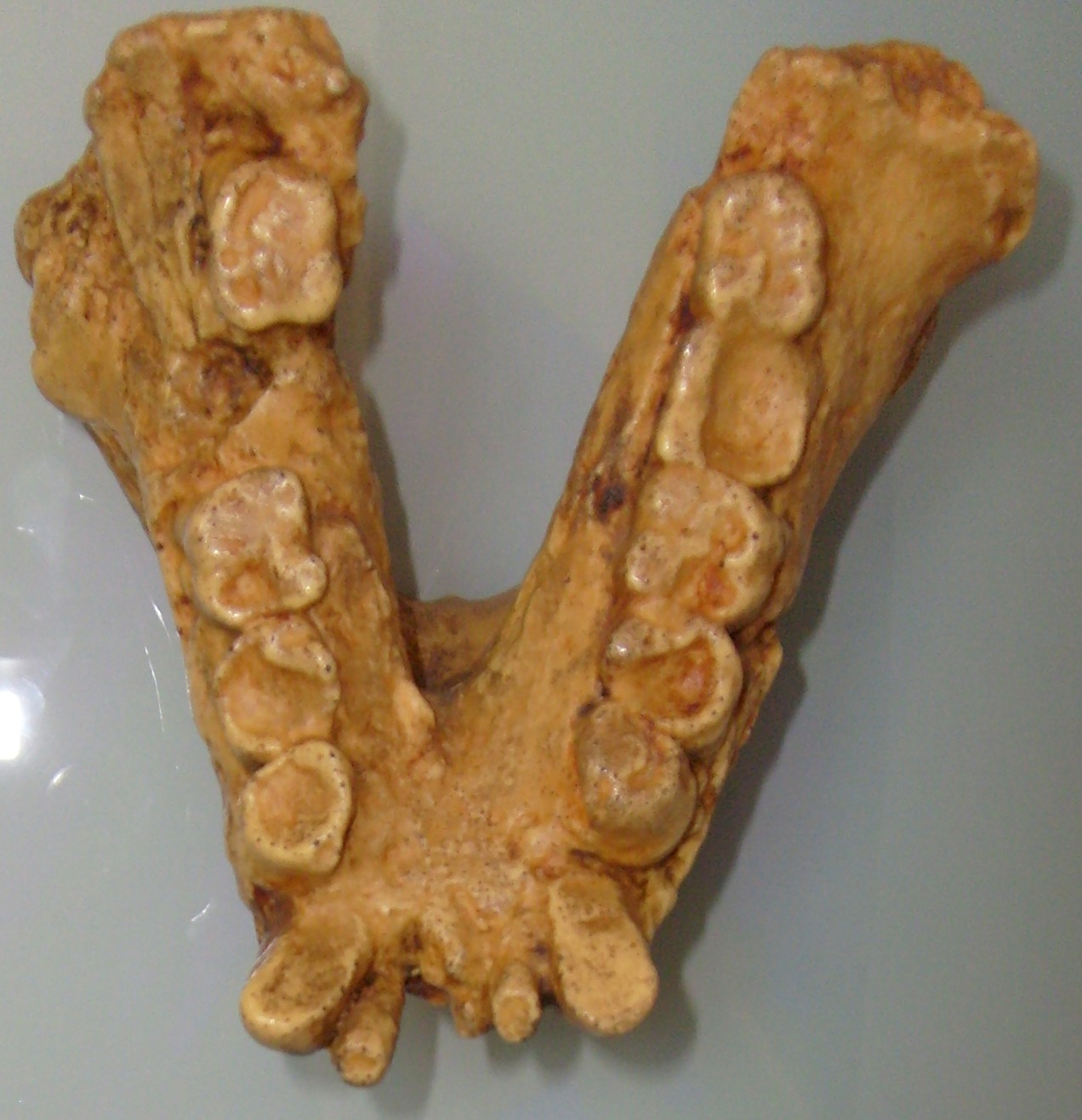
Four partial lower jaws, and nearly two thousand isolated teeth, from Early and Middle Pleistocene cave sites across southern China. That is the whole of it. Yingqi Zhang and Terry Harrison set the inventory out in their 2017 review of the material, and it has not moved since: there is no cranium, and there is no postcranial skeleton of any kind. Not a limb bone. Not a vertebra. Nothing at all from below the jaw.
It is worth sitting with how unusual that is. For most well-known extinct animals we argue about which skeleton is most complete. Here the most complete specimen in existence is a piece of jaw.
So where do the size figures come from?
From the teeth and the jaws, because there is nothing else to use. Zhang and Harrison give a body mass estimate of 200–300 kg and say plainly what it rests on: the size of the dentition and the mandible. That is a real, published, defensible number with its working shown.
The figures you are more likely to have met — three metres tall, up to 600 kg — are not in the published work. They come from press coverage, and they have been repeated often enough to read like measurements. This is a general hazard worth carrying around: when an animal is known only from fragments, every headline number about it is an extrapolation from those fragments, and the honest version of the claim names which fragments. Dunkleosteus is the same story in water — an armoured fish whose head and jaws fossilise well and whose body barely fossilises at all, reported for decades at a full length nobody had ever measured.
The teeth turned out to be enough anyway
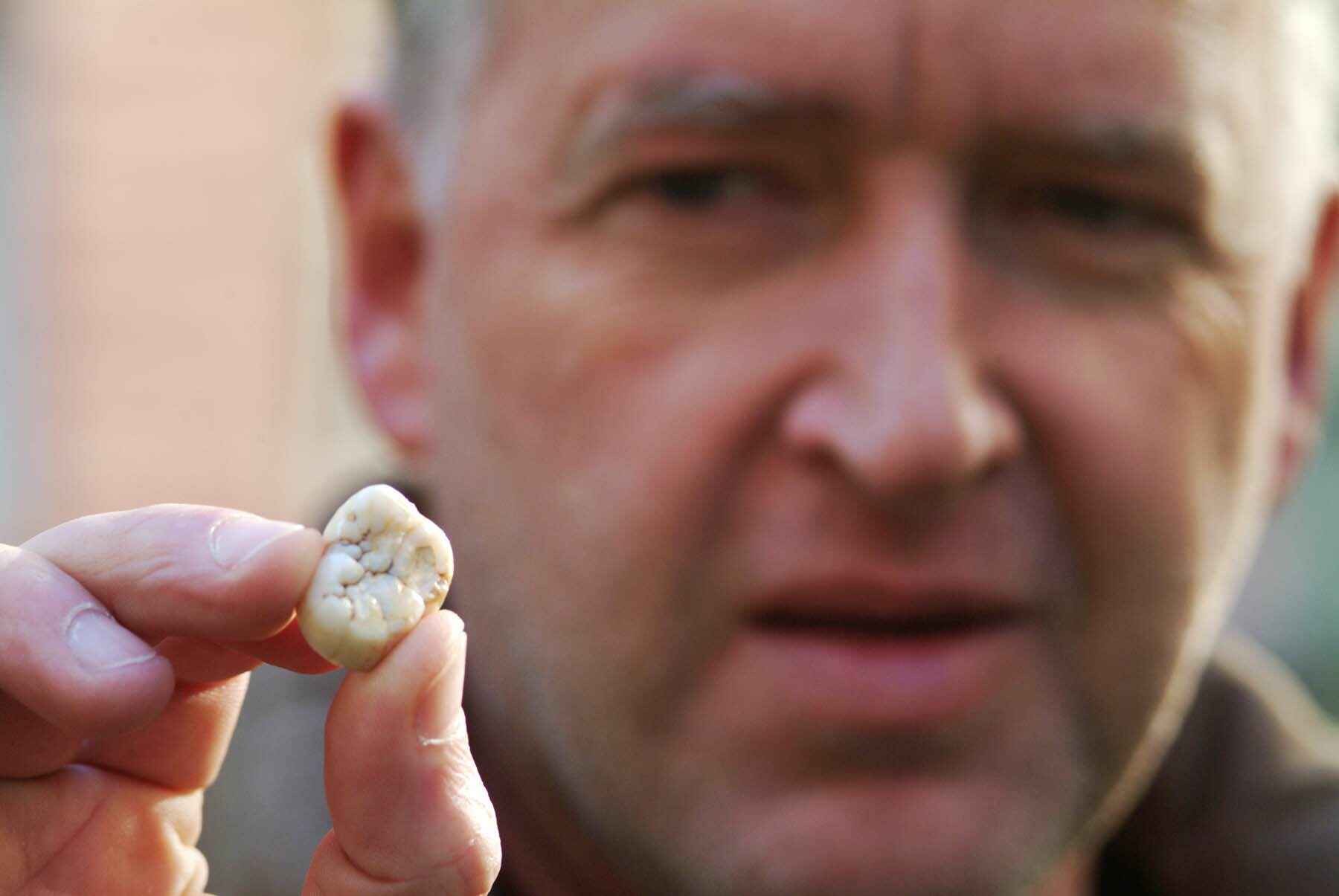
This is the part that makes the animal worth a post rather than a shrug. Tooth enamel is not just hard; it traps fragments of protein, and it holds onto them for far longer than bone holds onto DNA. Proteins are shorter and less informative than a genome, but they survive, and a protein sequence still carries enough signal to place a species on a tree.
In November 2019, Frido Welker, Jazmín Ramos-Madrigal, Martin Kuhlwilm, Wei Liao, Anne-Marie Bacon and colleagues published an enamel proteome recovered from a single Gigantopithecus molar: specimen CF-B-16, from Chuifeng Cave in the Bubing Basin, Guangxi, dated to 1.9 million years old. The thermal age of those sequences is roughly five times greater than that of any mammalian proteome or genome published before them — which is the technical achievement sitting underneath the headline.
What the proteins said
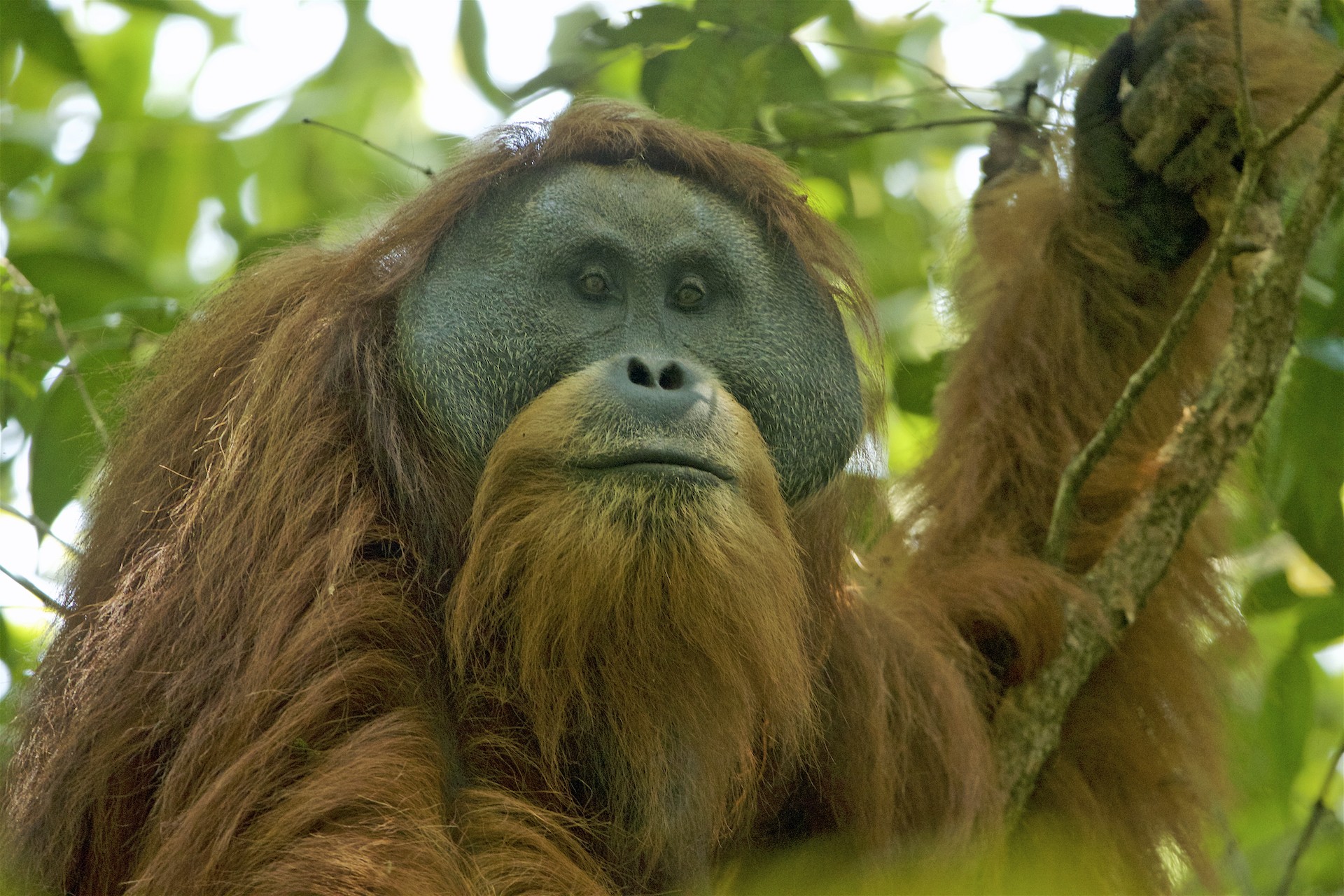
Gigantopithecus resolves as an early diverging pongine. In plain words: it sits on the orangutan branch of the ape family tree, as the sister group of Pongo, with the two lineages separating between 12 and 10 million years ago. That places its divergence inside the Miocene radiation of the great apes, and nowhere near our own line.
The careful part, because it is easy to overstate
It would be neat to end by saying the evidence shows this was not an upright, human-shaped ape, and therefore not a Bigfoot. That is one step further than the evidence goes, and the step is worth naming.
The proteome is a statement about ancestry. It is not a statement about anatomy, and it cannot be, because there are no postcranial remains — not one bone that bears on how this animal stood, walked or carried its weight. So nothing here tells you Gigantopithecus was not upright. Nothing tells you it was, either. Posture is simply a question this fossil record cannot answer, in any direction.
What the record can answer is whose relatives it had, and on that it is unambiguous. If you want the giant ape of the Bigfoot story to be a close relation of ours, hiding out in the Pacific Northwest, the proteins are not on your side: they put the animal with the orangutans. And if you want a specific, dated account of when this ape was last around, that is a separate question with its own evidence, and we have deliberately left it for its own post.
Why this belongs in PaleoDex
Because the good version of "how do we know?" is usually more interesting than the fact. An animal known from four broken jaws and a cabinet of loose teeth still yielded a testable answer about where it belongs — not by finding more bones, but by reading a molecule that nobody expected to survive two million years inside a tooth. The rest of the catalogue, sourced the same way, is in the Fossil Dex, and how we decide what counts as sourced is in About the data.
Sources
Every claim above traces to the sources below. Where we relied on someone else's reading of a source, we say so.
- Welker, F., Ramos-Madrigal, J., Kuhlwilm, M., Liao, W., Gutenbrunner, P., de Manuel, M., Samodova, D., Mackie, M., Allentoft, M.E., Bacon, A.-M. et al. (2019). "Enamel proteome shows that Gigantopithecus was an early diverging pongine." Nature 576: 262–265. DOI. Read in full. Source for the proteome, specimen CF-B-16, Chuifeng Cave, the 1.9-million-year age, the thermal-age comparison, the pongine placement and the 12–10 Ma divergence. Also the source for "four partial mandibles" and for the absence of cranial and postcranial remains, which the paper states as its own obstacle.
- Zhang, Y. & Harrison, T. (2017). "Gigantopithecus blacki: a giant ape from the Pleistocene of Asia revisited." American Journal of Physical Anthropology 162(Suppl. 63): 153–177. DOI. Source for the inventory of nearly two thousand isolated teeth, for "the largest hominoid that ever lived", for the southern Chinese cave sites and the closed-canopy forest habitat, and for the 200–300 kg body-mass estimate and the explicit statement that it rests on the size of the dentition and the mandible.
- Krantz, G.S. (1931–2002), physical anthropologist, Washington State University. Source for the attribution of the surviving-Gigantopithecus argument, which he pursued across his career and for which he proposed the name Gigantopithecus canadensis in 1986. We cite him as the argument's author, not as support for it.
The real record, in your pocket.
PaleoDex catalogues the real fossil record, and every fact in it is sourced. Get the app.
GET IT ON GOOGLE PLAY →