How Do You Prove Two Continents Were Joined?
PALEODEX · 20 August 2026 · 9 min read
Everyone can say the continents were once joined. Almost nobody can say how anyone found out — and the answer took a hundred years, three separate lines of evidence, and a man being told he was wrong about the part he actually got wrong.
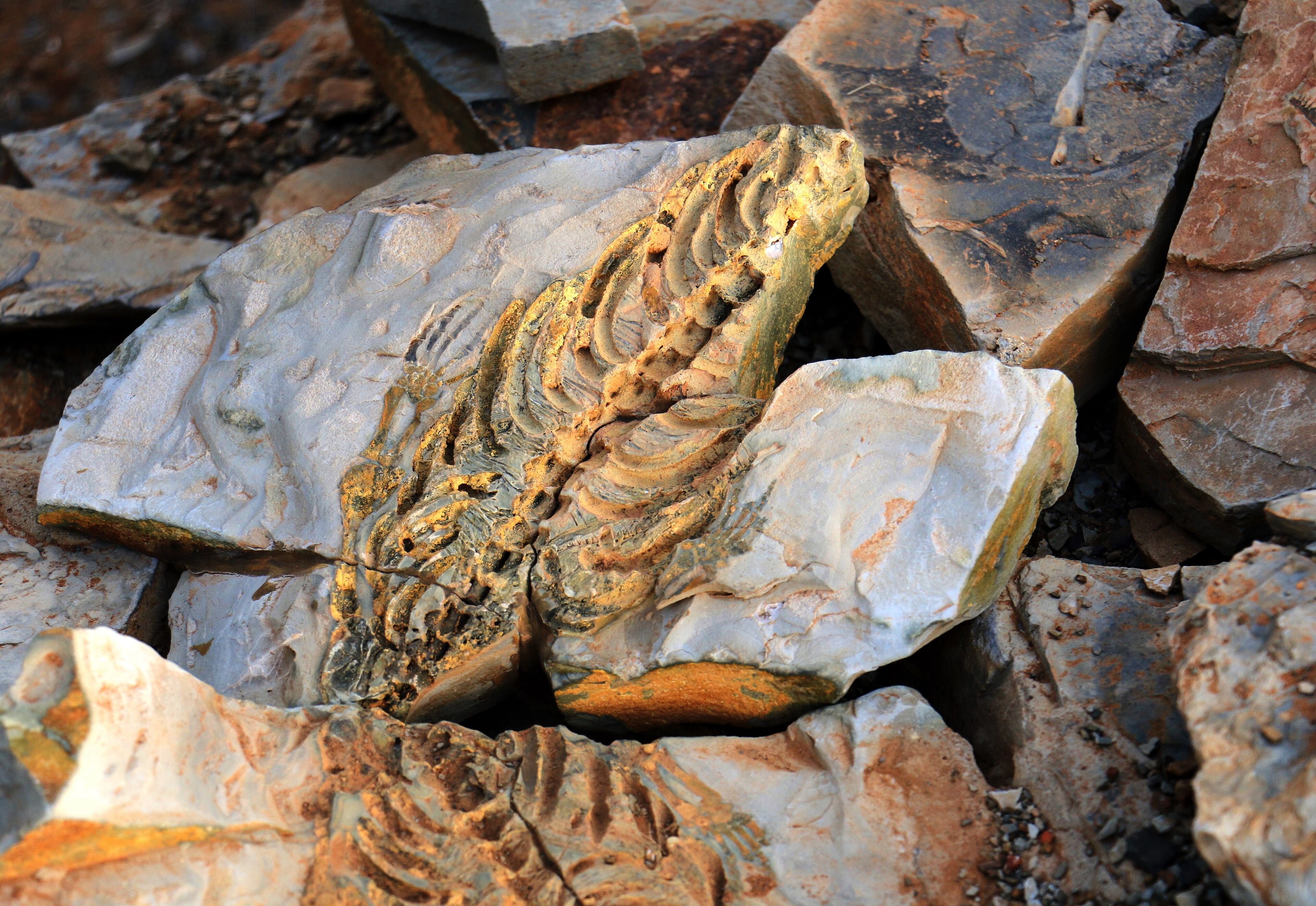
There are no satellites in this story, no GPS, and no way to measure a continent moving. For most of the time the question was open, there was nothing to measure with at all.
So the first real evidence was not a measurement. It was an animal.
One reptile, two coastlines
Mesosaurus was small — about a metre long — and aquatic, and it lived during the Permian. None of that is what makes it interesting. What makes it interesting is where it turns up.
Earth@Home, the public science resource of the Paleontological Research Institution, puts it flatly: fossil specimens of Mesosaurus “have only been found in two regions: southern Africa and South America.” Not mostly. Only.
Two coastlines that today face each other across the Atlantic, and one animal on both of them.
1912, and a rejection that was not stupid
Alfred Wegener assembled evidence of exactly this kind and presented it in 1912, arguing that the continents had once been joined in a single mass he called Pangea.
He was turned down. The version of this story usually told is one about closed minds and a lone genius ahead of his time, and it is worth being careful with, because the record does not really support it.
There were two objections and both were reasonable. The first was that a competing explanation already existed: a land bridge between South America and Africa which had later sunk. That accounts for the same fossil distributions without moving a single continent, and at the time nobody could rule it out.
The second objection is the one that matters. Wegener also proposed a mechanism — tidal forces in Earth's crust dragging the continents around — and that mechanism is, in the same source's words, “viewed by both his contemporaries and modern geophysicists as incorrect.”
He had the pattern. He did not have the engine, and his critics were right about that much. The engine took another fifty years to arrive, and it did not come from fossils at all.
Antarctica, the austral summer of 1969–70
The evidence kept accumulating in the meantime, and the single most decisive fossil arrived more than half a century after Wegener published.
During the austral summer of 1969–70, a field party excavated Lower Triassic vertebrates from the Fremouw Formation at Coalsack Bluff, in the Transantarctic Mountains. As the resulting paper in Science notes, this was “the first assemblage of fossil tetrapods of significant geologic age to be found on the Antarctic Continent.”
Among them was Lystrosaurus — a genus already, in the authors' words, “typical of the Lower Triassic of southern Africa” and “also found in India and China.”
The inference they drew is worth quoting exactly, because it is more careful than the retellings: Lystrosaurus and the vertebrates found with it were land-living animals, “therefore their presence on the South Polar Continent would seem to indicate the contiguity of Antarctica, Africa, and India in Early Triassic times.”
Three continents, one land animal, and no ocean between them at the time it was alive.
The thing that actually settled it
And it still was not proof of a mechanism. What finally closed the argument was not a fossil.
In September 1963, Nature published a three-page paper by Fred Vine and Drummond Matthews of Cambridge's Department of Geodesy and Geophysics. Their proposal was this: if the main crustal layer of the ocean floor forms over a rising current in the mantle at the centre of an oceanic ridge, then “it will be magnetized in the current direction of the Earth's field.”
Earth's magnetic field reverses periodically. So if the ocean floor is spreading, then “blocks of alternately normal and reversely magnetized material would drift away from the centre of the ridge and parallel to the crest of it.”
Which is a prediction you can go and check. Tow a magnetometer across a mid-ocean ridge and you should find matching stripes on both sides, mirrored about the crest. They are there.
The third name
Lawrence Morley reached the same hypothesis independently, and earlier the same year.
He submitted it to Nature and then to the Journal of Geophysical Research. Both, in the Geological Survey of Canada's words, “rejected his idea as too speculative.” Vine and Matthews published in September and their version gained wide acceptance.
Morley's contribution was recognised afterwards, and the idea is properly the Vine–Matthews–Morley hypothesis. It is routinely shortened to the first two names, which is why this paragraph exists.
What this story is actually about
Not one discovery. A hundred years of separate lines of evidence — a reptile's range, a land animal at the wrong pole, and a magnetic record on the seafloor — converging on the same answer from three directions, none of which could have settled it alone.
And a man who was right about the pattern, wrong about the cause, and told so for reasons that were good at the time.
We covered one more line of this evidence separately: the fern Glossopteris, whose distribution across South America, Africa, India, Australia and Antarctica is the other classic case, and which Scott's Terra Nova party carried back from the Beardmore Glacier — that is the paleoflora post. You can scrub the continents apart yourself in the Continental Drift map, and read about where our specimen data comes from on the data page.
Sources
Every quotation below is verbatim from the cited source, checked against it rather than a summary of it.
- Earth@Home, “Evidence for the Movement of Continents”, Paleontological Research Institution — Mesosaurus found in only two regions; the ~1 m aquatic reptile of the Permian; Wegener's 1912 presentation; the sunken land bridge; tidal forces judged incorrect by contemporaries and modern geophysicists alike
- Elliot, D.H., Colbert, E.H., Breed, W.J., Jensen, J.A. & Powell, J.S. (1970) “Triassic tetrapods from Antarctica: evidence for continental drift”, Science 169(3951):1197–1201 — the austral summer of 1969–70, the Fremouw Formation at Coalsack Bluff, and the contiguity of Antarctica, Africa and India
- Vine, F.J. & Matthews, D.H. (1963) “Magnetic Anomalies Over Oceanic Ridges”, Nature 199(4897):947–949 — ocean crust magnetised in the current direction of Earth's field, and alternately magnetised blocks drifting away from the ridge
- Geological Survey of Canada, “87. Seafloor Spreading (1963)” — Morley's independent hypothesis, both rejections, and the Vine-Matthews-Morley attribution
The real record, in your pocket.
PaleoDex catalogues the real fossil record, and every fact in it is sourced. Get the app.
GET IT ON GOOGLE PLAY →