Of Every T. rex That Lived, How Many Have We Found?
PALEODEX · 27 September 2026 · 5 min read
In 2021 a team put a number on every adult T. rex that ever lived: about 2.5 billion. The fight over how far to trust that number is the better story.
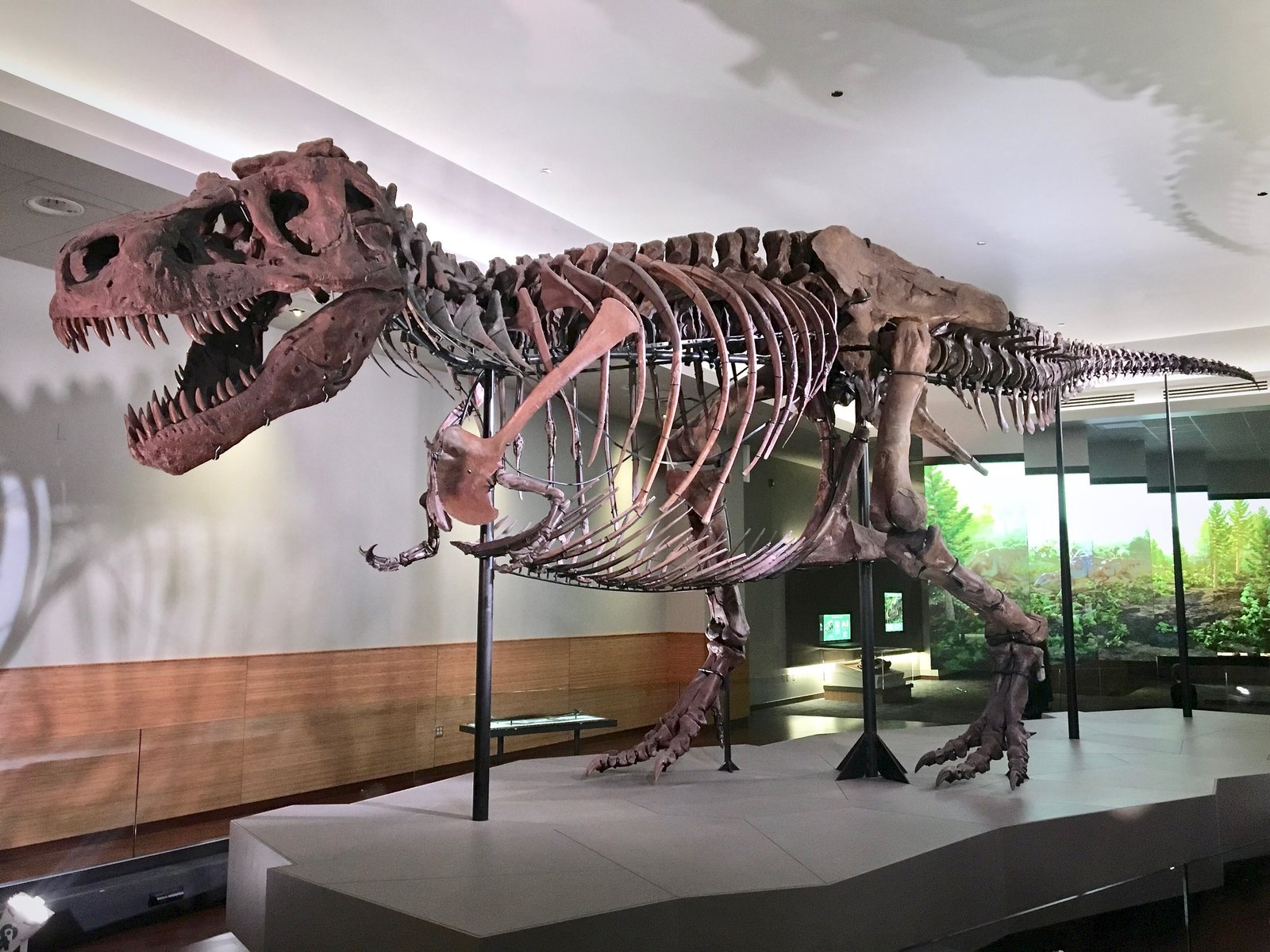
SUE, the Tyrannosaurus rex at the Field Museum in Chicago, is one of the best-known skeletons of the species. It is also one of very few. So here is a question that sounds impossible: out of every T. rex that ever lived, how many have we actually found? In 2021 a team led by Charles Marshall at UC Berkeley decided to put numbers on both halves of it.
The number you can count
Start with the half that is a tally, not a model. According to the Berkeley team, there are about 32 relatively well-preserved, post-juvenile T. rex in public museums today. That is a count of real specimens in real collections. Hold on to it, because it is the firmest number in this whole story.
Borrowing a rule from living animals
The other half is harder. Nobody can take a census of an extinct animal, so Marshall and six colleagues borrowed a pattern from the living world: the relationship between population density and body mass among living species. Combine that relationship with what is known about T. rex, and you can calculate how many there were.
To run the numbers, they had to decide what kind of animal T. rex was on the inside. They assumed a physiology midway between mammalian carnivores and large varanid lizards. With that, their paper in Science gave these values for post-juvenile T. rex:
- about 20,000 alive at any one time;
- a generation of about 19 years, over roughly 127,000 generations;
- a species that lasted roughly 2.5 million years;
- about 2.5 billion individuals in total;
- a fossil recovery rate of about 1 in every 80 million.
You can check the last line yourself. Divide 2.5 billion animals by 32 good specimens and you get about 78 million, consistent with the paper's figure of roughly one in 80 million.
The error bars are the headline
The same paper is blunt about how soft those numbers are. The uncertainties, the authors wrote, "span more than two orders of magnitude." The Berkeley release puts the standing population at about 20,000 "give or take a factor of 10," with a 95% interval running from 1,300 to 328,000 animals. The total that ever lived could be anywhere from 140 million to 42 billion. Divide the top of that range by the bottom and you get a 300-fold spread.
The authors also said where most of that uncertainty comes from, and it is not the fossils. "The uncertainty in our estimates is dominated by this ecological variability and not from the uncertainty in the paleontological data," Marshall said. Living animals of the same size do not all live at the same density, and that scatter flows straight into the answer. The paper puts it the same way: the spread comes "largely because of the variance in the density-body mass relationship rather than variance in the paleobiological input variables."
An ecologist objects
In 2022 Shai Meiri, an ecologist at the School of Zoology and the Steinhardt Museum of Natural History at Tel Aviv University, answered in Frontiers of Biogeography. His title states the case: Population sizes of Tyrannosaurus rex cannot be precisely estimated. The key word is "precisely."
Meiri argued that the parameters behind the estimate "are associated with much wider margins of error than they estimated," and that the "biogeographic estimates seem to have been especially unrealistic." His sharpest point is about metabolism. Nobody knows how T. rex's physiology worked, he argued, so a single "midway" point between mammal carnivores and big lizards has no direct support. His conclusion reaches past this one animal: "biogeographic and ecological uncertainties make it extremely unlikely to be able to estimate population sizes of long-extinct species."
Marshall's team did not let that stand without comment. They published a reply in the same journal, titled With what precision can the population size of Tyrannosaurus rex be estimated? A reply to Meiri.
A second model, a different life history
In 2023 Eva Griebeler, at Johannes Gutenberg University Mainz, came at the problem from another angle in Palaeontology. She built an age-structured population model, one that follows how a population is spread across ages, and argued that the earlier model's generation time and life-history values contradicted current understanding of theropod biology.
Her numbers came out different. In her words: "The average N values calculated by my model were at minimum 27.6% and p values at maximum 361.5% that of a previous model and uncertainties in all output variables were always larger in my model." The clause to notice is the last one. Whatever else changed, her uncertainty was wider in every output.
What is firm, and what is not
So, of every T. rex that lived, how many have we found? The question is a ratio, and its two halves are not the same kind of number.
The count is firm: about 32 relatively well-preserved, post-juvenile skeletons in public museums. The total is not. It is the output of a model, 2.5 billion at the centre, with a published range from 140 million to 42 billion. One later paper says the margins are much wider than that. Another rebuilt the model on different biology and got wider uncertainty in every output. The original authors have published a reply. Nobody has settled it, and we are not going to pretend to settle it here.
What the exercise does give you is scale. Even at the very bottom of the range, 140 million animals set against 32 good skeletons, every one of those skeletons stands in for millions of animals.
The line we draw
This is the same line PaleoDex draws. A count of specimens goes in as a fact. A modelled population goes in as a model, with its range and its critics attached, or it stays blank. Browse the real record in the Fossil-DEX, and see where every fact comes from.
Sources
- Marshall, C.R., Latorre, D.V., Wilson, C.J., Frank, T.M., Magoulick, K.M., Zimmt, J.B. & Poust, A.W. (2021). Absolute abundance and preservation rate of Tyrannosaurus rex. Science 372(6539): 284–287. doi:10.1126/science.abc8300
- UC Berkeley News (15 April 2021). How many T. rexes were there? Billions.
- Meiri, S. (2022). Population sizes of Tyrannosaurus rex cannot be precisely estimated. Frontiers of Biogeography 14(2): e53781. doi:10.21425/F5FBG53781
- Marshall, C.R. et al. With what precision can the population size of Tyrannosaurus rex be estimated? A reply to Meiri. Frontiers of Biogeography
- Griebeler, E.M. (2023). Vital statistics, absolute abundance and preservation rate of Tyrannosaurus rex. Palaeontology 66(2): e12648. doi:10.1111/pala.12648
Counts are counts. Models come with ranges.
PaleoDex catalogues the real fossil record, and every fact in it is sourced. Get the app.
GET IT ON GOOGLE PLAY →