Which Bird Was the Heaviest That Ever Lived?
PALEODEX · 5 October 2026 · 7 min read
The heaviest bird we know of was flightless, lived on Madagascar, and may be in the middle of losing its name.
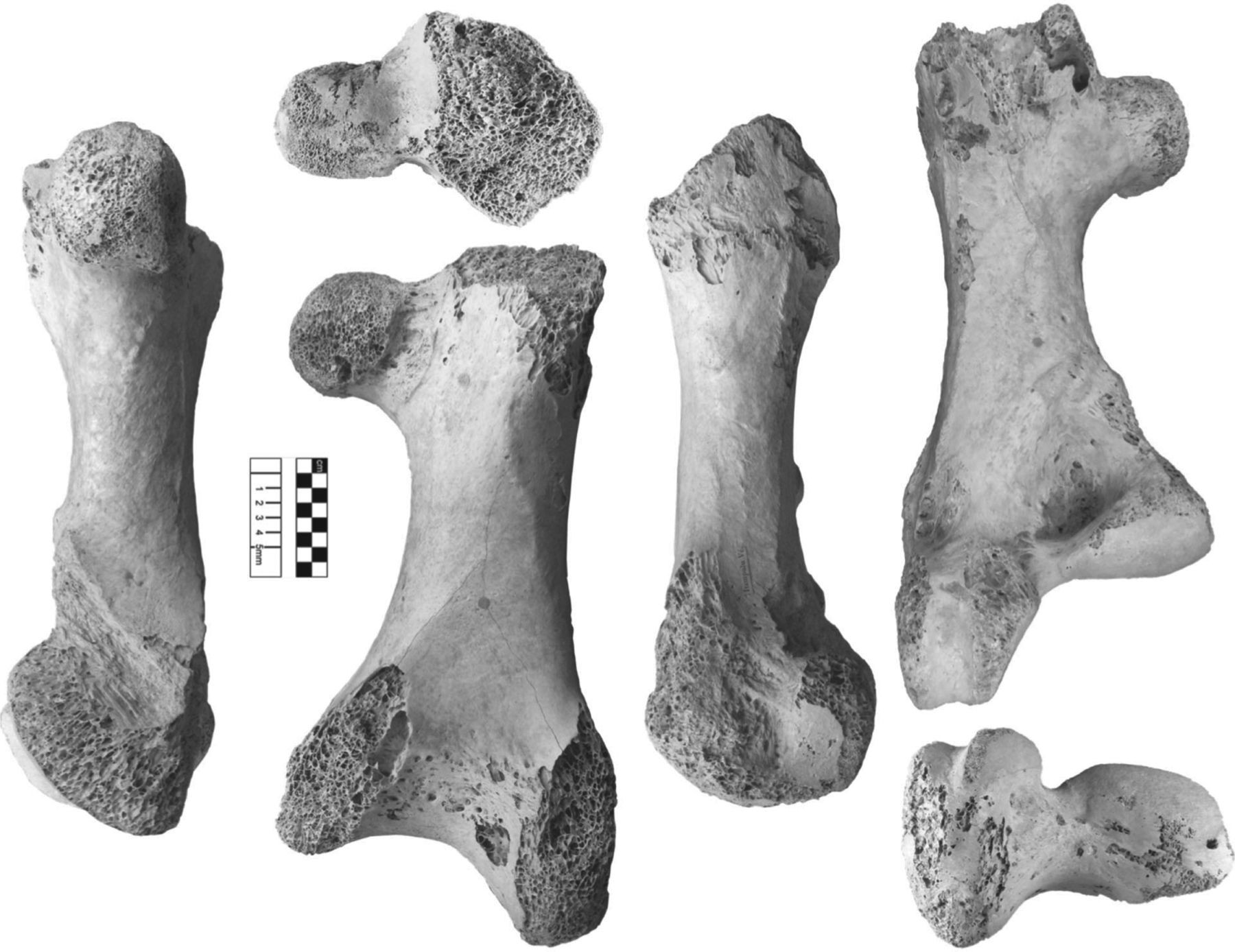
Nothing that flies is in the running. Powered flight puts a hard ceiling on how much bird you can get off the ground, so every candidate for the heaviest bird that ever lived is a flightless giant — and two islands supply them. Madagascar had its elephant birds. Australia had its dromornithids, the thunder birds. Both groups are long gone.
The question looks like it should have a one-line answer. It does not, and the reason is more interesting than the answer: the leading candidate may be in the process of losing the name it was given.
How you weigh a bird nobody ever weighed
You read it off the leg. The thickness of a thigh bone scales with the load it had to carry, so a measured bone yields an estimated mass. That is the whole method behind every figure in this post, and it is worth saying plainly up front, because it explains why two teams looking at the same animal can come back with different numbers: they are measuring different bones, from different individuals, with different equations.
It also explains why the estimates come with ranges rather than single values. A mass read off a bone is a prediction, not a weighing.
2018: a new identity for the largest
In 2018 James Hansford and Samuel Turvey published the first full taxonomic reassessment of the elephant birds in more than fifty years, in Royal Society Open Science. They gathered linear measurements from limb bones held in every major collection of elephant bird material in the world — including nearly all the type specimens — and ran them through cluster analysis.
Three distinct skeletal shapes came out. Two matched genera that already had names, Mullerornis and Aepyornis. The third had never been recognised as a genus of its own. They described it as Vorombe titan, with, in the paper's own words, “a mean body mass of almost 650 kg” — which made it, they wrote, “the world's largest bird”.
A small nomenclatural footnote that matters more than it looks: it is tempting to say the bird was named in 2018, and strictly it was not. Under the rules of zoological nomenclature, a new genus published electronically has to be registered in ZooBank for the name to become available, and that registration arrived in a 2020 correction to the original paper. A 2018 study; a 2020 name.
2023: the eggshell answers back
Elephant bird bone preserves biomolecules poorly. Their eggshell does not — and Madagascar has a great deal of it. In 2023 a team led by Alicia Grealy, publishing in Nature Communications, recovered mitochondrial genomes from fossil eggshell roughly a thousand years old, collected across the island, and compared the genetics against shell thickness, stable isotopes and geography.
Two results matter here. Variation between clades was high enough to support moving Mullerornis into a family of its own. And variation within clades was low enough to suggest there were only two elephant bird genera in southern Madagascar during the Holocene — not three.
The paper does not hedge about what that implies. The finding, it says, “draws into question the taxonomic legitimacy of the largest ever recorded birds, Vorombe titan”. The authors advocate tentatively synonymising Vorombe with Aepyornis, pending further evidence.
So what would the giants be?
Females, on their reading. In ratites — the group that includes ostriches, emus, rheas and the elephant birds — females commonly run considerably larger than males. If the southern elephant birds are one species rather than two genera, the very large individuals may simply be the large sex.
The size gap itself is not in dispute. The Vorombe cluster averages about 175% the size of Aepyornis maximus. What is disputed is what that gap means: a separate genus, or one strongly dimorphic species.
And this is not a feud. James Hansford described Vorombe in 2018 and is also a co-author of the 2023 paper that questions it — which is the clearest signal available that this is a live scientific question rather than two camps shouting past each other.
Australia's claim
Dromornis stirtoni is the largest of the dromornithids; a 2023 study of its bone histology in The Anatomical Record describes it that way. On published estimates it runs the elephant birds close, and the institutions that publish those estimates do not agree with each other about the figures — which is a good reason not to quote any one of them as a margin of victory. It is worth noting that the Australian Museum's own page on the animal calls it taller than the elephant bird, and stops short of calling it heavier.
Where that leaves it
The heaviest bird we know of probably lived on Madagascar. Whether it gets a name of its own depends on which study you follow, and as of now nothing has been formally synonymised: the 2018 clusters stand in the literature, and so does the 2023 recommendation to fold them together.
That is an unsatisfying answer only if you expected the record books to be tidier than the evidence. It is the kind of open question we like — and the kind we try to leave open rather than close for you. If you want to see what else is in the record, the catalogue is in Fossil Dex, and you can watch the continents move underneath all of it in Continental Drift. We write about how we handle uncertainty like this in About the Data.
Sources
- Hansford, J.P. & Turvey, S.T. 2018. Unexpected diversity within the extinct elephant birds (Aves: Aepyornithidae) and a new identity for the world's largest bird. Royal Society Open Science 5(9): 181295.
- Hansford, J.P. & Turvey, S.T. 2020. Correction to ‘Unexpected diversity within the extinct elephant birds (Aves: Aepyornithidae) and a new identity for the world's largest bird’. Royal Society Open Science 7(9): 201358. This is the correction that registered the genus name in ZooBank and made it available.
- Grealy, A., Miller, G.H., Phillips, M.J., Clarke, S.J., Fogel, M., Patalwala, D., Rigby, P., Hubbard, A., Demarchi, B., Collins, M., Mackie, M., Sakalauskaite, J., Stiller, J., Clarke, J.A., Legendre, L.J., Douglass, K., Hansford, J., Haile, J. & Bunce, M. 2023. Molecular exploration of fossil eggshell uncovers hidden lineage of giant extinct bird. Nature Communications 14: 914.
- Chinsamy, A., Handley, W.D. & Worthy, T.H. 2023. Osteohistology of Dromornis stirtoni (Aves: Dromornithidae) and the biological implications of the bone histology of the Australian mihirung birds. The Anatomical Record 306(7): 1842–1863.
- Australian Museum. Stirton's Thunder Bird (Dromornis stirtoni).