Haast's Eagle Hunted Moa Up to 15 Times Its Weight. How?
PALEODEX · 28 September 2026 · 5 min read
The top predator of New Zealand was not a mammal. It was an eagle, and it hunted birds up to fifteen times its own weight.
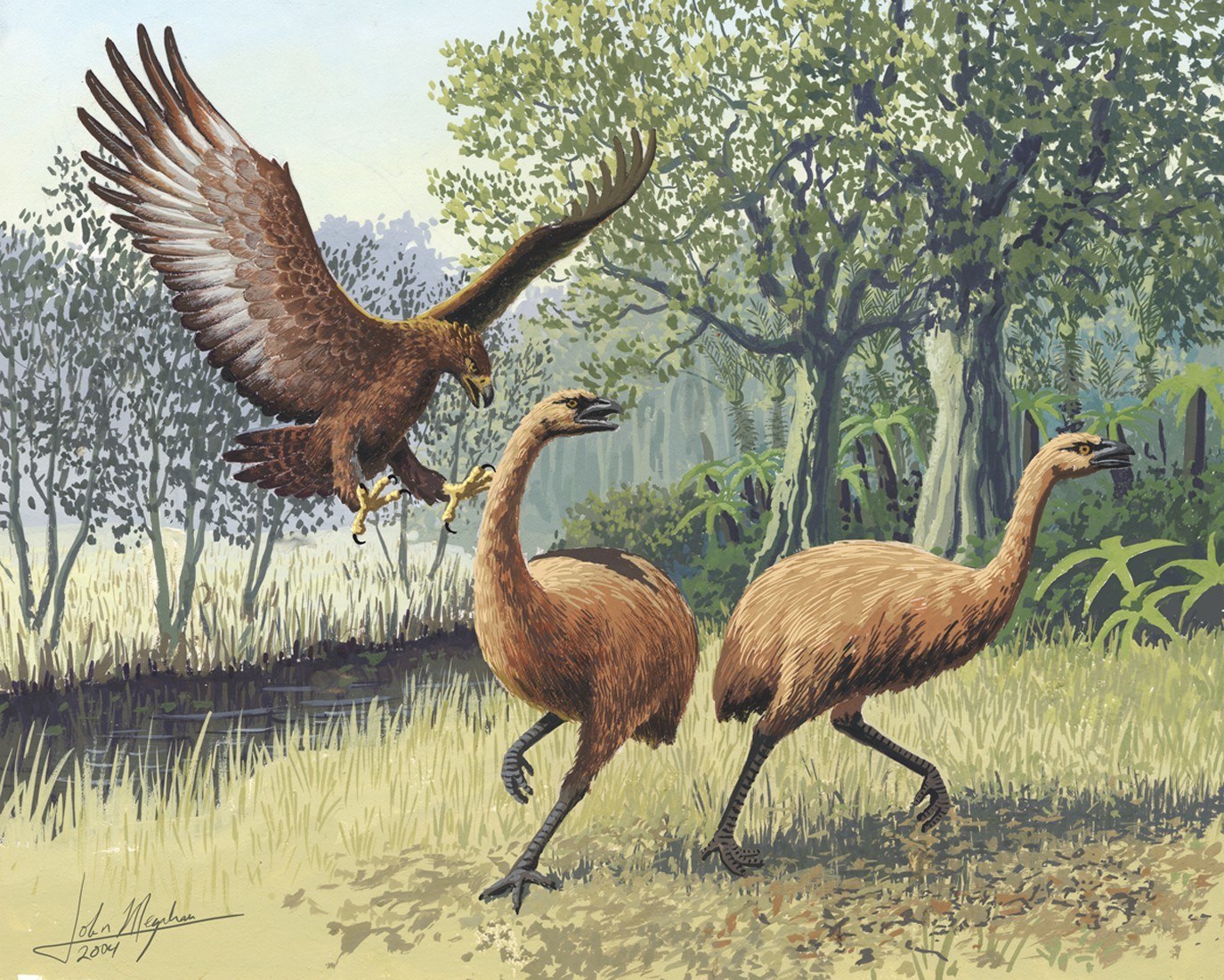
Before people reached New Zealand, about 700 years ago, the islands had no land mammals apart from three species of bats. Around 250 bird species dominated the ecosystem instead, and at the top of the food chain was Haast's eagle. It weighed 10 to 15 kg, had a wingspan of 2 to 3 metres, and is the largest eagle known. Its prey included moa, flightless birds of up to about 200 kg: up to fifteen times its own weight, in the words of the 2005 paper this post leans on.
A giant with a small ancestor
In 2005, a team led by Michael Bunce recovered ancient DNA from the eagle's bones. The result was a surprise. Haast's eagle turned out to be very closely related to some of the world's smallest living eagles, the little eagle of Australia and the booted eagle, which weigh around 1 kg. That is about one-tenth of its mass.
The same study dated the split to roughly 0.7 to 1.8 million years ago. A 2019 study of whole mitochondrial genomes placed it a little earlier, in the late Pliocene to early Pleistocene, and described it as rapid evolution of island gigantism. Either way, the eagle became roughly ten times heavier in a few million years at most.
What the moa bones show
So how does a 15 kg bird bring down a 200 kg one? Part of the answer is in the prey. Moa pelvic bones carry perforations that researchers think were made by the eagle's talons, and Te Papa, New Zealand's national museum, notes that its talons could penetrate a moa's pelvis bone.
The reconstruction built on those bones, as the 2005 paper describes it, has the eagle striking and gripping the moa's hips with one foot, then killing it with a single strike to the head or neck with the other. It is a reconstruction from damage on bones, not an observation, and it is worth reading that way.
Killed like an eagle, ate like a condor
In 2021, Anneke van Heteren and colleagues tested the eagle's anatomy directly. They compared the shape and mechanical strength of its braincase, beak and talons with five living scavenging and predatory birds, using shape analysis and finite-element models, the same kind of engineering simulation used to test bridges.
The results split in two. The talons were eagle-like and, even for a bird of its size, able to withstand extremely high loads. The braincase was vulture-like in shape, while the beak stayed eagle-like. The authors write that the results are consistent with an eagle that habitually killed prey larger than itself and then fed on the carcasses the way vultures do. Their title puts it more briefly: it killed like an eagle, ate like a condor.
That is a reading, not a verdict. The paper notes that the eagle was first thought of as a predator, then as a scavenger, before most recent authors settled on an active hunter, and its own conclusion is phrased as consistent with the evidence. What it adds is that both halves of the old argument may have been partly right.
What is firm
The size is firm, and so is the family tree: a bird of 10 to 15 kg whose nearest living relatives weigh about a kilo. The holes in moa bones are real, and the researchers who study them attribute them to the eagle's talons. How exactly it fed is the part still being tested. Browse the real record in the Fossil-DEX, and see where every fact comes from.
Sources
- Bunce, M., Szulkin, M., Lerner, H.R.L., Barnes, I., Shapiro, B., Cooper, A. & Holdaway, R.N. (2005). Ancient DNA provides new insights into the evolutionary history of New Zealand's extinct giant eagle. PLoS Biology 3(1): e9. doi:10.1371/journal.pbio.0030009
- van Heteren, A.H., Wroe, S., Tsang, L.R., Mitchell, D.R., Ross, P., Ledogar, J.A., Attard, M.R.G., Sustaita, D., Clausen, P., Scofield, R.P. & Sansalone, G. (2021). New Zealand's extinct giant raptor (Hieraaetus moorei) killed like an eagle, ate like a condor. Proceedings of the Royal Society B 288: 20211913. doi:10.1098/rspb.2021.1913
- Knapp, M., Thomas, J.E., Haile, J. et al. (2019). Mitogenomic evidence of close relationships between New Zealand's extinct giant raptors and small-sized Australian sister-taxa. Molecular Phylogenetics and Evolution 134: 122–128. doi:10.1016/j.ympev.2019.01.026
- Museum of New Zealand Te Papa Tongarewa, Collections Online. Giant eagle (Aquila moorei), Haast's eagle, or Pouākai.
A bird on top of the food chain.
PaleoDex catalogues the real fossil record, and every fact in it is sourced. Get the app.
GET IT ON GOOGLE PLAY →