Did Raptors Hunt in Packs? What the Evidence Actually Shows
PALEODEX · 1 October 2026 · 6 min read
Almost every raptor you have seen on screen hunts in a coordinated pack. That picture rests on one quarry in Montana — and it has been argued about ever since.
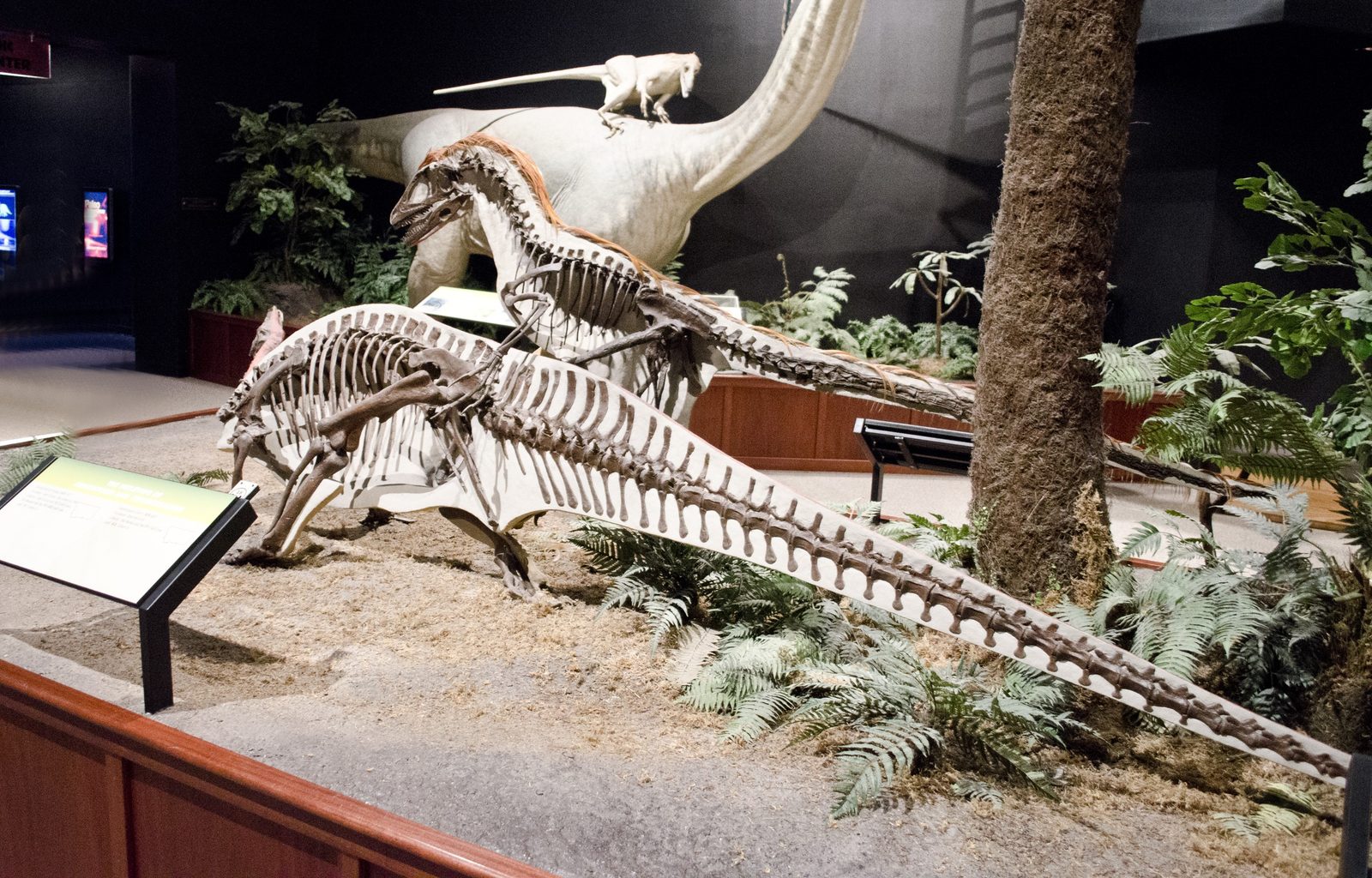
In 1969 John Ostrom described Deinonychus antirrhopus, a wolf-sized predator from the Lower Cretaceous of Montana. The quarry that produced it, catalogued at Yale as YPM 64–75, held at least three of them in association with a single much larger plant-eater, Tenontosaurus tilletti. That one site is the origin of the pack-hunting raptor.
Why a pack seemed necessary
The argument was about size. Deinonychus is estimated at roughly 70 to 100 kilograms. Tenontosaurus is described as a one-ton animal. Ostrom could not envisage a single Deinonychus dispatching prey of that size alone, so the association of several individuals with one carcass suggested a group that hunted together, in a manner similar to modern canids.
It is worth being precise about the date. 1969 is the year the idea was published, not the year the quarry was dug. The number in the quarry's catalogue code is a collection number, not an excavation year.
2007: the same bones, read the other way
In 2007 Brian Roach and Daniel Brinkman reassessed the whole idea by asking what living relatives of dinosaurs actually do. Highly coordinated hunting is rare among extant archosaurs. Modern crocodylians manage only the most rudimentary forms of cooperation while hunting; among birds, group coordination is more common, but pack hunting of large prey is almost non-existent.
Their conclusion was blunt: mammal-like cooperative pack hunting is "both unparsimonious and unlikely" for these animals, and the null hypothesis should be that non-avian theropods were "solitary hunters or, at most, foraged in loose associations". They proposed a different reading of the quarry itself — not a hunt, but an aggressive scrum around a carcass, closer to what Komodo dragons do, where several animals crowd a kill and a strict size-based pecking order decides who eats. They also reported new evidence from the Deinonychus type locality of probable aggression between individuals of the same species.
2020: the teeth
The strongest test came from chemistry. In 2020 Joseph Frederickson, Michael Engel and Richard Cifelli analysed stable carbon and oxygen isotopes locked in tooth carbonate from small and large Deinonychus teeth, drawn from microsites in the Cloverly Formation of Montana and the Antlers Formation of Oklahoma.
The reason this works is a difference in how social and asocial animals raise their young. In a pack-hunting canid, the young eat what the group kills, so juvenile and adult diets look the same. In an asocial reptile like the Komodo dragon, juveniles feed themselves and eat different things — and in that species they also keep out of the adults' way.
The small and large teeth did not match. The carbon signal indicates that juvenile and adult Deinonychus likely consumed different prey, at both sites. That is the reptile pattern, not the canid one, and the authors conclude that D. antirrhopus "was not a complex social hunter by modern mammalian standards".
Why it is still an open question
This is where a lot of coverage stops, and it should not. The 2020 paper carries its own caveats, and they are substantial.
Individuals of widely varying size turn up in close proximity, which suggests the young and the old were not physically separated. The authors say this makes an analogy with the Komodo dragon less palpable, and suggest hunting strategies closer to those of many living birds of prey, whose post-fledging behaviour ranges from entirely asocial to fairly gregarious even within one species. They note that the 2007 argument did not go unchallenged. And they state that their low sample size hinders immediate further statistical analysis.
They also make a point that cuts the other way entirely: gregariousness, even among individuals of different sizes, is not rare in theropods, and there is little reason to assume Deinonychus lacked a comparable level of social tolerance.
There is separate evidence for that. In 2008 a team led by Rihui Li described deinonychosaur trackways from the Early Cretaceous of Shandong, China. Multiple parallel, closely spaced trackways made by the larger of two trackmakers provide what the authors call the best evidence yet discovered for gregarious behaviour in deinonychosaurian theropods. Those trackmakers are deinonychosaurs — the wider group that includes raptors — and not Deinonychus itself.
Where that leaves it
The honest summary is narrower than either headline. Living in groups is plausible, and there is trackway evidence for it in related animals. Hunting cooperatively in the manner of a wolf pack is doubtful on the current evidence. The argument is not settled, and the people who published the strongest evidence against the pack say so themselves.
Sources
- Ostrom, J.H. 1969. Osteology of Deinonychus antirrhopus, an unusual theropod from the Lower Cretaceous of Montana. Bulletin of the Peabody Museum of Natural History 30.
- Roach, B.T. & Brinkman, D.L. 2007. A reevaluation of cooperative pack hunting and gregariousness in Deinonychus antirrhopus and other nonavian theropod dinosaurs. Bulletin of the Peabody Museum of Natural History 48: 103–138.
- Li, R., Lockley, M.G., Makovicky, P.J., Matsukawa, M., Norell, M.A., Harris, J.D. & Liu, M. 2008. Behavioral and faunal implications of Early Cretaceous deinonychosaur trackways from China. Naturwissenschaften 95: 185–191.
- Frederickson, J.A., Engel, M.H. & Cifelli, R.L. 2020. Ontogenetic dietary shifts in Deinonychus antirrhopus (Theropoda; Dromaeosauridae). Palaeogeography, Palaeoclimatology, Palaeoecology 552: 109780.
Every fact has a source.
PaleoDex catalogues the real fossil record, and every fact in it is sourced. Get the app.
GET IT ON GOOGLE PLAY →