Deinosuchus: Why Is It on Both Coasts?
PALEODEX · 23 September 2026 · 8 min read
A sea cut North America in two. The same giant crocodile relative turns up on both of its coasts, and the explanation has changed twice.
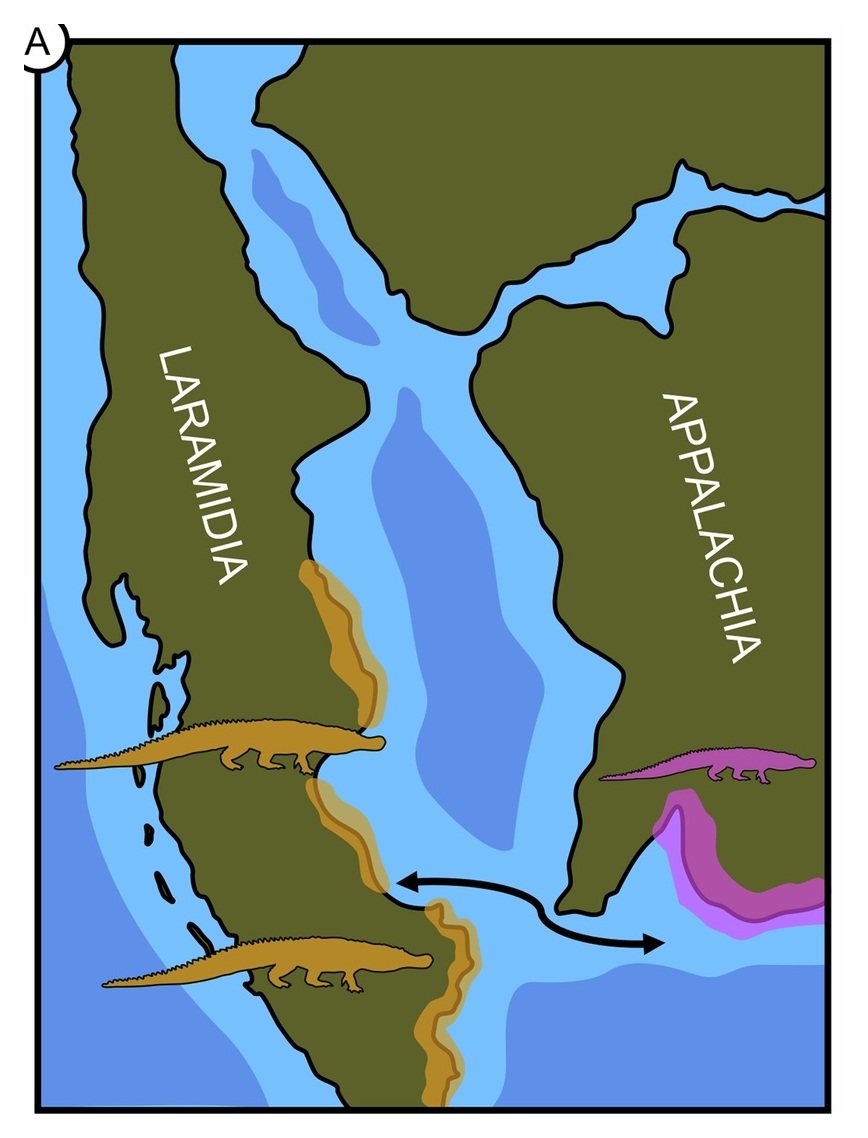
For much of the Late Cretaceous, North America was not one continent. A shallow sea — the Western Interior Seaway — ran from the Arctic down to the Gulf of Mexico and split the landmass in two: Laramidia in the west, Appalachia in the east. If you have spent any time with Cretaceous animals you will have met that map before, usually as a reason why the dinosaurs of Montana are not quite the dinosaurs of New Jersey.
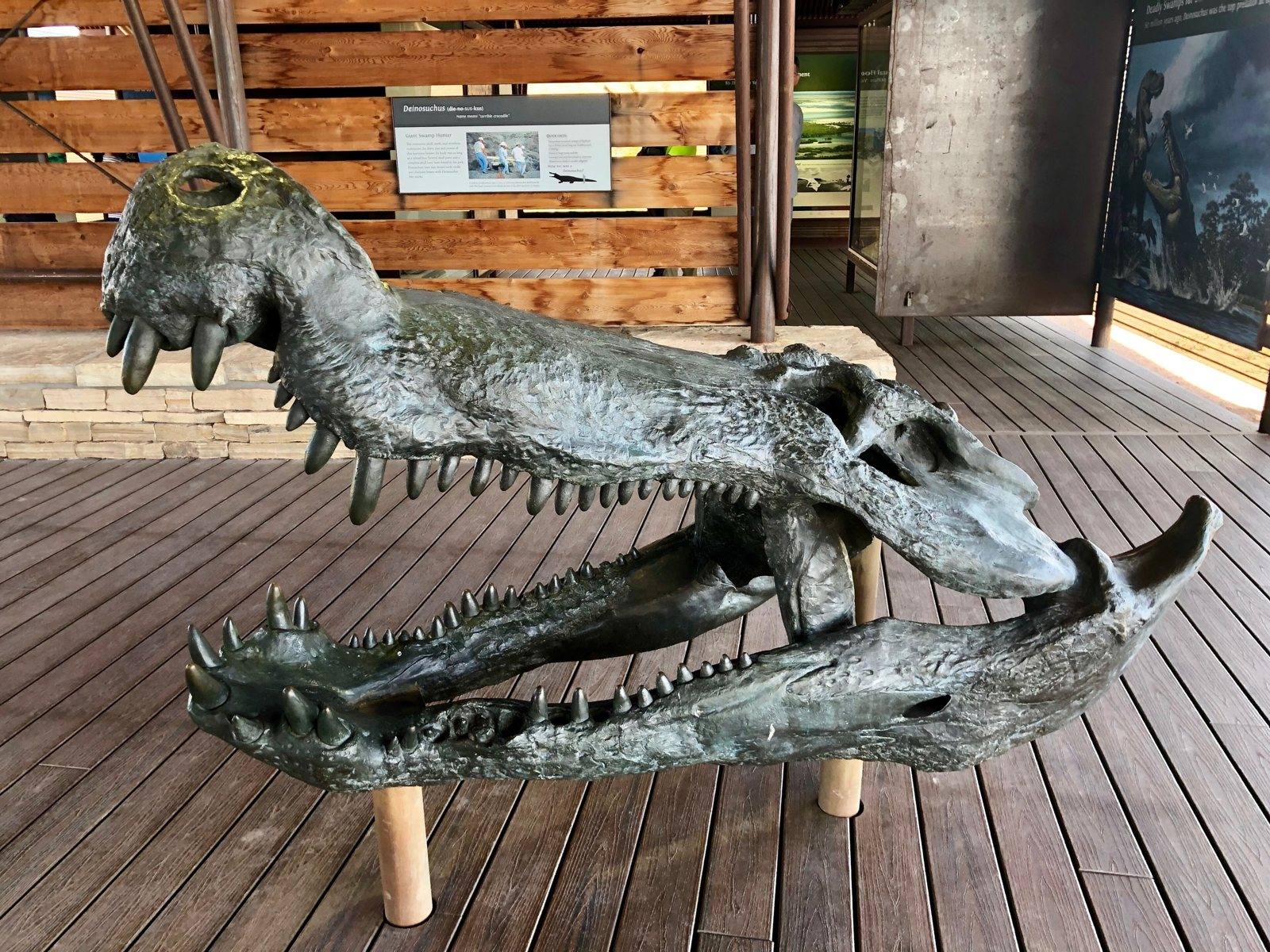
And then there is Deinosuchus, a giant crocodile relative, which is found on both sides of it.
That sounds like a small thing and it is not. It has been one of the more stubborn puzzles in Cretaceous biogeography since 1999, and the current answer is seventeen months old.
The map is the problem
Adam Cossette and Christopher Brochu's 2020 systematic review of the genus recognises three species, and they sort neatly by coastline: D. hatcheri and D. riograndensis on the western side, from Montana down into northern Mexico, and D. schwimmeri along the Atlantic coastal plain from New Jersey to Mississippi.
So the genus spans the seaway. The named species do not. Something got across — or something was already on both sides when the water arrived.
Why "it swam" was off the table
Because of where the animal sat on the family tree. Starting with Christopher Brochu's 1999 phylogeny of Alligatoroidea, and confirmed by every study afterwards including the 2020 revision, Deinosuchus came out inside the alligator line.
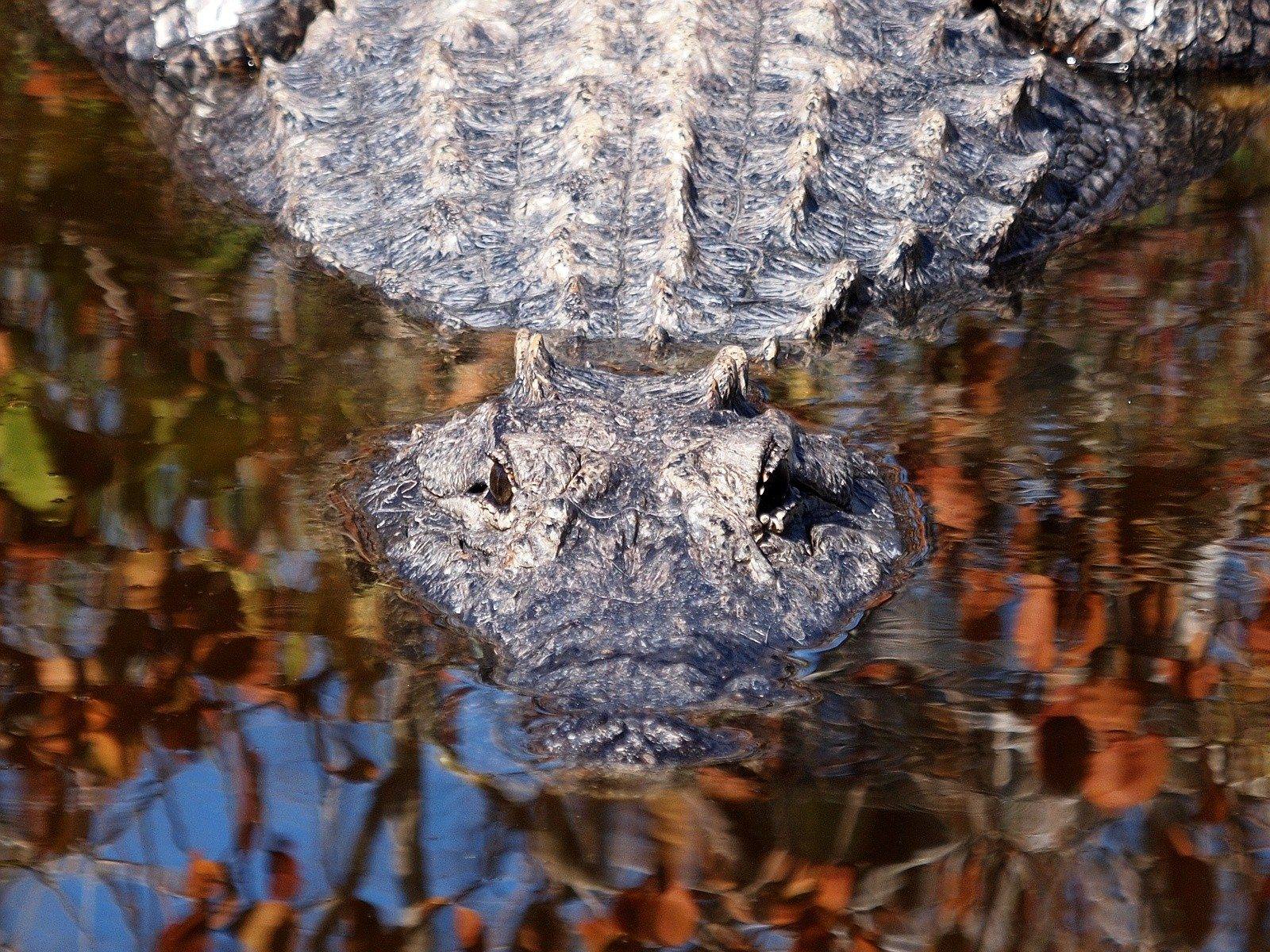
That placement carries a physiological consequence, and it is a specific one rather than a vague sense that alligators like fresh water. Living alligatorids lack lingual salt glands — the structures on the tongue that let a crocodile shed excess salt — and that absence is exactly why prolonged exposure to salt water is beyond them. An alligator will tolerate a brackish estuary for a while. Weeks in an open seaway is a different proposition.
So from 1999 onward the genus was an animal doing something its closest living relatives cannot do, and the explanation had to come from somewhere else.
The 2020 answer: the sea did the moving
Cossette and Brochu's solution was vicariance, and it is a good one. Nothing had to cross anything. An ancestral population was already spread across the region; the seaway opened through it; the eastern and western halves were separated by the new water and diverged into different species on either side of it.
That explanation asks nothing of the animal's physiology, which is precisely its appeal when the animal is filed with the alligators. The geography does the work.
The 2025 answer: the tree was in the wrong shape
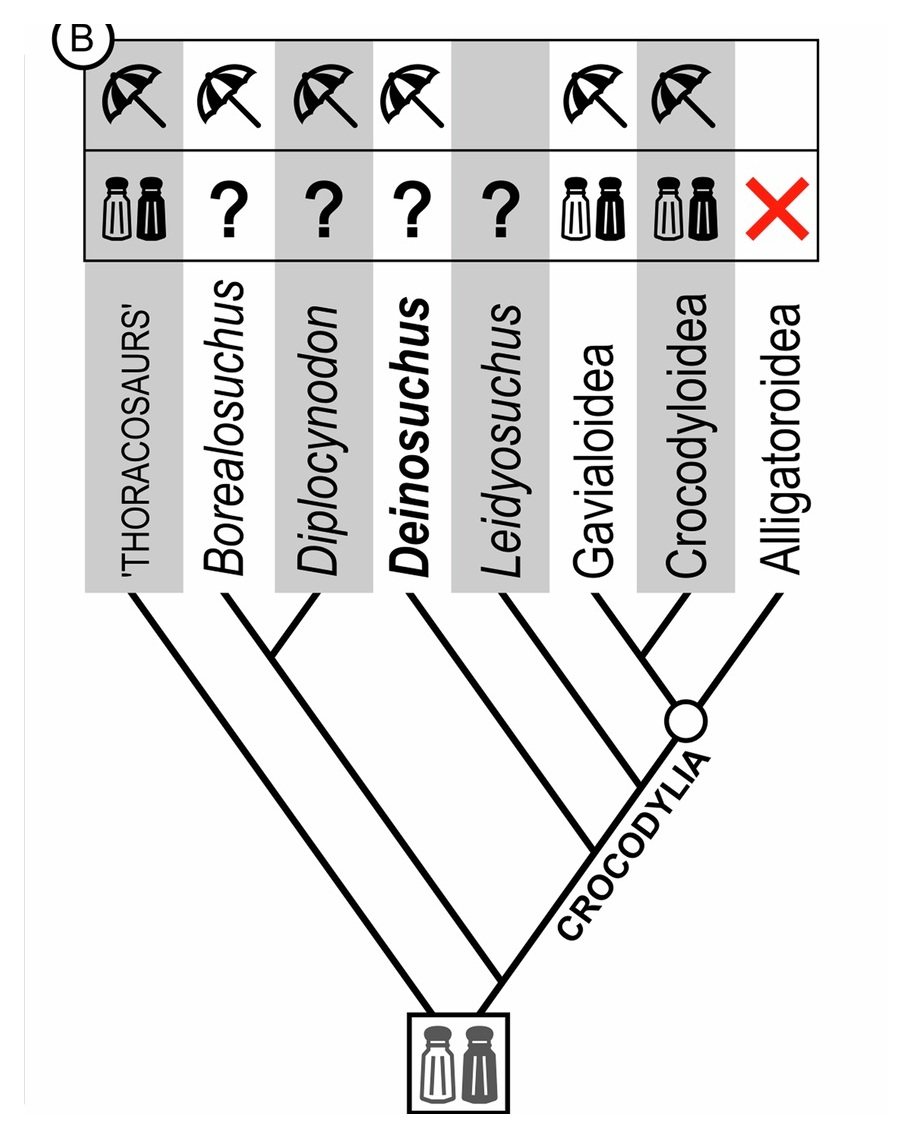
In April 2025, Jules Walter, Tobias Massonne, Ana Laura Paiva, Jeremy Martin, Massimo Delfino and Márton Rabi published an expanded phylogeny in Communications Biology. Their analysis pulls Deinosuchus — along with Leidyosuchus canadensis and the European Diplocynodon — out of Alligatoroidea altogether, and places it on the stem lineage of crown-group Crocodylia. The change came largely from adding two Paleocene taxa to the dataset, which is an unglamorous sentence describing a fairly dramatic result.
Move the animal there and the barrier stops being a barrier. On that tree, saltwater tolerance is inferred to be ancestral for Crocodylia and simply retained in Deinosuchus — not something it would have had to evolve for the occasion — while the alligator line lost it later. Crossing goes from impossible to unremarkable. The authors write that the distribution across the seaway "can be best explained by marine dispersal".
The careful part, because it is easy to overstate
Read a lot of coverage of this result and you will come away thinking somebody found salt glands in a fossil crocodile. Nobody did, and nobody could. Salt glands leave no known osteological correlates — the paper's own phrase. There is no bone that records whether an extinct animal had them.
What the 2025 paper produced is an ancestral-state reconstruction: a property inferred for an extinct animal from where it sits on a tree and what its relatives can do. And the authors are more careful with it than most of the coverage has been. They say saltwater tolerance may have been ancestral for the crown group and retained in Deinosuchus — and then say, in the very next sentence, that this "does not mean that osmoregulation was necessarily achieved through the presence of lingual salt glands."
That distinction is worth holding onto. The tolerance is the inference. The gland is a mechanism they decline to commit to. Those four question marks in the figure above are not decoration.
So which is it?
Nobody has settled it, and we are not going to pretend otherwise.
The 2020 reading has not been withdrawn. It depends on the alligatoroid placement that the 2025 analysis rejects, which is a real problem for it — but a phylogeny published seventeen months ago is not a consensus, it is a proposal that will be tested. The 2025 paper is itself careful to frame its own alternative conditionally: "if speciation took place", dispersal fits the new tree better than vicariance does. It even notes that a literal reading of the fossil record would imply an east-to-west crossing, because the eastern records are somewhat older, before adding that this may simply be sampling bias.
When we went looking for published pushback on the 2025 phylogeny, we did not find any. That is an absence of objection, not an endorsement, and it is worth saying which one it is.
Why this belongs in PaleoDex
Because the fossils are the easy part. Both teams agree completely on what has been dug up and where: Deinosuchus is on both coasts of a vanished sea, and has been known to be since long before either paper. What they disagree about is the story that connects those points — and the disagreement turned not on a new fossil but on where a branch sits, which is a reminder that a family tree is a piece of evidence and not a filing system.
If you want to see what that seaway did to the map, the continental drift view is the feature for it. The rest of the catalogue, sourced the same way, is in the Fossil Dex, and how we decide what counts as sourced is in About the data.
Sources
Every claim above traces to the sources below. Where we relied on someone else's reading of a source, we say so.
- Walter, J.D., Massonne, T., Paiva, A.L.S., Martin, J.E., Delfino, M. & Rabi, M. (2025). "Expanded phylogeny elucidates Deinosuchus relationships, crocodylian osmoregulation and body-size evolution." Communications Biology 8: 611. DOI. Open access, CC BY 4.0 — which is why two of its figures appear above. Read in full. Source for the stem-crocodylian placement, the ancestral-state reconstruction of osmoregulation, the "no known osteological correlates" point, the explicit refusal to attribute lingual salt glands, the marine-dispersal explanation, the conditional "if speciation took place", and the east-to-west sampling-bias note.
- Cossette, A.P. & Brochu, C.A. (2020). "A systematic review of the giant alligatoroid Deinosuchus from the Campanian of North America and its implications for the relationships at the root of Crocodylia." Journal of Vertebrate Paleontology 40(1): e1767638. DOI. Not read in full — it is paywalled. Its three-species taxonomy, its geography and its vicariance mechanism are taken from the 2025 paper's summary of it, which states all three explicitly, and its alligatoroid placement from its own title.
- Brochu, C.A. (1999). "Phylogenetics, taxonomy, and historical biogeography of Alligatoroidea." Society of Vertebrate Paleontology Memoir 6: 9–100. Not read — cited for its date and its result, both taken from the 2025 paper's reference list and its description of it as the first phylogeny to include Deinosuchus.
The real record, in your pocket.
PaleoDex catalogues the real fossil record, and every fact in it is sourced. Get the app.
GET IT ON GOOGLE PLAY →