The Coelacanth: The Fish That Came Back From Extinction
PALEODEX · 18 July 2026 · 6 min read
Two days before Christmas 1938, a South African trawler dumped its catch on a dock and, tangled in it, was a heavy blue fish that science was certain had died with the dinosaurs 66 million years earlier. It was a coelacanth — and it was alive. Here is the real story, and why the famous "living fossil" label is only half true.
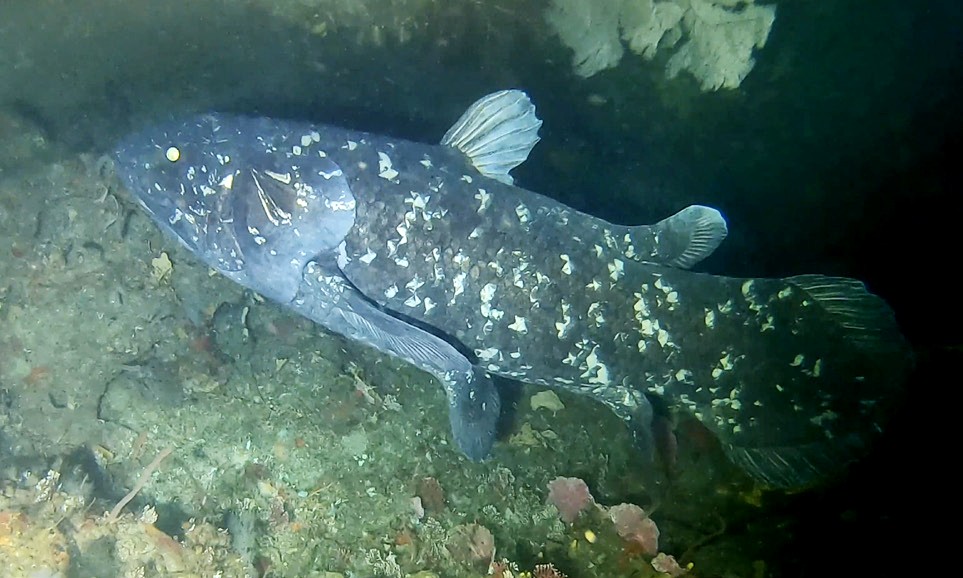
Some fossils tell you an animal existed. This one told scientists an animal never left. The coelacanth is the most famous case in all of paleontology of a "Lazarus taxon" — a lineage presumed long extinct that turns up alive — and its story is better, and more carefully caveated, than the version you usually hear.
The catch, 22 December 1938
Off the mouth of the Chalumna River near East London, South Africa, the trawler Nerine, under Captain Hendrik Goosen, hauled its catch onto the dock. Sorting through it was Marjorie Courtenay-Latimer, the young curator of the small East London Museum. One fish stopped her cold: over a metre and a half long, a pale mauve-blue, with thick, fleshy fins that moved like little limbs. She had never seen anything like it, and she could not identify it from any book she had. She fought to preserve it, and sketched it before it spoiled.
"A living fish of Mesozoic type"
Unable to name it, Courtenay-Latimer sent her sketch to the ichthyologist J. L. B. Smith. When he saw the drawing, he was stunned: this was a coelacanth, an animal known to science only from stone. In 1939 Smith described it in the journal Nature, under a title that says everything: "A Living Fish of Mesozoic Type." He named it Latimeria chalumnae — the genus after Courtenay-Latimer, the species after the Chalumna River it came from.
Why it stunned science: a 66-million-year gap
To feel the shock, you have to know what coelacanths were. Their fossils run back hundreds of millions of years — and then they stop. The youngest known coelacanth fossils are about 66 million years old: the group vanishes from the rock right at the Cretaceous–Paleogene boundary, the same moment that ended the non-bird dinosaurs. For nearly a century of paleontology, that was that. Coelacanths were extinct. Until that day on the dock.
The "living fossil" label — handle with care
The coelacanth earned a famous nickname: a "living fossil," supposedly frozen in time since the age of the dinosaurs. It is a great line, and it is where most retellings stop. But the science is more careful than the slogan.
The body plan is old and conservative — that part is fair. What doesn't hold up is the stronger, more common version: that the animal is somehow genetically frozen. In a 2013 review in BioEssays, Didier Casane and Michel Laurin laid out the case that coelacanths are not "living fossils": systematic studies find the Latimeria genome does not evolve unusually slowly, and the living fish is not even the same species as the fossils — no fossils of the genus Latimeria are known at all. "Frozen in time" describes the coelacanth's shape, not its DNA. It never stopped evolving; it just kept a very old design.
Then it happened again — a second living species
The surprises weren't over. In September 1997 — nearly 60 years later and almost a world away — the marine biologist Mark Erdmann spotted a coelacanth in a market in Manado, on the Indonesian island of Sulawesi. It sold before he could study it. A second Indonesian specimen was caught in 1998 and became the basis for study, and in 1999 it was described as a distinct second species: Latimeria menadoensis, living in the Pacific, thousands of kilometres from its Indian Ocean cousin.
The coelacanth today
So we now know not one living coelacanth, but two. They live hundreds of metres down, on steep volcanic slopes — L. chalumnae in the western Indian Ocean, especially around the Comoro Islands, and L. menadoensis in Indonesia. They are slow, they hunt at night, and they can live for decades. Both are rare, and both are on the IUCN Red List. They are, in every sense, fish we only ever expected to meet as fossils.
Why this belongs in PaleoDex
This is exactly the kind of story PaleoDex exists to get right: a real, dated discovery, traced to its actual 1939 paper, with the great headline ("extinct with the dinosaurs, then pulled from a net") kept — and the popular overreach ("frozen in time since the Cretaceous") clearly marked as contested. "Extinct" can be a verdict handed down too soon. Sometimes a lineage isn't gone; it's just somewhere we haven't looked yet, in deep, dark water. Read more myth-vs-record deep dives from the record.
Sources
Every fact above is drawn from the primary literature and reference sources:
- Smith, J.L.B. (1939). "A Living Fish of Mesozoic Type." Nature 143:455–456. (nature.com/articles/143455a0)
- Casane, D. & Laurin, M. (2013). "Why coelacanths are not 'living fossils': a review of molecular and morphological data." BioEssays 35(4):332–338. doi:10.1002/bies.201200145 (Wiley Online Library)
- Pouyaud, L. et al. (1999). "Une nouvelle espèce de cœlacanthe. Preuves génétiques et morphologiques." Comptes Rendus de l'Académie des Sciences, Série III 322:261–267. (the description of L. menadoensis)
- Holder, M.T., Erdmann, M.V. et al. (1999). "Two living species of coelacanths?" PNAS 96(22):12616–12620. (pnas.org)
- Australian Museum, "Coelacanth, Latimeria chalumnae Smith, 1939." (australian.museum)
The real record, in your pocket.
PaleoDex catalogues the real fossil record, and every fact in it is sourced. Get the app.
GET IT ON GOOGLE PLAY →