What Did This Armoured Dinosaur Eat Before It Died?
PALEODEX · 11 October 2026 · 8 min read
In 2011 an oil-sands mine in northern Alberta turned up a nodosaur with its scales and armour still in place. Inside the body cavity was a ball of plants — and fourteen separate reasons to call it a meal.
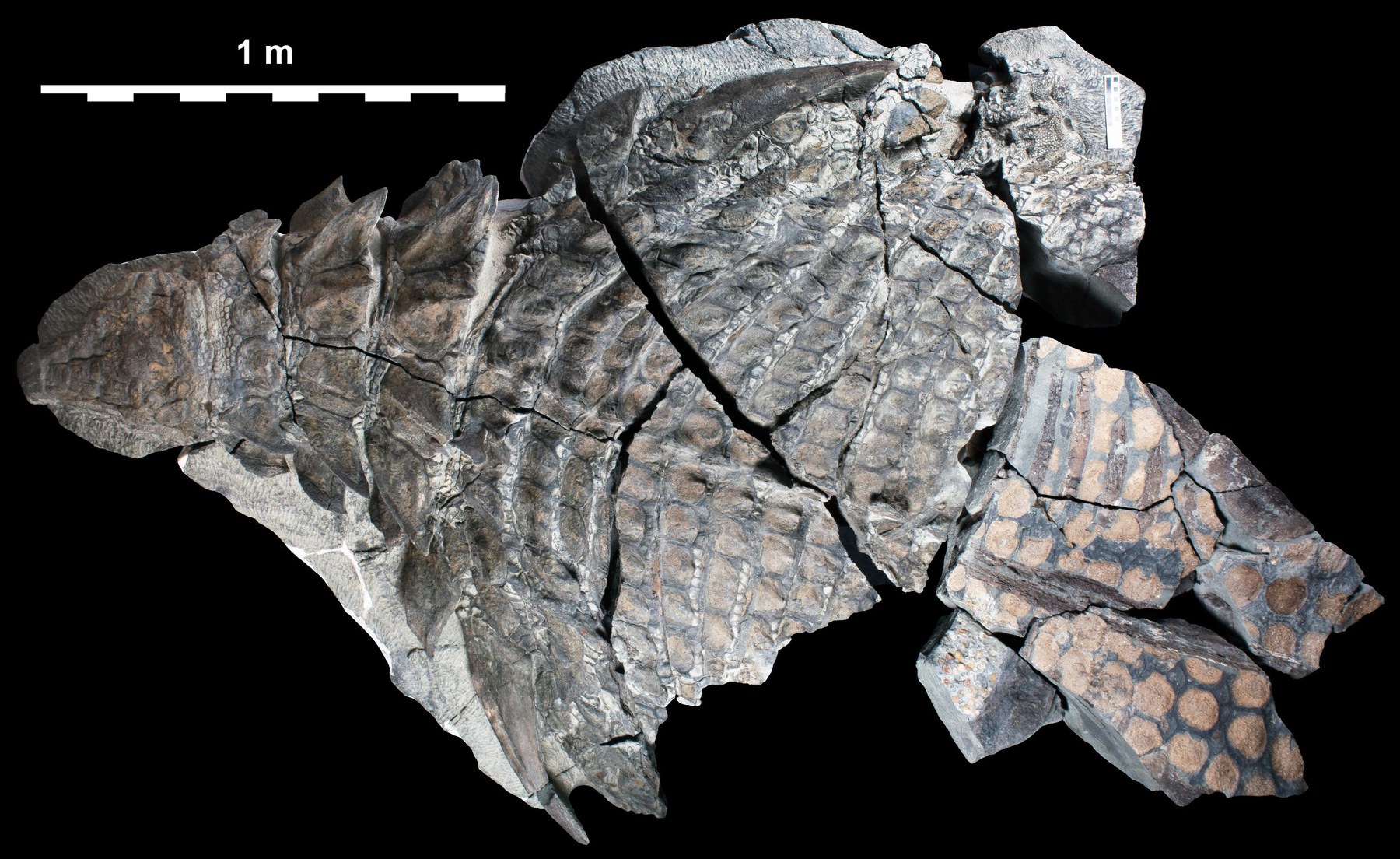
Almost everything we say about what dinosaurs ate is an inference from the equipment: the shape of a tooth, the wear on its surface, the reach of a neck, the plants that grew nearby. Those inferences are good. They are also one step removed from the thing itself, and they can only tell you what an animal could have eaten.
Once in a long while the record skips the inference. In 2011, workers at an open-pit oil-sands mine north of Fort McMurray, in northern Alberta, hit an armoured dinosaur. In 2017 it was named Borealopelta markmitchelli, a nodosaur, and what makes it unusual is not that it is complete but that it is not flat: it is, in the describing paper's words, exquisitely three-dimensionally preserved, with continuous fields of epidermal scales and intact horn sheaths. Most dinosaurs reach us as bone. This one kept its outside.
It also kept something else.
A mass in the abdomen
Sitting inside the body cavity, just left of the midline, is a distinct mass. It is a sphere flattened from above, roughly 36 cm across and 18 cm high — one large cluster of rounded, swallowed stones between 2 and 22 mm each, held in a light grey sandy matrix crowded with small, dark fragments of plant.
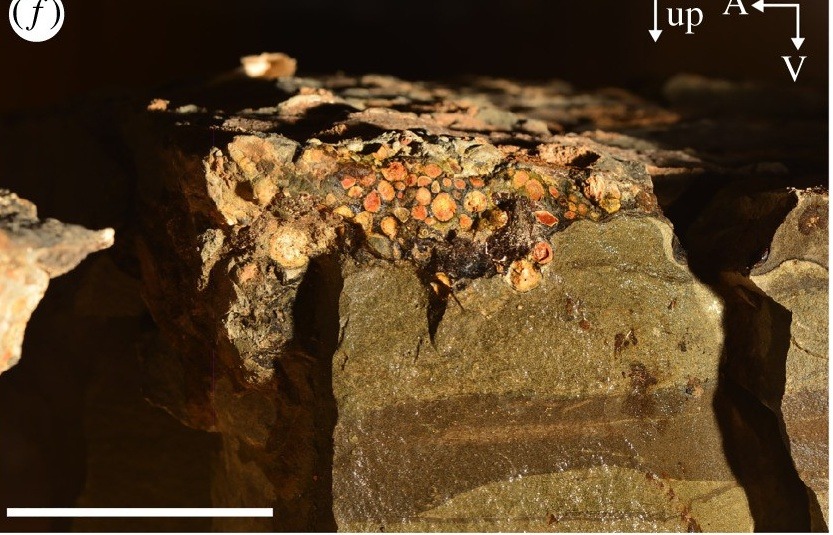
What makes that description worth trusting is how sharply the mass stops. The boundary with the rock around it is abrupt in four independent ways at once: the stones stop, the dense plant fragments stop, the rock itself changes from pale sandstone to dark green-grey siltstone, and in places a thin dark surface runs along the margin that may be stomach wall or other soft tissue. Under ultraviolet light the matrix inside the mass fluoresces more strongly than the sediment it is sitting in. That is not what a patch of mud looks like.
Fourteen criteria, because this field has been burned before
Claimed dinosaur stomach contents have a poor record. Several reported hadrosaur gut masses are now regarded as doubtful, and the honest reading of the literature is that a dark smudge in the right part of a skeleton is not evidence of anything on its own. So the 2020 study did not simply assert what it had found.
Instead it assembled sixteen published criteria for attributing fossil material to stomach contents — criteria developed by other researchers, for other specimens — and scored this mass against them one at a time. It meets fourteen: co-allochthony, anatomical position, exceptional preservation of the surrounding tissues, association with swallowed stones, a defined margin, a three-dimensional mass shape, pollen inside the mass that is a strict subset of the pollen outside it, and more. For comparison, the best-supported previous example, the Kunbarrasaurus specimen, meets ten. This is more criteria than any other purported dinosaur stomach remains.
Mostly leaves, and mostly ferns
Seven thin sections were cut through the mass and counted square by square. The plant material in it is dominated by leaf tissue — 88% — with about 7% stems and wood. Within that leaf fraction, 85% is leptosporangiate ferns, cycads and cycadophytes account for 3%, and conifer foliage appears only as a trace.
Two numbers there are easy to garble, so they are worth pinning down. The 88% is of the plant material in the mass, not of the mass as a whole — much of the mass is swallowed stones and matrix. And the 85% is of the leaf fraction, not of the meal. "Most of what it ate was leaves, and most of those leaves were ferns" is the accurate sentence.
The slides also turned up whole fern sporangia — the small capsules that hold spores — with the spores still inside them. That is not something ordinary sediment delivers, and it is itself one of the fourteen criteria.
Choosy, and we can say exactly how
This is the part that usually gets flattened in retelling, and the precise version is better than the flattened one.
Leptosporangiate ferns carry a thickened band called an annulus around the sporangium. Osmundaceae and the eusporangiate ferns do not. Every sporangium recovered from the mass has the annulus. Meanwhile, spores from Osmundaceae are present in the mass — but no Osmundaceae sporangium was found in place. That is exactly the pattern you would expect if those spores arrived on the wind and the plants themselves were never eaten.
So the animal was taking one group of ferns and passing over others growing in the same landscape. That is a preference between ferns, demonstrated at the level of individual spores. It is not the same claim as "it chose ferns over everything else", and the paper does not make that one.
Six per cent charcoal
Six per cent of the counted fragments are charcoal, against 4% unburnt wood. That is a lot of burnt material to find inside one animal, and it is the most atmospheric result in the study — which is precisely why the hedge on it should survive the retelling.
The authors' reading is that the charcoal "may represent" the dietary use of a recently burned conifer forest undergoing fern succession: early evidence of the fire-succession ecology that many large modern herbivores follow, moving into burnt ground to eat what comes back first. Ferns are good at coming back first. In the Early Cretaceous, with flowering plants still scarce, they may have been even better at it.
That is a likely explanation for the charcoal. It is not an established event in this animal's life, and nothing in the mass dates a fire.
A twig that was still growing
One twig in the mass preserves its annual growth rings in cross-section, and the outermost ring is incomplete — the year it was laid down had not finished. That is consistent with the twig being eaten mid-growing season, probably in late spring to midsummer, and the mature spores in those sporangia point the same way.
Read that carefully: it dates the meal. Because the meal was eaten at the end of this animal's life, the season is a reasonable thing to attach to the last few hours of it. But "this dinosaur died in late spring" is a step further than the evidence goes, and the paper does not take it.
What one stomach can and cannot tell you
Before it draws a single conclusion, the study states two caveats, and they matter more than any of the percentages above. The first: this is one specimen, which may not represent the species, let alone the wider group. The second: it is a single brief event, probably of the order of hours, at the end of one individual animal's life — it may not reflect even that animal's typical diet, once you allow for the seasons changing and food varying across a landscape.
A stomach is a snapshot. It tells you what one animal ate on one afternoon, and it tells you that with a precision nothing else in the record can match. With both caveats in place, the authors still conclude that these data represent the best available direct evidence of diet in a herbivorous non-avian dinosaur, and that is the honest size of the result: not the menu of a group, but the clearest single look anyone has had at what a plant-eating dinosaur actually put in its mouth.
We like this one because the restraint is doing the work. Fourteen criteria instead of an assertion, a denominator attached to every percentage, "may represent" where a press release would have written "proves". If you want to see what else is in the record, the catalogue is in Fossil Dex, you can watch the continents move underneath all of it in Continental Drift, and we have written about how we handle uncertainty like this in About the Data.
Sources
- Brown, C.M., Greenwood, D.R., Kalyniuk, J.E., Braman, D.R., Henderson, D.M., Greenwood, C.L. & Basinger, J.F. 2020. Dietary palaeoecology of an Early Cretaceous armoured dinosaur (Ornithischia; Nodosauridae) based on floral analysis of stomach contents. Royal Society Open Science 7(6): 200305. The source of the fourteen criteria, the 36 × 18 cm measurement, 88% / 85% / 7% / 3% / 6% / 4%, the annulus argument, the growth-ring season, and both caveats.
- Brown, C.M., Henderson, D.M., Vinther, J., Fletcher, I., Sistiaga, A., Herrera, J. & Summons, R.E. 2017. An exceptionally preserved three-dimensional armored dinosaur reveals insights into coloration and Cretaceous predator-prey dynamics. Current Biology 27(16): 2514–2521. Cited here for the naming and the preservation only.
- Royal Tyrrell Museum of Palaeontology, Breakthroughs exhibit page and the specimen fact sheet. The 2011 discovery at a mine north of Fort McMurray, and the specimen's home collection.