What Did Titanoboa Actually Eat?
PALEODEX · 4 October 2026 · 8 min read
The best witness to what the largest snake in the fossil record ate is a broken skull — and its full testimony has never been published.
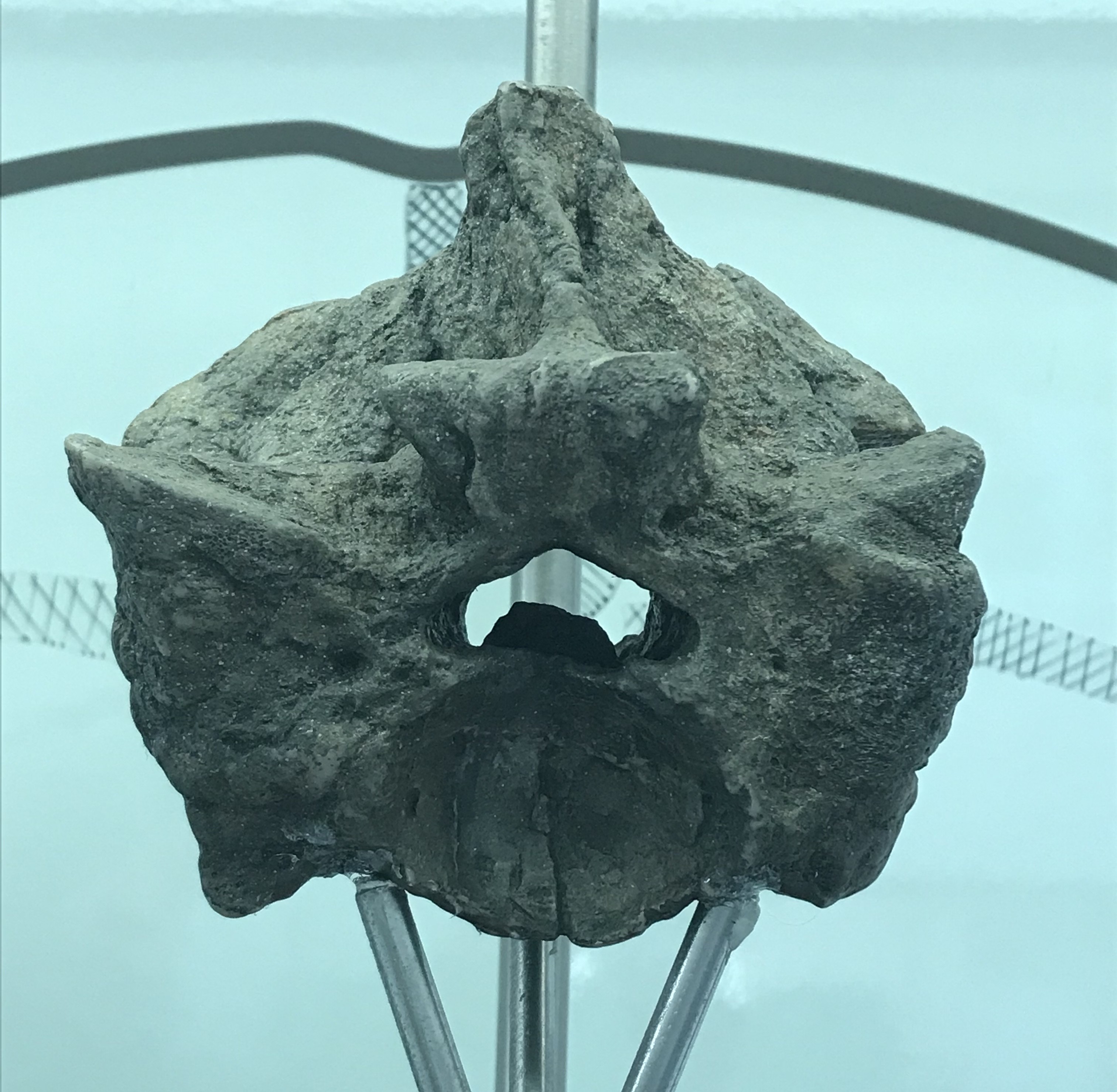
You cannot open a sixty-million-year-old stomach. So when the question is what the largest snake in the fossil record ate, the honest answer begins with a problem: the one piece of evidence that would settle it outright does not exist, and almost certainly never will.
The easy answer, and why it was a good one
Titanoboa cerrejonensis was described in Nature in 2009, from the Cerrejón Formation in northeastern Colombia — the oldest known neotropical rainforest fauna, laid down between 58 and 60 million years ago. It is the largest snake in the fossil record.
That description did not read the animal’s diet off the animal. It read it off the neighbourhood. “Depositional environments and faunal composition of the Cerrejón Formation,” the paper concluded, “indicate an anaconda-like ecology for the giant snake.”
And the neighbourhood is suggestive. The same rock preserves crocodyliforms — including a small, short-snouted species described in 2010 — alongside turtles with shells the size of manhole covers. Living anacondas do take caimans. Put a giant aquatic constrictor in a river full of crocodile relatives and the answer writes itself.
Nothing about that reasoning is weak. It simply is not evidence from the snake.
The problem with answering it properly
A fossil snake almost never preserves a last meal. Gut contents are the thing that would turn an inference about habitat into a finding about the animal, and for Titanoboa they are absent.
Which leaves the skeleton. And for a long time the skeleton meant vertebrae — big, blocky, diagnostic, and almost completely silent on the subject of food.
2011: pieces of the skull
Then field seasons at Cerrejón turned up cranial material: jaw and palate elements, the bones that actually carry a snake’s feeding apparatus.
This is rarer than it sounds. A snake skull is a cage of thin, loosely articulated struts built to come apart and swallow something wider than its owner’s head. It is close to the worst possible candidate for fossilisation. Jonathan Bloch, who co-led the excavations, put it plainly to Smithsonian Magazine: “It’s not beautiful, but it’s a snake skull and there aren’t many of those.”
The only skull known is still incomplete.
What the teeth suggest
The team reported a high count of tooth positions along the palate and the marginal bones, with the teeth themselves only weakly anchored to the jaw. More teeth across the roof of the mouth, held less rigidly.
Among snakes alive today, they argue, that combination goes with eating fish. The mechanical version is intuitive, and Jason Head gave it in 2012: “If you’ve got lots of teeth, it’s easier to grab slippery, scaly fish.” A loosely hung, densely toothed mouth is a better trap for something smooth and thrashing than for something armoured.
And the prey was there. The same deposits preserve large lungfish and other big fish. If the reading is right, a dominantly fish-eating habit would make Titanoboa unlike any other boa, living or fossil.
The part that usually gets left out
That reading has only ever been presented as meeting abstracts — summaries of work shown at a Society of Vertebrate Paleontology conference, a few hundred words long, not externally refereed the way a journal paper is.
There is still no published cranial description of Titanoboa. That is not an assumption carried over from somewhere; it was searched again specifically for this piece, across the literature, the Journal of Vertebrate Paleontology and the year-by-year summaries of new reptile palaeontology for 2024, 2025 and 2026. Nothing. The 2023 study discussed below still cites the abstract, and still calls the skull incomplete.
It is worth being blunt about what that means, because popular coverage rarely is. You will find the fish diet reported as established fact, sometimes with a length figure attached that comes from the same unpublished work. The evidence may well be good. It has not been through peer review, and nobody outside the team has been able to check the measurements.
And the other reading is also published
In 2023, in the Herpetological Journal, Jesús Rivas took the opposite route: instead of reasoning from the fossil, he reasoned from the living animal, using decades of fieldwork on green anacondas in the Venezuelan Llanos to model what Titanoboa’s biology would have looked like.
He keeps fish, crocodiles and turtles on the menu together, and points out that an animal that size had to take very large prey. He is also candid that his own results are “largely speculative”.
The important thing, and the thing most retellings get backwards: he does not argue against the fish evidence. He cites it approvingly — Titanoboa “likely included fish in their diet, as evidenced by abundant palatine teeth” — and then adds the rest of the river to it. This is not a fight between two camps. It is a narrow reading and a broad one, and the broad one has the peer review.
The same research group has voiced both. Bloch, a co-author of the fish abstract, described that small Cerrejón crocodyliform as “a frequent meal for Titanoboa” in 2010. Head, in the same 2012 interview as the fish quote, allowed that it “could also eat the crocs and turtles”.
Where that leaves it
Probably mostly fish. Not proven — and that is not the same as ruling crocodiles out.
What makes this worth sitting with is not the answer but the shape of the evidence. The obvious answer came from the environment and is twelve years older. The surprising answer came from the animal itself and has never been formally published. The best witness anyone has is a broken skull, its testimony points away from what everyone assumed, and the full version of that testimony has still not reached the literature.
That is a normal state of affairs in palaeontology, and it is almost never how it gets reported.
Sources
- Head, J.J., Bloch, J.I., Hastings, A.K., Bourque, J.R., Cadena, E.A., Herrera, F.A., Polly, P.D. & Jaramillo, C.A. 2009. Giant boid snake from the Palaeocene neotropics reveals hotter past equatorial temperatures. Nature 457: 715–717.
- Head, J.J., Bloch, J.I., Moreno-Bernal, J.W., Rincon, A.F. et al. Cranial osteology, body size, systematics, and ecology of the giant Paleocene snake Titanoboa cerrejonensis. Society of Vertebrate Paleontology, meeting abstract (2012/2013). A conference abstract, not a peer-reviewed description.
- Rivas, J.A. 2023. What can studying anacondas tell us about Titanoboa cerrejonensis? Exploring the life of an extinct giant snake using an extant pretty big snake. Herpetological Journal 33: 68–75.
- Hastings, A.K., Bloch, J.I., Cadena, E.A. & Jaramillo, C.A. 2010. A new small short-snouted dyrosaurid (Crocodylomorpha, Mesoeucrocodylia) from the Paleocene of northeastern Colombia. Journal of Vertebrate Paleontology 30(1): 139–162.
- Gugliotta, G. Smithsonian Magazine, April 2012. Interviews with Jason Head and Jonathan Bloch.