The Last Passenger Pigeon Had A Name, And A Date
PALEODEX · 1 September 2026 · 7 min read
A century before she died, her species may have been the most abundant bird in North America. Almost no extinct species gets a date of death. This one does — and the paperwork behind it is thinner and stranger than the date makes it look.
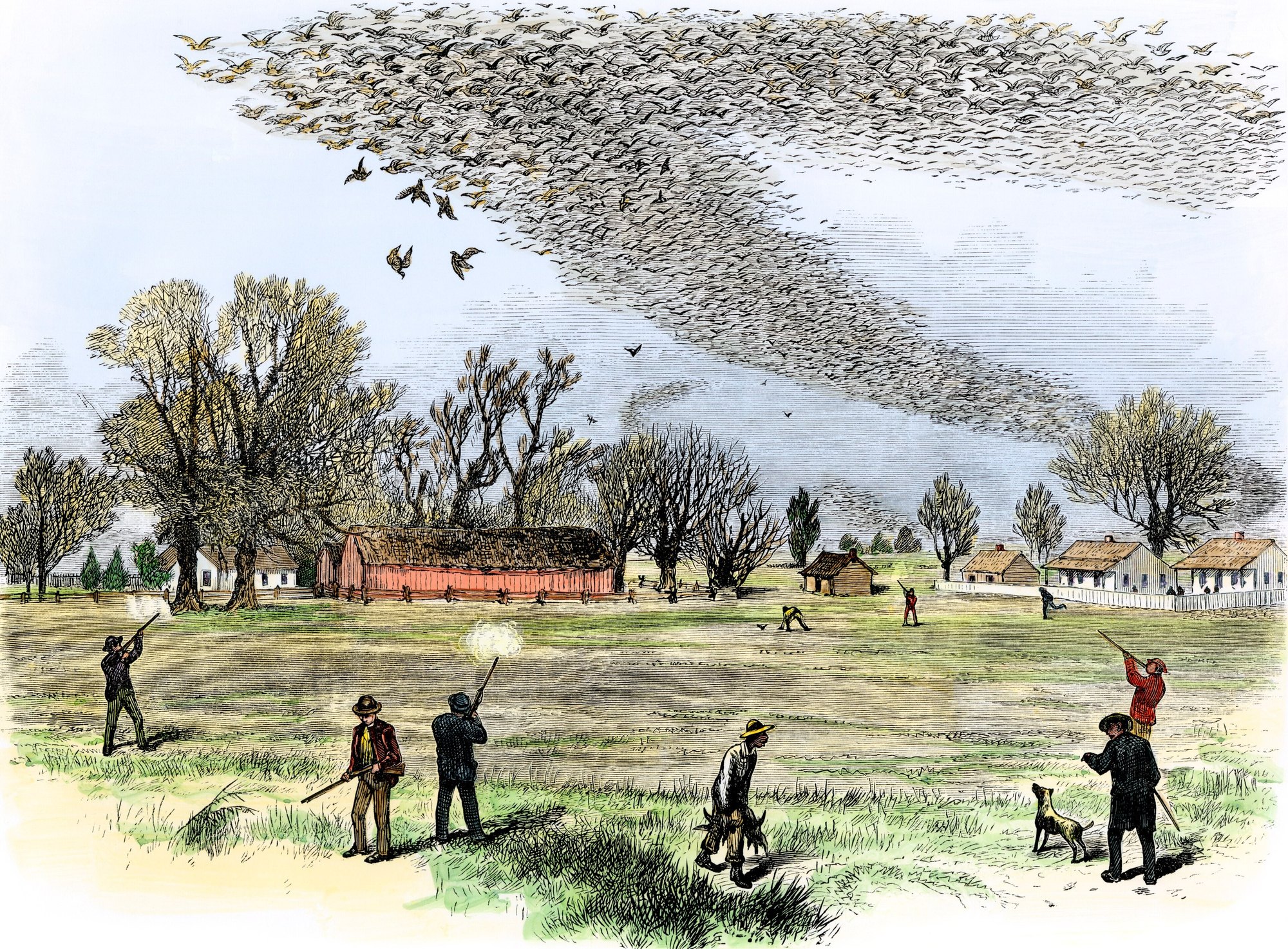
Extinction usually happens without a receipt. A species stops being recorded, then stops being looked for, and years later somebody works out that the last sighting was probably the last one. The date, if there is one at all, is a retrospective guess.
The passenger pigeon is the exception, and that is the interesting part of the story — not that it died out, but that we can put a day on it.
Wilson timed a flock and did the arithmetic
In 1810, near Frankfort, Kentucky, the ornithologist Alexander Wilson watched a single flock of passenger pigeons pass overhead. It took four hours, with stragglers for about an hour more. Wilson did what a naturalist of his period did with an observation like that: he estimated. Assuming a column roughly a mile wide moving at about sixty miles an hour, he worked out a length of some 240 miles, multiplied through by an assumed density, and arrived at a figure he printed in American Ornithology: 2,230,272,000 birds.
It is worth being precise about what that number is. It is a calculation, not a count — density times width times speed, with every term assumed. A. W. Schorger, whose 1955 monograph is still the source of record for this species, treated continental totals of three to five billion as probably generous, while allowing that Wilson had undoubtedly seen well over a billion birds in one sitting. Schorger also reckoned the species accounted for somewhere between a quarter and two fifths of every land bird in the United States.
So: the biggest number in the story is an estimate, and the people who study it say so. Hold that thought, because it comes back.
The telegraph found them, the railway moved them
What happened next was not a slow decline. It was an industry, and it turned on two pieces of nineteenth-century infrastructure arriving at the same time.
Passenger pigeons nested communally, in enormous concentrations, in predictable places. Once the telegraph could report a nesting the moment it was found, and the railways could carry the result to city markets before it spoiled, a nesting site stopped being a local event and became a supply. Birds were netted at the roost and packed into barrels with ice or salt.
The scale is in shipping records rather than in anyone's estimate. Eight shippers in Grand Rapids, Michigan sent out 688 barrels — 105,855 pounds of pigeon — between 28 March and 11 July 1860. At the great Petoskey nesting of 1878, professional hunters worked for months at an estimated 50,000 birds a day: roughly 1.5 million dead, plus another 80,352 shipped out alive for trap shooting.
By 1914 there was one left, in a cage at the Cincinnati Zoological Garden.
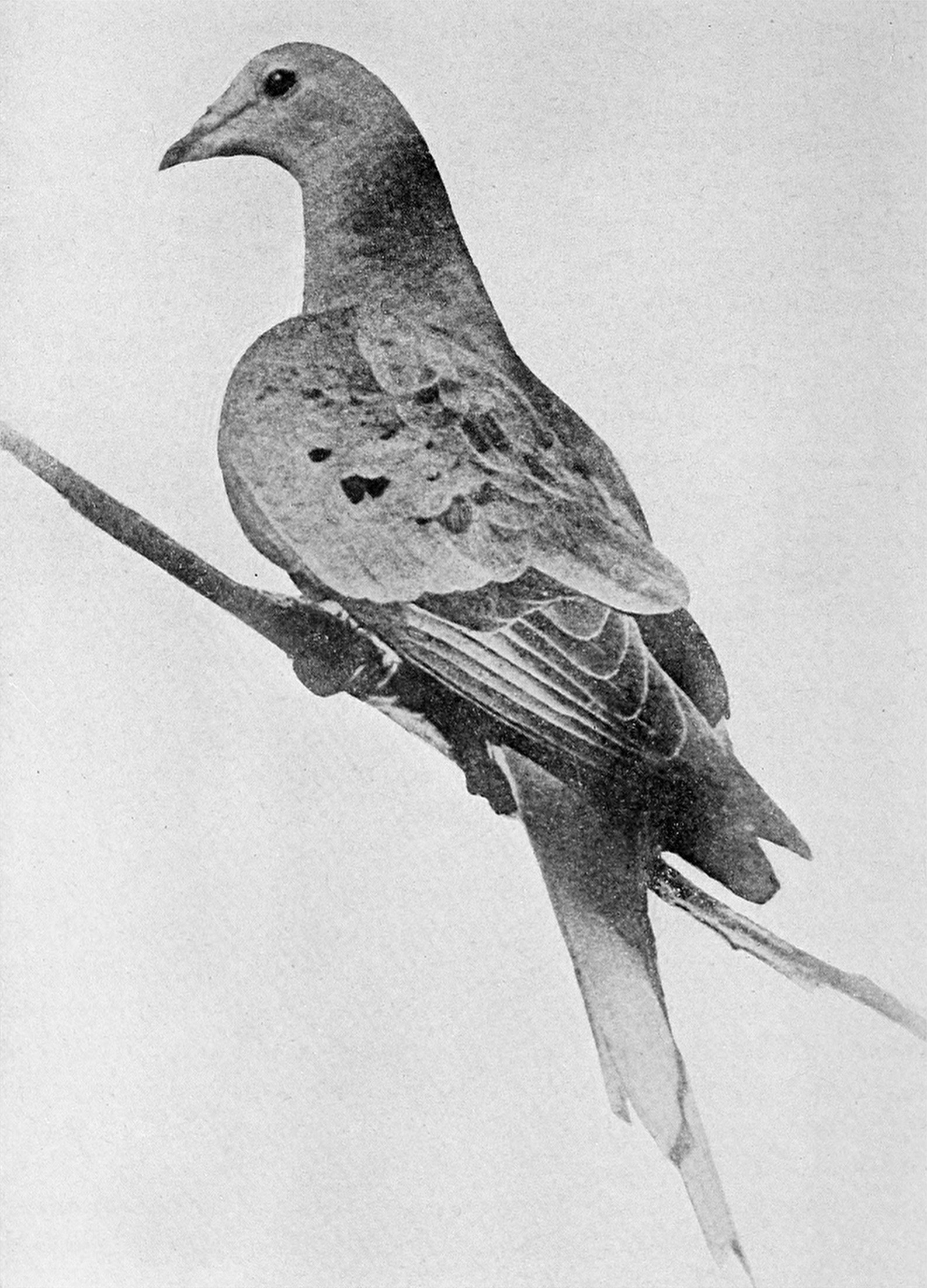
Her name was Martha, and her paperwork disagrees with itself
She was called Martha. She was photographed, more than once, while she was alive — which is itself unusual for an animal that was about to become the last of its kind.
Almost everything else about her is softer than you would expect. The Cincinnati Zoo's administration building and its written records burned in 1963, so there is no ledger to check. Her age at death is an estimate, not a record: published figures run from seventeen to twenty-nine years, and twenty-nine is a convention repeated so often that it reads like data. A Smithsonian photograph card, typed in 1946, states flatly that she was "hatched in the Cincinnati Zoo in 1888" — which does not square with the 1885 that produces the familiar twenty-nine.
The accounts of the day she died disagree too. Robert W. Shufeldt, who dissected the bird and published on it in The Auk four months later, recorded a time of death on the authority of the zoo's superintendent, Sol Stephan. Later work — Errol Fuller's 2014 book on the species among it — records that Stephan and his son Joseph gave conflicting versions, one of them putting the death several hours later than the other, and that the accounts do not even agree on who was in the room. Some say a group of keepers; some say the two Stephans; one has her found alone by an assistant keeper.
We have deliberately left the hour out of this article, and out of the video that goes with it. Two contemporary accounts disagree and nothing survives to settle them. What they do agree on is the afternoon, and the day.
1 September 1914
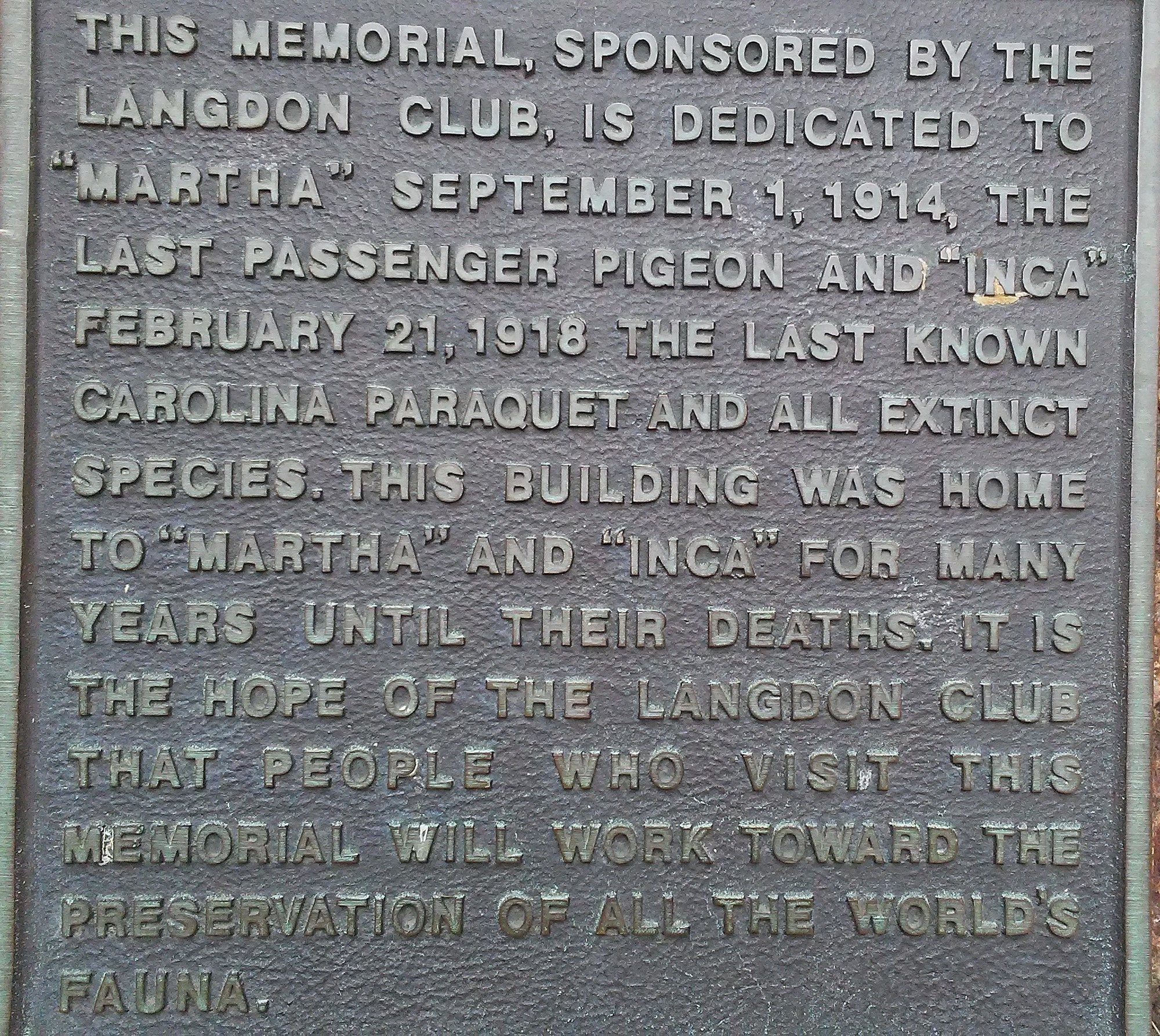
That is the date, and it survived everything else. It was in the scientific literature within four months. It is cast in bronze on the Langdon Club memorial at the zoo, on the building where she lived.
The same plaque carries a second name and a second date: Incas, the last known Carolina parakeet, 21 February 1918, in the same building. It is a useful correction to have standing right there in the metal, because it stops the obvious overstatement. Martha is not the only extinct animal with a recorded date of death. She is one of a very small number — and for almost every other extinct species, there is no date at all.
What the story is actually about
It would be easy to tell this as a fable about a bird going from billions to one. That version is true and it is also the least interesting reading available, because it flattens the thing that makes the case unusual.
What is unusual is the documentation, and how uneven it is. The population figure that opens the story is an estimate built on assumptions, published by a man who said as much. The collapse is recorded in commercial shipping weights, which are about as hard as historical numbers get. The last individual's age is a guess, her hour of death is disputed between two people who were supposedly present, and her zoo's records burned half a century later. And yet the date came through all of that intact, because it happened recently enough, publicly enough, and in a country that printed newspapers and owned cameras.
Extinction is normally something we notice afterwards. This one was watched.
Why this belongs in PaleoDex
Because the useful skill here is telling those tiers apart. A calculation is not a census. A shipping manifest is not an anecdote. A date confirmed by a published dissection is not the same kind of fact as an age repeated until it hardened. PaleoDex is built on keeping those distinctions visible instead of smoothing them into one confident story. Read more of the record here.
Sources
Every fact above is drawn from the primary and authoritative literature:
- Wilson, A. (1812). American Ornithology, vol. 5 — the Kentucky flock, the four-hour timing and the 2,230,272,000 calculation, in Wilson's own words.
- Schorger, A.W. (1955). The Passenger Pigeon: Its Natural History and Extinction. University of Wisconsin Press — the source of record for the population estimates, the flock accounts and the commercial hunt.
- Shufeldt, R.W. (1915). "Anatomical and other notes on the Passenger Pigeon (Ectopistes migratorius) lately living in the Cincinnati Zoological Gardens." The Auk 32(1):29–41 — published four months after the death, by the man who dissected the bird.
- Fuller, E. (2014). The Passenger Pigeon. Princeton University Press — the conflicting Stephan accounts, and the 1963 fire that destroyed the zoo's records.
- Audubon, J.J. (1831). Ornithological Biography, vol. 1 — the 1813 Ohio-river flight that "continued to do so for three days in succession".
- The Langdon Club memorial, Cincinnati Zoo & Botanical Garden — the dates for Martha (1 September 1914) and Incas (21 February 1918), cast in bronze on site.
The real record, in your pocket.
PaleoDex catalogues the real fossil record, and every fact in it is sourced. Get the app.
GET IT ON GOOGLE PLAY →